
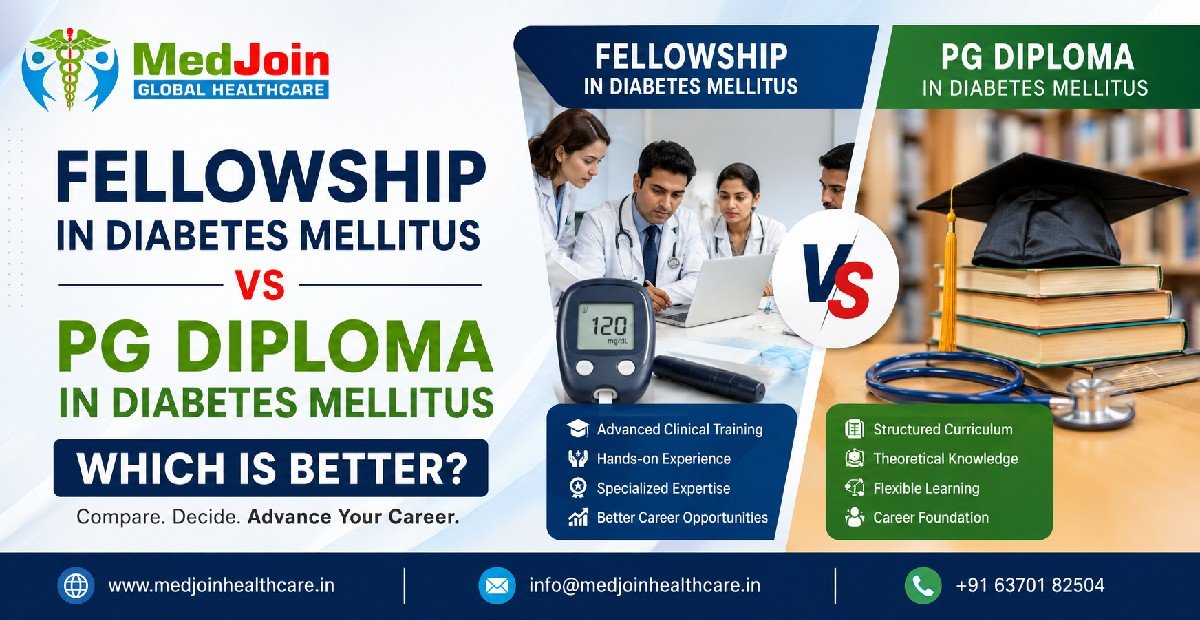
Choosing the right postgraduate training pathway in diabetes care can be challenging for MBBS doctors and other eligible healthcare professionals. Two commonly considered options are a Fellowship in Diabetes Mellitus and a PG Diploma in Diabetes Mellitus. Both can help learners develop knowledge and skills in diabetes management, but they are not identical qualifications and should not automatically be treated as interchangeable.
The most important question is therefore not simply “Which is better?” The better question is:
Which programme is better for your career goal, current qualification, preferred learning style, need for clinical exposure, and the recognition requirements of the role you want to pursue?
Diabetes Mellitus has become one of the most important areas of modern clinical practice. Doctors working in primary care, internal medicine, hospitals, emergency departments and multispecialty settings frequently encounter patients with diabetes.
However, diabetes management is far more complex than diagnosing a high blood glucose level and prescribing medication.
A doctor managing a patient with diabetes may need to understand:
- Type 1 diabetes
- Type 2 diabetes
- Prediabetes
- Gestational diabetes
- Secondary diabetes
- Obesity and insulin resistance
- Medical nutrition therapy
- Oral antidiabetic drugs
- Insulin initiation and titration
- Hypoglycaemia
- Diabetic ketoacidosis
- Hyperosmolar hyperglycaemic states
- Continuous glucose monitoring
- Insulin pump technology
- Diabetic kidney disease
- Cardiovascular risk
- Diabetic neuropathy
- Diabetic foot disease
- Retinopathy
- Diabetes during surgery and hospitalisation
- Diabetes in elderly patients
- Diabetes in pregnancy
- Multimorbidity and polypharmacy
Because of this complexity, many doctors seek structured additional education after MBBS or postgraduate medical training.
In India, diabetes capacity-building programmes have been offered in different formats, including fellowships, diplomas, certificates, full-time programmes, online programmes and contact-session-based programmes. A review of diabetes education programmes for primary care physicians documented substantial variation in eligibility, duration and mode of delivery, showing why individual programme evaluation is essential.
This is why comparing labels alone is insufficient.
A strong Fellowship may provide extensive supervised clinical learning, while another Fellowship may be largely lecture-based. Similarly, one PG Diploma may be delivered through a structured university system, while another programme carrying a similar title may have a completely different educational and recognition framework.
Always compare the actual programme—not just the name printed on the certificate.
What Is a Fellowship in Diabetes Mellitus?
A Fellowship in Diabetes Mellitus is generally a focused training programme designed to build specialised knowledge and, depending on the programme, clinical competence in diabetes management.
The exact structure varies significantly between institutions.
Some fellowships are:
- Full-time and hospital-based
- Part-time
- Hybrid
- Online with clinical observerships
- Modular
- Case-based
- Designed for MBBS doctors
- Designed for postgraduate physicians
- Designed for more experienced specialists
For example, the Fellowship of DiabetesIndia is not the same type of educational programme as a post-MBBS clinical fellowship. It is a professional fellowship recognition awarded under specific eligibility requirements to experienced physicians, diabetologists and endocrinologists. This demonstrates why the word “fellowship” can describe very different programmes or recognitions.
Therefore, before joining a Fellowship, ask:
What exactly is this Fellowship?
A prospective learner should verify:
- Who awards it?
- Is it a training programme or a professional fellowship recognition?
- What are the eligibility requirements?
- What is the duration?
- Is it full-time, online, hybrid or part-time?
- How many clinical training hours are included?
- Is clinical training supervised?
- Who are the faculty members?
- How are candidates assessed?
- What qualification does the programme award?
- What does the programme explicitly state regarding recognition?
What Is a PG Diploma in Diabetes Mellitus?
A PG Diploma in Diabetes Mellitus is generally positioned as a structured postgraduate-level academic programme focused on diabetes and its management.
The exact duration, admission criteria and academic structure depend on the institution.
A recent overview of PG Diploma in Diabetology programmes notes that duration can vary from one to three years depending on the institution, further demonstrating that there is no universal format attached to the title alone.
A PG Diploma may include:
- Structured modules
- Theory classes
- Assignments
- Case discussions
- Clinical components
- Internal assessment
- Formal examinations
- Research or academic projects, depending on the institution
The educational focus may be broader and more academically structured.
However, a PG Diploma title does not automatically establish that every programme is NMC-recognised or equivalent to a recognised medical postgraduate qualification.
This distinction is critical.
A programme should clearly state:
- Awarding university or institution
- Nature of affiliation
- Applicable recognition status
- Regulatory status
- Eligibility
- Whether the qualification can be used for the particular career purpose claimed
If a programme is described as “university affiliated,” prospective students should still verify what the affiliation means and whether it provides recognition relevant to their intended professional use.
Fellowship vs PG Diploma in Diabetes Mellitus: Quick Comparison
| Parameter | Fellowship in Diabetes Mellitus | PG Diploma in Diabetes Mellitus |
|---|---|---|
| Primary orientation | Often specialised and clinically focused | Often structured and academically focused |
| Clinical emphasis | Can be high, depending on the programme | Varies according to curriculum |
| Academic structure | Varies considerably | Often more formally structured |
| Duration | Varies widely | Often institution-dependent |
| Flexibility | May be suitable for working professionals | Depends on the institution |
| Learning mode | Offline, online, hybrid or modular | Offline, online or blended, depending on the provider |
| Case-based learning | Often a major component | May be included |
| Hands-on exposure | Depends entirely on programme design | Depends entirely on programme design |
| Assessment | May include cases, assignments and examinations | Often includes structured assessments and examinations |
| Career use | Depends on the specific qualification and employer/regulatory requirements | Depends on the specific qualification and employer/regulatory requirements |
| Best for | Doctors seeking focused diabetes skill development | Doctors seeking structured academic diabetes education |
The table is a general comparison, not a regulatory classification. Individual programmes may differ substantially.
The Fundamental Difference Between the Two Pathways
The traditional distinction is often explained as:
Fellowship = greater specialisation and clinical skill focus
PG Diploma = structured academic and clinical education
But this should be treated as a starting point—not an absolute rule.
A high-quality Fellowship can include:
- Extensive case discussions
- Faculty mentorship
- Supervised OPD training
- Inpatient exposure
- Clinical rotations
- Logbooks
- Assessments
- Research discussions
Similarly, a high-quality PG Diploma can provide:
- Deep academic teaching
- Practical workshops
- Clinical postings
- Case presentations
- Objective assessments
The actual question is:
What percentage of the programme is:
- Passive lectures?
- Interactive teaching?
- Case-based discussion?
- Supervised clinical training?
- Independent reading?
- Assessment?
- Feedback?
- Mentorship?
The programme with the strongest alignment to your professional needs may be the better choice regardless of whether the certificate says Fellowship or PG Diploma.
Fellowship in Diabetes Mellitus: Main Objectives
A Fellowship may be particularly useful when the educational objective is focused clinical development.
Potential objectives include:
- Improving diabetes diagnosis skills
- Developing confidence in medication selection
- Understanding insulin therapy
- Learning insulin initiation and titration
- Managing hypoglycaemia
- Interpreting glucose data
- Understanding CGM reports
- Managing complex diabetes cases
- Identifying complications early
- Improving long-term follow-up strategies
- Participating in multidisciplinary diabetes care
A clinically strong Fellowship should ideally move beyond lectures.
For example, learners may discuss:
Case:
A 55-year-old patient with Type 2 diabetes, obesity, hypertension and chronic kidney disease has poor glycaemic control.
The learner may be required to consider:
- Current HbA1c
- Renal function
- Cardiovascular risk
- Current medications
- Hypoglycaemia history
- Weight
- Diet
- Adherence
- Affordability
- Need for specialist referral
- Follow-up strategy
This kind of case-based reasoning is valuable because clinical practice rarely presents patients with one isolated problem.
PG Diploma in Diabetes Mellitus: Main Objectives
A PG Diploma in diabetes mellitus may be especially attractive to doctors seeking a systematic educational pathway.
Its objectives may include developing a strong foundation in:
- Diabetes epidemiology
- Pathophysiology
- Classification
- Diagnosis
- Pharmacology
- Lifestyle medicine
- Nutrition
- Insulin therapy
- Complications
- Acute metabolic emergencies
- Research
- Evidence-based practice
- Guidelines and clinical decision-making
A structured academic programme can help learners progress from fundamental concepts to complex clinical scenarios.
For example:
Stage 1: Foundation
- Physiology of glucose regulation
- Insulin secretion
- Insulin action
- Insulin resistance
Stage 2: Disease understanding
- Type 1 diabetes
- Type 2 diabetes
- Secondary diabetes
- Gestational diabetes
Stage 3: Treatment
- Lifestyle interventions
- Oral medications
- Injectable therapies
- Insulin
Stage 4: Advanced management
- Diabetes and cardiovascular disease
- Diabetes and kidney disease
- Technology
- Complex cases
Stage 5: Complications
- Neuropathy
- Retinopathy
- Nephropathy
- Foot disease
Fellowship in Diabetes Mellitus for MBBS Doctors
A Fellowship may be attractive for an MBBS doctor who:
- Frequently manages diabetic patients
- Wants focused diabetes knowledge
- Wants practical skill development
- Cannot commit to a long full-time programme
- Wants structured mentorship
However, eligibility varies. Some fellowships documented in India accept MBBS graduates, while other advanced programmes require prior postgraduate qualifications such as MD/DNB General Medicine.
Therefore, MBBS doctors should specifically verify:
- Eligibility
- Clinical training
- Faculty
- Assessment
- Awarding body
- Regulatory status
- Appropriate professional use of the qualification
PG Diploma in Diabetes Mellitus for MBBS Doctors
A PG Diploma may appeal to MBBS doctors seeking:
- Systematic education
- Structured curriculum
- Formal academic assessment
- A longer academic pathway
Before enrolling, verify:
- Entry requirements
- Duration
- Mode of study
- Clinical requirements
- Examination system
- Awarding institution
- Recognition for intended career use
Do not assume that every programme called “Postgraduate Diploma” has the same legal, academic or professional status.
Which Is Better for General Practitioners?
For a GP, the answer depends largely on clinical needs.
A GP who sees large numbers of diabetic patients may benefit significantly from a programme with:
- Practical case discussions
- Treatment decision-making
- Insulin training
- Complication recognition
- Patient counselling
- Follow-up planning
If the primary objective is immediate improvement in day-to-day patient management, a clinically intensive Fellowship or hybrid programme may be attractive.
If the doctor wants a highly structured academic curriculum and formal examination pathway, a suitable PG Diploma may be preferable.
Best question for a GP:
Which programme will make me more competent and confident in managing the patients I actually see?
Fellowship vs PG Diploma: A Decision Framework
Choose a Fellowship if:
- You want focused diabetes skill development
- You value case-based learning
- You want clinical mentoring
- You prefer a specialised pathway
- The programme offers verifiable supervised clinical exposure
- The learning format suits your professional schedule
Choose a PG Diploma if:
- You want a systematic academic structure
- You prefer formal examinations
- You want extensive theoretical grounding
- The particular programme's awarding and recognition status aligns with your career objective
Either can be suitable if:
- The curriculum is comprehensive
- Faculty are qualified
- Assessment is meaningful
- Clinical training is appropriate
- The qualification is transparent
- The programme aligns with your goals
Frequently Asked Questions
1. Which is better: Fellowship or PG Diploma in Diabetes Mellitus?
Neither is universally better. A Fellowship may be better for focused clinical skill development, while a PG Diploma may be better for learners seeking a structured academic programme. The specific programme should be evaluated carefully.
2. Can an MBBS doctor join a Fellowship in Diabetes Mellitus?
Some programmes accept MBBS graduates, while others require postgraduate qualifications. Eligibility must be checked for the specific Fellowship.
3. Can an MBBS doctor join a PG Diploma in Diabetes Mellitus?
Eligibility varies by institution. Check the official admission requirements.
4. Is a Fellowship in Diabetes Mellitus recognised?
Recognition depends on the specific Fellowship and its awarding body. The word “Fellowship” alone does not establish a universal recognition status.
5. Is a PG Diploma in Diabetes Mellitus recognised?
This also depends on the exact programme, awarding institution and applicable regulatory framework.
6. Which provides more practical training?
There is no universal answer. Compare actual supervised clinical hours, rotations, faculty supervision and assessments.
7. Can I study while working?
Some programmes are designed for working professionals through online, hybrid or modular formats.
8. Does an online course provide hands-on training?
Not by itself. A separate, structured clinical component is required for direct practical exposure.
9. How important is CGM training?
Modern glucose-monitoring technology is increasingly important, so prospective learners should evaluate whether the programme covers CGM and contemporary diabetes technology appropriately.
10. Should I choose the cheapest programme?
No. Compare curriculum, faculty, assessment, clinical exposure and transparency—not only fees.
11. Should I choose the programme with the biggest brand name?
Brand can be one consideration, but the actual learning structure and relevance to your goals are equally important.
12. Can I call myself a specialist after completing a Fellowship?
Professional titles and scope should be used according to applicable laws, registration rules, employer policies and the exact qualification held. Do not assume that every Fellowship automatically creates specialist status.