
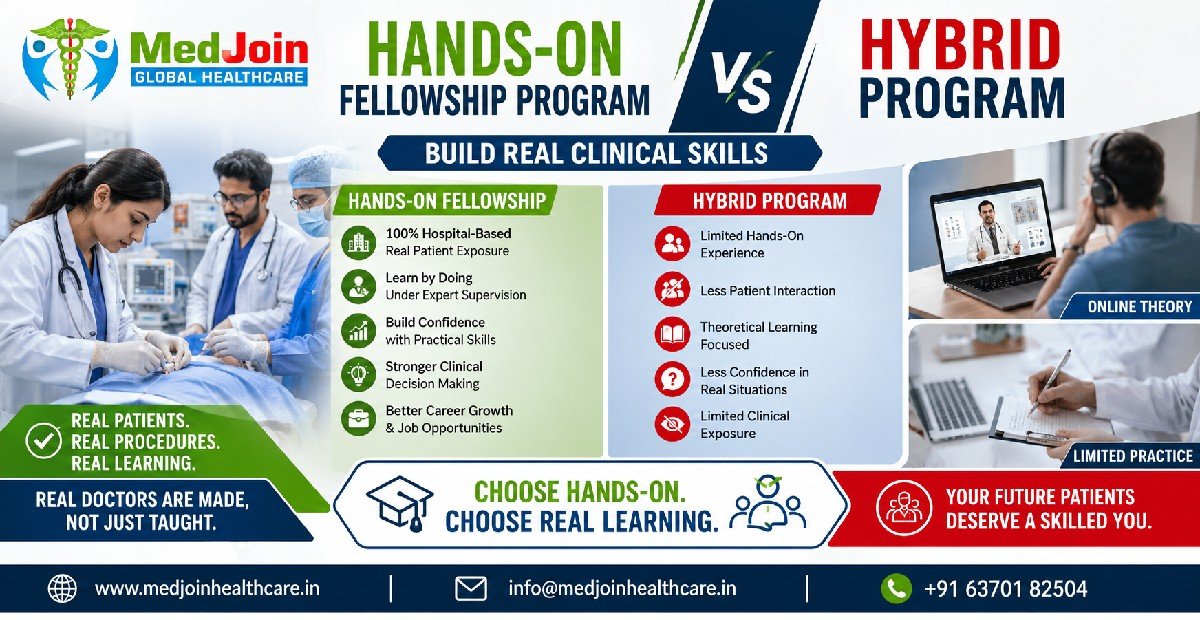
Medical education does not end when a doctor completes MBBS, MD, MS, or another formal qualification. In fact, for many doctors, graduation is only the beginning of a long journey toward developing confidence, practical competence, clinical judgment, procedural ability, and specialty-focused expertise.
Modern doctors have access to multiple forms of continuing medical education. Online programs, recorded lectures, webinars, virtual classrooms, hybrid fellowships, simulation-based learning, workshops, observerships, and hospital-based clinical fellowship programs have all become part of the medical education ecosystem.
Among these options, hybrid fellowship programs have gained popularity because they combine online academic learning with a limited period of practical exposure. They can provide flexibility and make theoretical education more accessible.
However, when the primary objective is to develop real clinical skills through repeated patient interaction and supervised hospital exposure, a structured hands-on fellowship training program can offer a substantially different learning experience.
A doctor may understand a disease from a textbook. A doctor may watch a procedure through a video. A doctor may attend an online lecture delivered by an experienced specialist. But clinical competence develops when knowledge is repeatedly applied to real patients under appropriate supervision.
That is the fundamental difference between learning about medicine and learning to practice medicine.
A hands-on fellowship training program places the doctor closer to the actual clinical environment. Instead of spending most of the training away from the hospital, the doctor can learn within a healthcare setting where patient assessment, clinical decision-making, documentation, investigations, treatment planning, procedures, communication, teamwork, emergency situations, and follow-up become part of the learning environment.
This article explains why a hospital-based, offline, hands-on fellowship training program may be a stronger option than a primarily hybrid fellowship for doctors whose objective is to build practical clinical competence.
Whether a doctor is interested in Family Medicine, Diabetes Mellitus, Clinical Cardiology, 2D Echocardiography, Internal Medicine, Critical Care Medicine, Emergency Medicine, Nephrology, Dermatology, Pediatrics, Obstetrics and Gynaecology, or another clinical specialty, the central question remains the same:
How much real clinical exposure will the training provide?
Hands-On Fellowship vs Hybrid Fellowship: Understanding the Difference
Before comparing the two approaches, it is important to understand what they generally mean.
What Is a Hands-On Fellowship Training Program?
A hands-on fellowship is a structured clinical learning program in which doctors spend substantial training time within a hospital, clinic, diagnostic centre, or other appropriate healthcare environment.
Depending on the specialty and program structure, the doctor may participate in activities such as:
- Patient history taking
- Clinical examination
- Case presentation
- Ward rounds
- Outpatient department exposure
- Inpatient management
- Emergency department exposure
- Clinical discussions
- Investigation interpretation
- Treatment planning
- Follow-up assessment
- Documentation
- Procedures under supervision
- Observation of specialist consultations
- Multidisciplinary discussions
- Clinical audits and academic activities
- Case-based learning
- Patient counselling
- Team-based healthcare activities
The exact scope of participation depends on the specialty, hospital, local regulations, institutional policies, supervision, and the doctor's qualifications and permitted responsibilities.
The defining feature is simple:
The doctor learns in the environment where clinical medicine actually happens.
What Is a Hybrid Fellowship?
A hybrid fellowship generally combines online academic education with some amount of physical or clinical exposure.
For example, a program may include:
- Recorded lectures
- Online modules
- Digital reading material
- Live virtual classes
- Online assessments
- Case discussions
- Webinars
- Assignments
- A shorter period of hospital-based training
Hybrid learning can be useful because it offers flexibility. A doctor may be able to study theoretical concepts remotely and then attend clinical training for a designated period.
However, the practical exposure in a hybrid model can vary significantly from one program to another.
Some programs may provide meaningful clinical exposure. Others may provide only a short observership or limited hospital attendance.
Therefore, doctors should not judge a fellowship simply by its title.
The more important questions are:
- How many hours are spent in the clinical environment?
- How frequently does the doctor interact with real cases?
- Is there supervised practical exposure?
- How much of the program is actually hospital-based?
- What clinical activities are included?
- Who supervises the training?
- How is competency assessed?
These questions help distinguish a genuinely clinical fellowship from a program that is primarily academic.
Real Patients Create Real Clinical Learning
One of the strongest advantages of hands-on fellowship training is exposure to real patients.
Medical knowledge becomes meaningful when it is applied to actual clinical situations.
A textbook may explain the classical presentation of diabetes mellitus. An online lecture may discuss diagnostic criteria. A video may demonstrate insulin administration.
But real clinical practice is rarely as straightforward as a textbook case.
A patient may present with multiple complaints. The medical history may be incomplete. The patient may have several comorbidities. Laboratory results may not perfectly match the expected pattern. Medication adherence may be poor. Family circumstances may affect treatment decisions.
These situations require clinical reasoning.
Hospital-based learning gives doctors opportunities to see how experienced clinicians approach such complexity.
A doctor can observe how a specialist:
- Takes a focused history
- Identifies important clinical clues
- Performs examination
- Prioritizes differential diagnoses
- Orders relevant investigations
- Interprets reports
- Explains treatment options
- Communicates risk
- Counsels patients
- Reviews response to therapy
- Adjusts management when circumstances change
This type of learning is difficult to reproduce completely through online education.
Clinical Skills Require Repetition
Watching a procedure once does not make someone proficient at performing it.
This principle applies to many aspects of clinical medicine.
Skills improve through:
Observation → Demonstration → Supervised Practice → Feedback → Repetition → Increasing Competence
A hands-on fellowship can provide opportunities for this cycle.
For example, consider a doctor learning a practical diagnostic skill.
During an online class, the doctor may learn:
- Indications
- Contraindications
- Equipment
- Basic technique
- Interpretation
- Common errors
- Complications
All of these are valuable.
But clinical proficiency requires more.
The doctor must learn how the equipment feels in actual use, how patients respond, how positioning affects the examination, how technical limitations affect results, and how experienced clinicians adapt their approach.
Repeated exposure makes these concepts more practical.
This is particularly important for programs involving diagnostic and procedural skills.
Hands-On Training Bridges the Gap Between Theory and Practice
Medical education often creates a gap between theoretical knowledge and practical application.
A doctor may know the definition of a disease but still hesitate when facing a patient.
A doctor may understand the theoretical steps of a procedure but lack confidence in a real clinical setting.
A doctor may know the textbook interpretation of an investigation but find real-world reports more complicated.
Hands-on training helps bridge this gap.
The doctor learns to ask:
- What should I look for first?
- Which findings are clinically significant?
- Which investigation is actually necessary?
- How should I interpret this result in context?
- What should be done next?
- When should the patient be referred?
- What complications should be anticipated?
- How should the patient be counselled?
This transition from knowledge acquisition to clinical application is one of the most valuable outcomes of practical fellowship training.
Hospital Exposure Develops Clinical Confidence
Confidence in medicine should come from competence, experience, supervision, and appropriate preparation—not from simply completing an online course.
A doctor who repeatedly sees patients and participates in clinical discussions may gradually become more comfortable with:
- Taking histories
- Performing examinations
- Presenting cases
- Discussing differentials
- Reviewing investigations
- Communicating with patients
- Working with nurses and other healthcare professionals
- Understanding hospital workflows
- Participating in clinical decision-making
This does not mean that every doctor becomes independently competent simply by attending a hospital.
Competence depends on the quality and structure of training.
However, meaningful exposure provides an environment in which confidence can develop through experience and feedback.
Feedback Is Faster in a Clinical Environment
Feedback is a critical component of professional development.
Online education often provides feedback through:
- Quizzes
- Assignments
- Automated assessments
- Discussion boards
- Virtual sessions
These tools can be useful for academic learning.
But clinical feedback can be different.
A supervising doctor may immediately notice that a trainee:
- Missed an important history question
- Performed an examination incorrectly
- Misinterpreted a finding
- Ordered an unnecessary investigation
- Failed to recognize a warning sign
- Communicated poorly with a patient
- Needs to improve documentation
- Needs to modify a procedural technique
Immediate feedback can prevent incorrect habits from becoming established.
The trainee can then correct the mistake and repeat the activity.
That learning loop is particularly valuable in practical medical education.
Hands-On Fellowship Builds Patient Communication Skills
Medicine is not only about diagnosis and treatment.
Doctors also need to communicate effectively with patients and families.
Clinical communication includes:
- Taking a sensitive history
- Explaining a diagnosis
- Discussing investigations
- Explaining treatment choices
- Discussing lifestyle modification
- Explaining medication use
- Managing expectations
- Addressing patient concerns
- Obtaining appropriate consent
- Communicating uncertainty
- Explaining follow-up requirements
These skills are difficult to learn entirely from slides.
A hospital environment allows trainees to observe how experienced clinicians communicate with different types of patients.
They can see how communication changes depending on:
- Age
- Educational background
- Clinical urgency
- Emotional state
- Family involvement
- Disease complexity
- Cultural context
- Language preferences
This real-world exposure can be an important part of becoming a more effective clinician.
Hands-On Training Exposes Doctors to Clinical Workflow
A successful doctor must understand more than individual diseases.
They also need to understand how healthcare systems work.
Hospital exposure can help doctors understand:
- Registration processes
- Patient triage
- OPD workflow
- Admission procedures
- Ward management
- Investigation coordination
- Referral systems
- Discharge planning
- Follow-up
- Documentation
- Infection-control practices
- Team communication
- Emergency escalation
- Clinical handover
These operational details are rarely the primary focus of online lectures.
Yet they are an important part of real-world healthcare delivery.
Clinical Reasoning Develops Through Case Diversity
A textbook generally presents organized information.
Real patients do not.
Clinical cases may involve:
- Multiple diseases
- Atypical presentations
- Medication interactions
- Complications
- Incomplete histories
- Different age groups
- Different risk profiles
- Variable treatment responses
Exposure to a diverse patient population helps trainees appreciate this complexity.
For example, diabetes management may differ substantially between:
- A newly diagnosed young adult
- An elderly patient
- A patient with chronic kidney disease
- A patient with cardiovascular disease
- A patient with poor medication adherence
- A patient with recurrent hypoglycemia
- A patient requiring insulin
- A patient with diabetic complications
The disease may be the same.
The patient is not.
That distinction is central to clinical medicine.
Hands-On Training Is Particularly Valuable for Procedural Specialties
Certain specialties depend heavily on practical skills.
Examples include:
- 2D Echocardiography
- Clinical Cardiology
- Emergency Medicine
- Critical Care Medicine
- Anaesthesiology
- Obstetrics and Gynaecology
- Dermatology
- Nephrology
- Ultrasonography
- ENT
- Orthopedics
- Gastroenterology
- Interventional procedures
- Radiology-related clinical applications
In these fields, theoretical knowledge is necessary but may not be sufficient.
A trainee needs to understand equipment, positioning, workflow, patient preparation, safety considerations, technical limitations, image acquisition, interpretation, and procedural decision-making where applicable.
Repeated exposure can therefore be especially important.
Clinical Training Develops Professional Behaviour
A fellowship is not only about knowledge and technical skills.
It can also help develop professional habits.
In a hospital, doctors learn the importance of:
- Punctuality
- Documentation
- Professional communication
- Teamwork
- Patient privacy
- Consent
- Infection control
- Respectful communication
- Accountability
- Appropriate escalation
- Following institutional protocols
These habits are developed through repeated participation in a clinical environment.
Hands-On Learning Encourages Active Participation
Online learning is often passive.
A doctor may:
- Watch a lecture
- Read a PDF
- Complete a quiz
- Watch a recording
Hands-on training is inherently more active.
The trainee may be expected to:
- Present a case
- Observe a patient
- Discuss findings
- Ask questions
- Perform an assigned task
- Participate in rounds
- Interpret an investigation
- Discuss treatment options
Active participation generally creates stronger engagement with the subject matter.
Clinical Immersion Improves Retention
People often remember experiences differently from information presented in isolation.
A doctor who encounters a memorable clinical case may associate:
- Symptoms
- Examination findings
- Investigation results
- Diagnosis
- Treatment
- Outcome
with a real clinical story.
That integrated experience can make the learning more memorable.
For example, reading about heart failure is one thing.
Seeing a patient with breathlessness, edema, elevated blood pressure, abnormal cardiac findings, and echocardiographic changes can create a much richer clinical understanding.
Hospital Training Creates an Environment for Mentorship
A strong fellowship should not simply place a doctor inside a hospital.
It should create opportunities for structured mentorship.
Experienced clinicians can provide guidance about:
- Clinical reasoning
- Career development
- Specialty practice
- Common mistakes
- Patient communication
- Clinical documentation
- Further learning
- Professional development
Mentorship is particularly valuable for doctors who are transitioning from academic education into more focused clinical practice.
Hands-On Training Provides Exposure to Real Clinical Challenges
Medicine is full of uncertainty.
- A patient may not fit a standard pattern.
- An investigation may be inconclusive.
- A treatment may not produce the expected response.
- A patient may decline a recommended intervention.
- A family may have concerns.
Another specialist may need to be consulted.
The doctor must navigate these situations.
Real clinical environments provide exposure to these challenges.
This can help trainees understand that good medicine is not simply about memorizing answers.
It is about:
Assessing → Reasoning → Acting → Monitoring → Reassessing
Hybrid Fellowships Still Have Advantages
A fair comparison should acknowledge that hybrid fellowship programs can be valuable.
Hybrid education may provide:
- Flexibility
- Remote access
- Recorded lectures
- Convenient learning schedules
- Digital resources
- Online assessments
- Virtual expert sessions
- Reduced travel requirements
- Easier access for working doctors
For doctors who cannot relocate or attend a hospital regularly, hybrid learning can be a practical option.
The issue is not that online learning has no value.
The issue is whether online learning alone or limited clinical exposure is sufficient for the specific clinical skills a doctor wants to develop.
For many practical specialties, theoretical learning should ideally be complemented by meaningful supervised clinical exposure.
The Key Difference: Time Spent in the Clinical Environment
One of the simplest ways to compare programs is to look at where the learning happens.
Hybrid Fellowship
A significant portion of learning may happen:
- At home
- In an office
- Through a computer
- Through recorded content
- Through virtual classrooms
Hands-On Fellowship
A significant portion of learning happens:
- In hospitals
- In OPDs
- In wards
- In diagnostic areas
- In procedure rooms where appropriate
- In clinical discussions
- Through supervised patient exposure
The environment matters because the environment determines the type of experience available.
The Importance of 1-Year and 2-Year Fellowship Options
Longer clinical training can provide greater opportunity for repeated exposure.
A short clinical attachment may introduce a doctor to a specialty.
A longer fellowship can provide more time to:
- Observe different cases
- Follow patient journeys
- Develop familiarity with hospital systems
- Repeat clinical activities
- Receive feedback
- Improve confidence
- Participate in academic discussions
- Understand seasonal and case-volume variations
For doctors seeking deeper practical exposure, a 1-year or 2-year hospital-based hands-on fellowship may therefore be worth considering.
The appropriate duration depends on the specialty, learning objectives, clinical workload, supervision, and institutional structure.
Hands-On Training Promotes Learning by Doing
The concept of “learning by doing” is particularly relevant to clinical medicine.
When doctors participate appropriately under supervision, they engage multiple forms of learning:
- Visual learning
- Auditory learning
- Tactile learning
- Analytical reasoning
- Communication
- Decision-making
- Procedural coordination
This multidimensional learning experience can be difficult to replicate entirely through online content.
Hospital-Based Training Can Improve Case Presentation Skills
Case presentation is a core medical skill.
Doctors need to communicate information efficiently and clinically.
A good case presentation may include:
- Patient identification
- Chief complaints
- History
- Relevant examination
- Investigations
- Differential diagnosis
- Assessment
- Management plan
Regular exposure to clinical presentations helps trainees become more organized.
They learn what information matters and what information can be omitted.
This is a practical skill that develops through repeated participation.
Clinical Documentation Is Best Learned in Context
Documentation is another important aspect of clinical practice.
Trainees can learn about:
- Clinical notes
- Case sheets
- Progress notes
- Investigation documentation
- Discharge summaries
- Referral notes
- Procedure documentation
- Follow-up records
The exact documentation process varies by institution.
Learning within the hospital allows doctors to understand how documentation fits into actual clinical workflow.
xposure to Multidisciplinary Healthcare Improves Understanding
Modern healthcare is team-based.
A patient may require collaboration among:
- Physicians
- Surgeons
- Nurses
- Pharmacists
- Radiologists
- Laboratory professionals
- Physiotherapists
- Dietitians
- Technicians
- Emergency teams
Hospital-based fellowships can expose doctors to this collaborative environment.
This helps demonstrate that effective patient care is often a coordinated effort rather than the work of one individual.
Hands-On Training Encourages Professional Networking
A hospital-based fellowship can also create professional relationships.
Trainees may interact with:
- Consultants
- Senior physicians
- Fellow doctors
- Hospital administrators
- Clinical staff
- Specialists from other departments
These professional relationships may support future academic collaboration, mentorship, and career development.
However, networking should be viewed as a secondary benefit.
The primary objective should remain quality clinical education.
Clinical Fellowship Can Help Identify Strengths and Weaknesses
A doctor may believe they are strong in a particular area.
Practical exposure can test that assumption.
For example, a doctor may discover:
- Strong theoretical knowledge but weak practical confidence
- Good examination skills but weak documentation
- Good communication but limited investigation interpretation
- Strong diagnosis but uncertainty about treatment planning
- Good procedural understanding but insufficient technical experience
Recognizing these gaps is useful.
A good fellowship creates opportunities to work on them.
A Hands-On Fellowship Should Be Structured, Not Merely Observational
Not every hospital attachment qualifies as effective hands-on training.
A high-quality program should have structure.
Important elements may include:
Orientation
The trainee understands:
- Hospital policies
- Training objectives
- Department workflow
- Safety requirements
- Professional expectations
Supervised Clinical Exposure
The trainee participates within the permitted scope and under appropriate supervision.
Academic Sessions
Clinical experience is supported by:
- Case discussions
- Lectures
- Journal discussions
- Seminars
- Presentations
Assessment
Progress is evaluated through suitable methods.
Feedback
Supervisors identify areas for improvement.
Documentation
Training activities and progress are appropriately recorded.
This structure differentiates organized clinical training from informal observation.
A Hands-On Fellowship Should Be Structured, Not Merely Observational
Not every hospital attachment qualifies as effective hands-on training.
A high-quality program should have structure.
Important elements may include:
Orientation
The trainee understands:
- Hospital policies
- Training objectives
- Department workflow
- Safety requirements
- Professional expectations
Supervised Clinical Exposure
The trainee participates within the permitted scope and under appropriate supervision.
Academic Sessions
Clinical experience is supported by:
- Case discussions
- Lectures
- Journal discussions
- Seminars
- Presentations
Assessment
Progress is evaluated through suitable methods.
Feedback
Supervisors identify areas for improvement.
Documentation
Training activities and progress are appropriately recorded.
This structure differentiates organized clinical training from informal observation.
Why Online Learning Should Complement Clinical Training
The strongest educational model does not necessarily have to be “offline versus online.”
A better approach can be:
Theory + Clinical Exposure + Supervision + Feedback + Assessment
Online resources can provide:
- Background knowledge
- Guidelines
- Recorded demonstrations
- Reading materials
- Revision
- Case discussions
Hospital training provides:
- Patient interaction
- Clinical observation
- Practical exposure
- Teamwork
- Real-world decision-making
Therefore, digital education can be used as a supporting tool while hospital-based learning provides the clinical context.
Hands-On Fellowship vs Hybrid Fellowship: A Practical Comparison
| Factor | Hands-On Fellowship | Hybrid Fellowship |
|---|---|---|
| Hospital exposure | Typically substantial | Often limited/variable |
| Online learning | May supplement training | Major component |
| Patient interaction | High potential | Depends on clinical component |
| Practical repetition | Greater opportunity | Often more limited |
| Flexibility | Lower | Higher |
| Clinical immersion | High | Moderate/variable |
| Procedural exposure | Potentially greater under supervision | Depends on program |
| Mentorship | Direct | Often partly virtual |
| Case diversity | Depends on hospital | Depends on clinical period |
| Convenience | Lower | Higher |
| Travel requirement | Usually higher | Usually lower |
| Best suited for | Doctors seeking practical clinical immersion | Doctors prioritizing flexibility and academic access |
The table is a general comparison. Actual fellowship structures can vary considerably.
Hands-On Training Can Improve Understanding of Clinical Variability
Medicine is not always predictable.
Two patients with the same diagnosis can have very different:
- Symptoms
- Risk factors
- Comorbidities
- Treatment responses
- Prognoses
- Social circumstances
Clinical exposure teaches this variability.
That understanding can make doctors less dependent on rigid textbook patterns.
Why Clinical Immersion Matters After MBBS
For many doctors, MBBS provides a broad foundation.
After graduation, some doctors want deeper exposure to a particular clinical area.
A focused fellowship can provide an opportunity to develop specialty-oriented knowledge and practical familiarity.
Examples may include:
- Family Medicine
- Diabetes Mellitus
- Pediatrics
- Clinical Cardiology
- 2D Echocardiography
- Critical Care Medicine
- Emergency Medicine
- Internal Medicine
- Nephrology
- Dermatology
- Obstetrics and Gynaecology
The objective should be clearly defined.
A fellowship should supplement the doctor's existing qualification and professional development rather than be presented as a substitute for legally required postgraduate qualifications or specialist registration where applicable.
Hands-On Fellowship Can Develop Decision-Making Skills
Clinical decision-making requires prioritization.
A doctor must determine:
- What is urgent?
- What can wait?
- What needs investigation?
- What can be managed conservatively?
- When is specialist input required?
- When should the patient be admitted?
- When is escalation necessary?
These skills develop through exposure to real cases and supervised discussion.
Hands-On Fellowship Can Help Reduce the Theory-Practice Gap
One of the most common challenges after academic training is the theory-practice gap.
A doctor may have learned extensively but may not have had enough opportunities to apply that knowledge.
A structured clinical fellowship can help reduce this gap by providing an environment for application.
The goal is not simply to accumulate another certificate.
The goal is to develop usable clinical knowledge and supervised practical experience.
Why 1-Year Hospital-Based Training Can Be Different
A one-year clinical fellowship provides an extended period for immersion.
Compared with a short clinical attachment, it may provide more opportunity for:
- Repeated exposure
- Broader case experience
- Ongoing mentorship
- Clinical routine
- Follow-up
- Academic integration
A structured one-year program can be particularly valuable for doctors who want a deeper experience in a focused clinical field.
Why Some Doctors May Choose 2-Year Training
Some doctors may prefer a longer pathway because they want more time to develop familiarity with a specialty.
A two-year training period can allow:
- Greater repetition
- Deeper exposure
- More longitudinal learning
- Continued mentorship
- Greater familiarity with hospital systems
- More time for case discussions and academic activities
Again, the value depends on program quality.
Longer does not automatically mean better.
Quality + structure + supervision + clinical exposure matter more than duration alone.
Why Hands-On Training Can Be a Better Choice for Skill-Oriented Learning
If your objective is primarily:
Knowledge → Practice → Feedback → Repetition
then a hands-on fellowship can be particularly attractive.
If your objective is primarily:
Knowledge → Flexibility → Remote Learning
then hybrid education may be more appropriate.
The difference is not simply online versus offline.
It is learning objective versus learning environment.
Why Doctors Should Avoid Choosing Solely on Price
The cheapest fellowship is not necessarily the best value.
The most expensive fellowship is not necessarily the best either.
Instead, compare:
Cost ÷ Quality of Clinical Exposure
Look at:
- Duration
- Clinical hours
- Supervision
- Case exposure
- Curriculum
- Faculty
- Hospital environment
- Assessment
- Support
Value should be measured by educational quality, not price alone.
Build Real Clinical Skills Through 1-Year or 2-Year Training
Doctors looking for deeper practical development may consider structured 1-year or 2-year hospital-based fellowship training, depending on their specialty, qualifications, career goals, and the program's structure.
Potential fellowship areas may include:
- Clinical Fellowship in Family Medicine
- Clinical Fellowship in Diabetes Mellitus
- Clinical Fellowship in Obstetrics and Gynaecology
- Clinical Fellowship in Pediatrics
- Clinical Fellowship in 2D Echocardiography
- Clinical Fellowship in Clinical Cardiology
- Clinical Fellowship in Internal Medicine
- Clinical Fellowship in Critical Care Medicine
- Clinical Fellowship in Emergency Medicine
- Clinical Fellowship in Nephrology
- Clinical Fellowship in Dermatology
- Clinical Fellowship in Ultrasonography
- Clinical Fellowship in Gastroenterology
- Clinical Fellowship in Anaesthesiology
- Clinical Fellowship in ENT
- Clinical Fellowship in Orthopedics
- Clinical Fellowship in Clinical Oncology
- Clinical Fellowship in Geriatric Medicine
- Clinical Fellowship in Rheumatology
- Clinical Fellowship in Neonatology
- Clinical Fellowship in Urology
- Clinical Fellowship in Fertility and IVF
- Clinical Fellowship in Clinical Research
- Clinical Fellowship in Interventional Nephrology
Availability, eligibility, curriculum, duration, hospital placement, supervision, and practical activities may vary by program and specialty.
However, if the primary goal is real clinical exposure and supervised practical learning, a hospital-based hands-on fellowship deserves serious consideration.
If the primary goal is flexible academic education, a hybrid fellowship may be more convenient.
The most important thing is to understand what you are actually buying:
Are you buying access to information, or are you seeking structured clinical experience?
That distinction can make all the difference.
Learn Medicine Where Medicine Happens
- Doctors spend years studying medicine.
- But medicine is ultimately practiced with patients.
- Clinical knowledge becomes meaningful when it is applied.
- Clinical confidence develops through experience.
- Procedural familiarity develops through supervised repetition.
- Clinical judgment develops through cases.
- Professional communication develops through patient interaction.
- Teamwork develops within healthcare environments.
And practical competence develops through a combination of knowledge, supervised experience, feedback, reflection, and continued learning.
That is why a structured hands-on fellowship training program can offer significant advantages over a primarily hybrid model for doctors seeking practical clinical development.
Hybrid learning has an important place in modern medical education. Online lectures, digital resources, webinars, recorded content, and virtual discussions can make learning more accessible and flexible.
But for skill-oriented clinical education, digital learning should ideally complement—not replace—meaningful clinical exposure.
- A hospital can become the classroom.
- A real patient can become the case study.
- A supervising clinician can become the mentor.
- A clinical challenge can become the lesson.
And repeated supervised exposure can turn theoretical knowledge into practical understanding.
Frequently Asked Questions
1. What is a hands-on fellowship training program?
A hands-on fellowship is a structured clinical training program that provides substantial exposure to a hospital, clinic, diagnostic centre, or relevant healthcare environment. Depending on the specialty and institutional policies, doctors may observe and participate in clinical activities under appropriate supervision.
2. How is a hands-on fellowship different from a hybrid fellowship?
A hands-on fellowship generally emphasizes physical clinical exposure and hospital-based learning. A hybrid fellowship combines online academic education with some amount of offline or clinical exposure. The exact structure varies by provider.
3. Is hands-on fellowship better than hybrid fellowship?
It depends on the doctor's objective. For doctors primarily seeking practical clinical exposure, repeated patient interaction, supervised learning, and clinical immersion, a hands-on fellowship may be more suitable. For doctors prioritizing flexibility and online academic education, hybrid learning may be more convenient.
4. Can online lectures replace hospital training?
Online lectures are valuable for theoretical learning, but they may not fully replicate real patient interaction, clinical workflow, supervised practice, equipment handling, team communication, or the variability of real-world cases.
5. Why is hospital exposure important for doctors?
Hospital exposure allows doctors to connect theoretical knowledge with actual clinical situations. It can provide opportunities to observe patient assessment, investigations, treatment planning, procedures, teamwork, documentation, and follow-up under appropriate supervision.
6. Does hands-on training mean doctors can perform every procedure independently?
No. Practical participation must remain within the doctor's qualifications, legal scope of practice, institutional policies, supervision requirements, and applicable regulations. Patient safety should always be the priority.
7. Is a 1-year fellowship better than a short course?
A longer program can provide more opportunities for repeated exposure and longitudinal learning, but duration alone does not determine quality. Curriculum, clinical exposure, supervision, assessment, and training structure are equally important.
8. What are the benefits of a 2-year hands-on fellowship?
A two-year program may provide greater time for repeated clinical exposure, mentorship, case diversity, follow-up, and skill development. Its value depends on the quality and structure of the specific program.
9. Which specialties can benefit from hands-on fellowship training?
Many clinical areas can benefit from practical exposure, including Family Medicine, Diabetes Mellitus, Clinical Cardiology, 2D Echocardiography, Critical Care Medicine, Emergency Medicine, Internal Medicine, Pediatrics, Obstetrics and Gynaecology, Nephrology, Dermatology, Ultrasonography, and other clinical specialties.
10. Should doctors choose a fellowship only because it offers a certificate?
No. Doctors should evaluate the actual educational and clinical value of the program. The certificate should be considered alongside curriculum, clinical exposure, supervision, assessment, duration, and professional relevance.
11. What should doctors ask before enrolling?
Doctors should ask about hospital affiliation, clinical duration, clinical hours, supervision, patient exposure, practical activities, assessment, curriculum, certification, fees, schedule, eligibility, and applicable regulations.
12. Can hands-on training improve clinical confidence?
Structured clinical exposure, appropriate supervision, repetition, and feedback can help doctors become more familiar with clinical situations and may support development of professional confidence. Confidence should always be based on appropriate competence and should not exceed one's qualifications or scope of practice.
13. Is hybrid fellowship useless?
No. Hybrid learning can be highly useful for academic education and offers flexibility. The question is whether the clinical component is sufficient for the doctor's particular learning objectives.
14. What is the ideal approach to medical fellowship training?
For many skill-oriented areas, an effective approach can combine academic learning with clinical exposure, supervised practice, feedback, assessment, and continued professional development.
15. Why choose hospital-based clinical training?
Hospital-based training places doctors in the environment where patient care occurs. This can provide exposure to real cases, clinical workflow, multidisciplinary teamwork, equipment, investigations, procedures where appropriate, and patient communication.
The difference between a hybrid fellowship and a hands-on fellowship is ultimately the difference between learning primarily through digital resources and learning through meaningful clinical immersion supported by academic education.
Neither format should be judged solely by its label.
Instead, doctors should examine what happens during the training.
- How many days are spent in the hospital?
- How many clinical hours are provided?
- What cases are encountered?
- Who supervises the doctor?
- What practical activities are included?
- How is progress assessed?
- What feedback is provided?
- What does the certificate actually represent?
These questions matter because clinical competence is developed through more than information.
- It requires application.
- It requires repetition.
- It requires feedback.
- It requires clinical reasoning.
- It requires patient interaction.
- It requires professional discipline.
And, where appropriate, it requires supervised practical experience.
For doctors whose primary objective is to strengthen real-world clinical exposure, a structured 1-year or 2-year hospital-based hands-on fellowship training program can provide a more immersive learning environment than a fellowship in which most education takes place online.
The goal should not simply be to complete another course.
The goal should be to learn, observe, participate, receive feedback, reflect, and continue developing as a clinician.
Because when it comes to medicine:
- You can learn the theory online.
- You can watch the procedure on a screen.
- But meaningful clinical skills are developed through appropriate, supervised experience.
- Learn where medicine happens.
- Choose hands-on clinical training.
- Build real clinical experience.
Invest in your next stage of professional development with a structured hospital-based fellowship.