
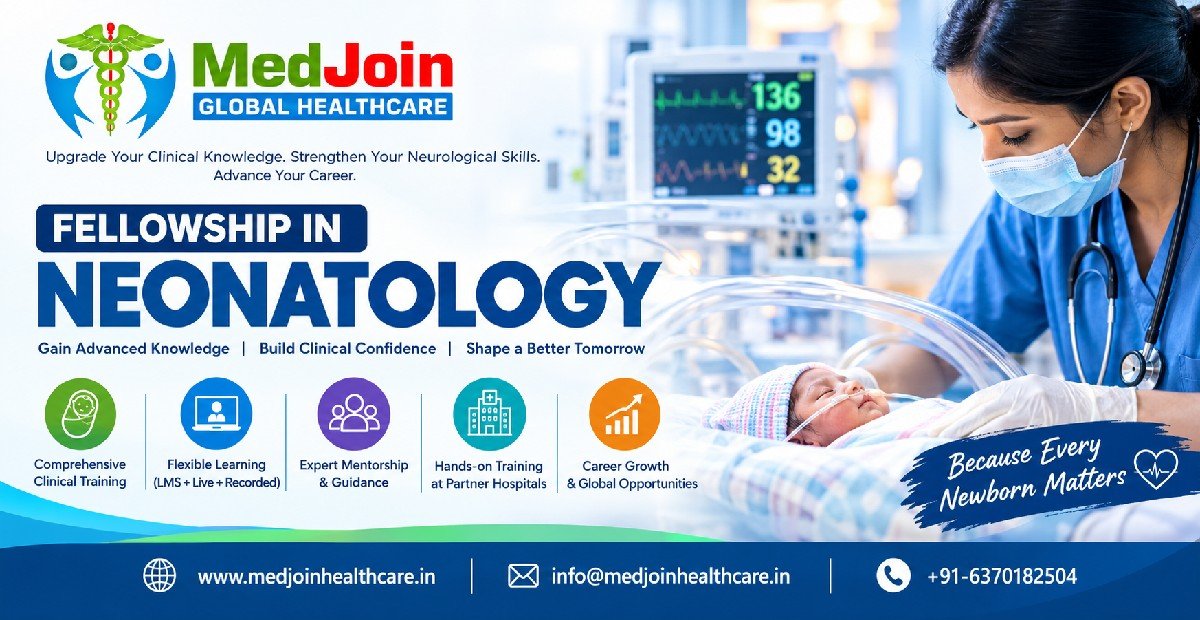
Neonatology is one of the most specialized and rapidly evolving areas of modern medicine. It focuses on the care of newborn babies, particularly premature infants, low-birth-weight babies, critically ill neonates, and newborns who require specialized medical attention immediately after birth.
For doctors who want to develop focused knowledge in newborn care, a Fellowship in Neonatology can provide an opportunity to strengthen their understanding of neonatal assessment, stabilization, monitoring, diagnosis, and management. With advances in neonatal intensive care, respiratory support, infection control, nutrition, imaging, and monitoring technologies, the field offers a wide range of learning opportunities for healthcare professionals.
A structured fellowship can help doctors bridge the gap between theoretical knowledge and practical clinical decision-making. It can also expose learners to common and complex neonatal conditions through case-based learning, academic discussions, clinical demonstrations, simulations, and supervised clinical exposure where applicable.
If you are a medical graduate or practicing doctor considering specialization in newborn care, this comprehensive guide explains why to join a Fellowship in Neonatology, its career scope, potential benefits, eligibility considerations, curriculum, skills developed, career opportunities, and factors to consider before enrolling.
What Is a Fellowship in Neonatology?
A Fellowship in Neonatology is a focused educational program designed to provide doctors with advanced knowledge and structured learning in newborn and neonatal care.
Depending on the institution and program model, a fellowship may include:
- Online learning
- Recorded lectures
- Live expert sessions
- Case discussions
- Assignments
- Assessments
- Clinical demonstrations
- Simulation-based learning
- Hospital-based clinical exposure
- Observership
- NICU exposure
- Academic presentations
- Case-based discussions
The exact curriculum, duration, eligibility requirements, certification, and clinical components vary between institutions.
Therefore, doctors should carefully review the program structure before enrollment.
Why Is Neonatal Care Important?
The newborn period is a highly sensitive stage of life.
Problems that develop during pregnancy, labor, delivery, or immediately after birth can require prompt recognition and intervention.
Early identification of complications can be important for appropriate management and referral.
Neonatal medicine therefore emphasizes:
- Early assessment
- Stabilization
- Appropriate monitoring
- Timely diagnosis
- Respiratory support
- Infection prevention
- Nutritional management
- Temperature control
- Fluid and electrolyte management
- Neurological monitoring
- Family communication
- Safe referral and transport
Doctors who develop stronger knowledge in these areas can contribute to improved organization and delivery of neonatal care within their professional scope.
Why Join a Fellowship in Neonatology?
There are several reasons a doctor may consider pursuing a fellowship in neonatology.
5.1 Develop Focused Knowledge
Medical education provides broad exposure to multiple disciplines. A fellowship allows doctors to concentrate on a specific area.
A neonatology fellowship can provide structured learning around newborn physiology, neonatal emergencies, intensive care, respiratory management, nutrition, infection, and other important areas.
5.2 Understand Neonatal Emergencies
Neonatal emergencies can develop rapidly.
Doctors need to recognize warning signs and understand initial stabilization principles.
A structured fellowship can provide case-based exposure to situations such as:
- Respiratory distress
- Apnea
- Sepsis
- Hypoglycemia
- Neonatal seizures
- Shock
- Birth-related complications
- Severe jaundice
5.3 Improve Clinical Decision-Making
Neonatal medicine involves frequent clinical decisions.
Doctors may need to determine:
- When a baby requires escalation of care
- What monitoring is appropriate
- When respiratory support should be considered
- When infection should be suspected
- When feeding should be modified
- When referral is necessary
- How to communicate deterioration to the family
Case-based learning can help develop structured approaches to such decisions.
5.4 Learn Modern NICU Practices
Modern NICUs use advanced monitoring and treatment technologies.
A fellowship can introduce learners to concepts related to:
- Mechanical ventilation
- Non-invasive respiratory support
- CPAP
- Pulse oximetry
- Blood gas interpretation
- Infusion therapy
- Phototherapy
- Incubator care
- Neonatal monitoring
- Nutritional support
The precise level of hands-on experience depends on the program.
5.5 Build Professional Confidence
Structured learning may help doctors become more comfortable discussing neonatal cases, interpreting clinical information, and communicating with multidisciplinary teams.
Professional confidence should always be supported by appropriate training, supervision, institutional protocols, and clinical competence.
Career Scope After Fellowship in Neonatology
The career scope of neonatology-related training can be considered across several professional environments.
Doctors may work in or interact with:
- Hospitals
- NICUs
- Pediatric departments
- Maternity hospitals
- Child-care centers
- Emergency departments
- Newborn stabilization units
- Community healthcare facilities
- Academic environments
- Clinical education
- Healthcare organizations
The actual professional role depends on the doctor's primary qualification, registration, experience, institutional requirements, and applicable regulations.
A fellowship should therefore be viewed as additional focused education rather than automatically equivalent to a formal postgraduate specialty qualification.
Benefits of a Fellowship in Neonatology
7.1 Focused Medical Education
One of the primary benefits is focused education.
Instead of studying multiple unrelated specialties, learners spend dedicated time developing knowledge about newborn medicine.
7.2 Structured Curriculum
A structured curriculum can help organize learning around major neonatal topics.
Typical areas include:
- Neonatal physiology
- Newborn examination
- Resuscitation
- Prematurity
- Respiratory disorders
- Neonatal infections
- Nutrition
- Neurology
- Neonatal emergencies
- NICU monitoring
7.3 Flexible Learning
For working doctors, flexible learning can be particularly useful.
Online programs may provide:
- LMS access
- Recorded lectures
- Study materials
- Assignments
- Online assessments
- Live academic sessions
This allows learners to study alongside their professional responsibilities.
7.4 Clinical Exposure
Where included, supervised clinical exposure can help learners observe real-world neonatal care.
Clinical exposure may include:
- NICU rounds
- Patient observation
- Case discussions
- Clinical demonstrations
- Monitoring practices
- Documentation
- Multidisciplinary interaction
The scope of hands-on activities should always be determined by the host institution and applicable regulations.
7.5 Case-Based Learning
Case discussions help connect theory with clinical situations.
A case may involve:
A premature infant presenting with respiratory distress.
The discussion can cover:
- Initial assessment
- Differential diagnosis
- Oxygenation
- Respiratory support
- Monitoring
- Investigations
- Infection considerations
- Nutrition
- Follow-up
- Referral or escalation
This approach encourages structured clinical reasoning.
Eligibility for Fellowship in Neonatology
Eligibility depends on the institution offering the fellowship.
Many medical fellowship programs may require an MBBS or equivalent medical qualification.
Some advanced programs may have additional requirements related to:
- Postgraduate qualification
- Clinical experience
- Pediatric experience
- Medical registration
- Hospital employment
The exact requirements should be checked with the fellowship provider.
Doctors should also distinguish between:
Educational fellowship certification
and
recognized postgraduate specialty qualifications.
A fellowship certificate does not automatically confer specialist status where specialist recognition is governed by a separate regulatory or licensing framework.
Duration of a Neonatology Fellowship
The duration of a fellowship can vary.
Programs may be structured as:
- Short-term certificate programs
- Six-month programs
- One-year fellowships
- Longer advanced programs
- Hybrid academic and clinical programs
A one-year fellowship may provide sufficient time for systematic learning across multiple neonatal topics while allowing working professionals to continue their careers.
The actual duration should be evaluated alongside curriculum depth, faculty involvement, assessment structure, and clinical exposure.
Online, Hybrid and Clinical Fellowship Models
Modern medical education increasingly uses multiple learning formats.
Online Fellowship
An online fellowship may include:
- LMS access
- Recorded lectures
- Study materials
- Assignments
- Online assessments
- Live sessions
- Case discussions
This format can be suitable for doctors who need flexibility.
Hybrid Fellowship
A hybrid program combines online academic education with a clinical component.
For example:
Online Learning + Hospital Clinical Exposure
This model can allow doctors to complete theoretical learning remotely while gaining supervised exposure in a clinical environment where applicable.
Clinical Fellowship
A clinical fellowship places greater emphasis on hospital-based learning.
Depending on the program, this may include:
- Clinical rounds
- NICU observation
- Case discussions
- Supervised procedures
- Clinical demonstrations
- Academic meetings
Doctors should verify exactly what procedures and responsibilities are permitted.
Important Neonatal Conditions Covered
A fellowship should expose learners to common and clinically significant neonatal conditions.
These may include:
Prematurity
Premature infants may have immature respiratory, neurological, gastrointestinal, immune, and thermoregulatory systems.
Low Birth Weight
Low birth weight infants may require additional monitoring and nutritional support.
Respiratory Distress
Respiratory problems are among the major reasons newborns require specialized care.
Neonatal Sepsis
Sepsis can become serious quickly and requires prompt assessment and appropriate management.
Jaundice
Neonatal jaundice is common, but severe hyperbilirubinemia requires appropriate evaluation and management.
Hypoglycemia
Low blood glucose can be associated with specific neonatal risk factors and may require monitoring and intervention.
Neonatal Seizures
Seizures in newborns require careful evaluation to identify possible underlying causes.
Birth Asphyxia
Infants with compromised condition around birth may require immediate stabilization and subsequent monitoring.
Neonatal Resuscitation and Stabilization
One of the most important areas of neonatal education is immediate care after birth.
The first minutes after delivery can be critical.
A doctor should understand principles of:
- Rapid assessment
- Maintaining warmth
- Airway positioning
- Breathing support
- Circulatory assessment
- Appropriate escalation
- Post-resuscitation monitoring
Training programs may use simulation-based exercises to teach these principles.
Practical training is particularly important for procedures and emergency skills because theoretical knowledge alone cannot replace supervised clinical competency.
Prematurity and Low Birth Weight
Premature infants often require specialized care because organ systems may not be fully mature.
Potential problems include:
- Respiratory distress
- Feeding difficulties
- Temperature instability
- Infection
- Apnea
- Hypoglycemia
- Jaundice
- Neurological complications
A fellowship can help doctors understand the clinical principles involved in monitoring and supporting these infants.
Respiratory Care in Neonates
Respiratory support is a major component of neonatal intensive care.
Doctors may encounter:
- Oxygen therapy
- CPAP
- Non-invasive ventilation
- Mechanical ventilation
- Surfactant therapy
- Blood gas interpretation
A fellowship curriculum may introduce learners to indications, monitoring principles, complications, and escalation pathways.
Hands-on respiratory procedures should only be performed by appropriately trained professionals under authorized supervision.
Role of Case-Based Learning
Case-based learning is particularly useful in neonatology because newborns can present with overlapping symptoms.
For example, respiratory distress may result from multiple conditions.
A case discussion can encourage learners to ask:
- What is the likely diagnosis?
- What are the immediate priorities?
- What investigations are appropriate?
- Does the baby need respiratory support?
- Could infection be involved?
- Is referral required?
- What monitoring is necessary?
This develops a structured clinical approach.
Importance of Clinical Exposure
Clinical exposure can help bridge the gap between academic knowledge and real-world healthcare delivery.
Where a fellowship includes hospital exposure, doctors may observe:
- NICU rounds
- Newborn assessments
- Respiratory support
- Monitoring
- Feeding practices
- Infection-control measures
- Documentation
- Family counseling
- Multidisciplinary discussions
Clinical exposure should be supervised and conducted within the learner's authorized scope of practice.
Skills Developed During Fellowship
A well-designed program can help doctors develop several competencies.
Clinical Knowledge
Understanding neonatal physiology and common diseases.
Assessment Skills
Recognizing clinical signs and identifying deterioration.
Decision-Making
Developing structured approaches to diagnosis and management.
Communication
Explaining clinical situations to parents and caregivers.
Teamwork
Working with pediatricians, nurses and other healthcare professionals.
Documentation
Understanding the importance of accurate neonatal records.
Emergency Response
Recognizing and responding to neonatal emergencies.
Fellowship and Career Development
A fellowship can become part of a doctor's broader professional development strategy.
For doctors already working in hospitals, focused education may help them:
- Strengthen their knowledge
- Participate more effectively in neonatal case discussions
- Understand NICU workflows
- Develop academic interests
- Prepare for further formal training
- Expand their professional focus
Career outcomes vary depending on prior qualifications, experience, location, employer requirements, and applicable regulations.
Fellowship for Practicing Doctors
Working doctors often face difficulty attending full-time academic programs.
A flexible fellowship can provide an alternative educational format.
Online LMS-based learning may allow doctors to access:
- Recorded lectures
- Learning modules
- Reading material
- Assignments
- Assessments
- Live sessions
This can make continuing education more manageable alongside clinical practice.
Fellowship for Doctors Working in Hospitals
Doctors already employed in hospitals may benefit from focused neonatal learning when their professional responsibilities involve newborn patients.
For example, doctors working in:
- Emergency departments
- Maternity units
- Pediatric departments
- General hospitals
- Community hospitals
may encounter newborns requiring initial assessment and stabilization.
Focused education can support their understanding of neonatal care within their authorized clinical role.
Fellowship for Primary and Secondary Care Physicians
Not every newborn is initially treated in a tertiary NICU.
Some infants may first present to:
- Primary care centers
- Community hospitals
- General hospitals
- Emergency departments
- Maternity centers
Doctors working in these settings need to recognize when a newborn requires escalation or transfer.
A fellowship can emphasize:
- Early recognition
- Stabilization
- Referral
- Communication
- Safe transfer principles
Fellowship and Academic Development
Doctors interested in teaching may also benefit from structured neonatal education.
Potential academic activities include:
- Case presentations
- Journal discussions
- Clinical seminars
- Teaching sessions
- Academic writing
- Research discussions
A fellowship may therefore complement broader professional and academic development.
Fellowship and Professional Networking
Healthcare education increasingly involves professional networking.
Fellowship programs may provide opportunities to interact with:
- Faculty
- Consultants
- Pediatricians
- Other doctors
- Healthcare professionals
Live sessions, case discussions, webinars, and professional forums can help learners exchange clinical perspectives.
Technology in Modern Neonatology
Technology has transformed neonatal care.
Modern neonatal units may use:
- Advanced incubators
- Patient monitors
- Respiratory support systems
- Digital medical records
- Blood gas analyzers
- Point-of-care testing
- Neonatal imaging
- Telemedicine
- Clinical decision-support systems
Doctors need to understand not only how technology is used but also its limitations.
Technology should support clinical decision-making rather than replace clinical assessment.
Career Settings After Fellowship
Depending on qualifications and professional requirements, doctors with focused neonatal training may explore opportunities in:
Hospitals
Private and public hospitals may have pediatric and neonatal departments.
NICUs
Doctors involved in newborn care may work in or collaborate with NICU teams according to their qualifications and institutional requirements.
Maternity Hospitals
Maternity centers frequently need professionals capable of recognizing neonatal problems.
Pediatric Departments
Neonatal knowledge can complement broader pediatric practice.
Emergency Departments
Emergency physicians may encounter newborns requiring stabilization and referral.
Academic Institutions
Doctors interested in teaching may participate in medical education.
Online Fellowship vs Clinical Fellowship
Both models have different advantages.
| Feature | Online Fellowship | Clinical/Hybrid Fellowship |
|---|---|---|
| Flexible learning | High | Moderate |
| Recorded content | Usually available | May be available |
| Live sessions | Possible | Possible |
| Clinical exposure | Limited/none | Included where specified |
| Working-doctor friendly | High | Depends on schedule |
| Hospital environment | Not necessarily | Included where specified |
| Case discussions | Yes | Yes |
| Practical learning | Limited | Greater opportunity |
| Travel requirement | Usually lower | May be required |
The appropriate model depends on the learner's professional goals, schedule, location, and need for clinical exposure.
How MedJoin Global Healthcare Can Help
MedJoin Global Healthcare offers healthcare education and fellowship-oriented learning programs for medical professionals.
A structured fellowship model can combine academic education with flexible learning.
Depending on the selected program, learning may include:
- Online LMS
- Recorded lectures
- Live expert sessions
- Course modules
- Assignments
- Assessments
- Case-based learning
- Clinical exposure where applicable
For doctors interested in neonatology, the key objective should be to build structured knowledge and strengthen understanding of newborn care.
Before enrollment, prospective learners should review the exact current program curriculum, eligibility, fee, duration, certification details, and clinical-training terms.
Potential Career Benefits
A Fellowship in Neonatology can contribute to several areas of professional development.
Focused Knowledge
Gain deeper exposure to neonatal medicine.
Clinical Reasoning
Develop structured approaches to newborn cases.
Emergency Awareness
Improve understanding of neonatal emergencies and stabilization.
NICU Familiarity
Understand common NICU workflows and monitoring practices.
Professional Development
Add focused medical education to your professional portfolio.
Continuing Education
Continue learning while working, depending on the program format.
Networking
Interact with faculty and healthcare professionals.
Academic Growth
Participate in case discussions and academic activities.
Is a Fellowship in Neonatology Worth Considering?
For doctors interested in newborn medicine, a fellowship can be a useful way to pursue structured additional education.
Its value depends on several factors:
- Your existing qualification
- Your clinical experience
- Your career objectives
- The program's curriculum
- Faculty expertise
- Clinical exposure
- Assessment methods
- Certification
- Institutional recognition
- Flexibility
- Cost
A fellowship should complement, rather than be confused with, formal postgraduate specialty training where applicable.
Doctors should evaluate the program based on their own professional requirements and applicable regulations.
Neonatology is a specialized and continually evolving field of medicine focused on the care of newborn infants, especially those who are premature, critically ill, or require specialized monitoring and treatment.
A Fellowship in Neonatology can provide doctors with structured education in areas such as neonatal assessment, resuscitation, prematurity, respiratory care, sepsis, jaundice, nutrition, neurological conditions, NICU monitoring, and neonatal emergencies.
The potential benefits extend beyond academic knowledge. A structured program can support clinical reasoning, professional development, case-based learning, networking, and greater familiarity with modern neonatal care practices.
For working doctors, flexible online or hybrid learning can make focused medical education more accessible. For learners seeking practical experience, a program with supervised hospital exposure may offer an additional dimension to theoretical education.
However, the quality and relevance of a fellowship depend on its curriculum, faculty, assessment structure, clinical exposure, certification, and the learner's own professional goals.
If you are considering a fellowship, evaluate the program carefully before enrollment. Understand exactly what the course provides, what it does not provide, and how it fits within your existing medical qualification and professional scope.
For doctors who are passionate about newborn care and want to develop focused knowledge in this area, a well-structured Fellowship in Neonatology can be considered as part of a broader strategy for continuous medical education, clinical learning, and professional development.
Explore Fellowship Opportunities With MedJoin Global Healthcare
If you are looking for a structured healthcare education program with flexible learning options, explore the available fellowship programs from MedJoin Global Healthcare.
Take the Next Step in Your Medical Education
Build focused knowledge. Learn from structured modules. Participate in case-based discussions. Strengthen your understanding of neonatal medicine and continue your professional learning journey.
Fellowship in Neonatology – Focused Learning for Doctors Interested in Newborn Care.