
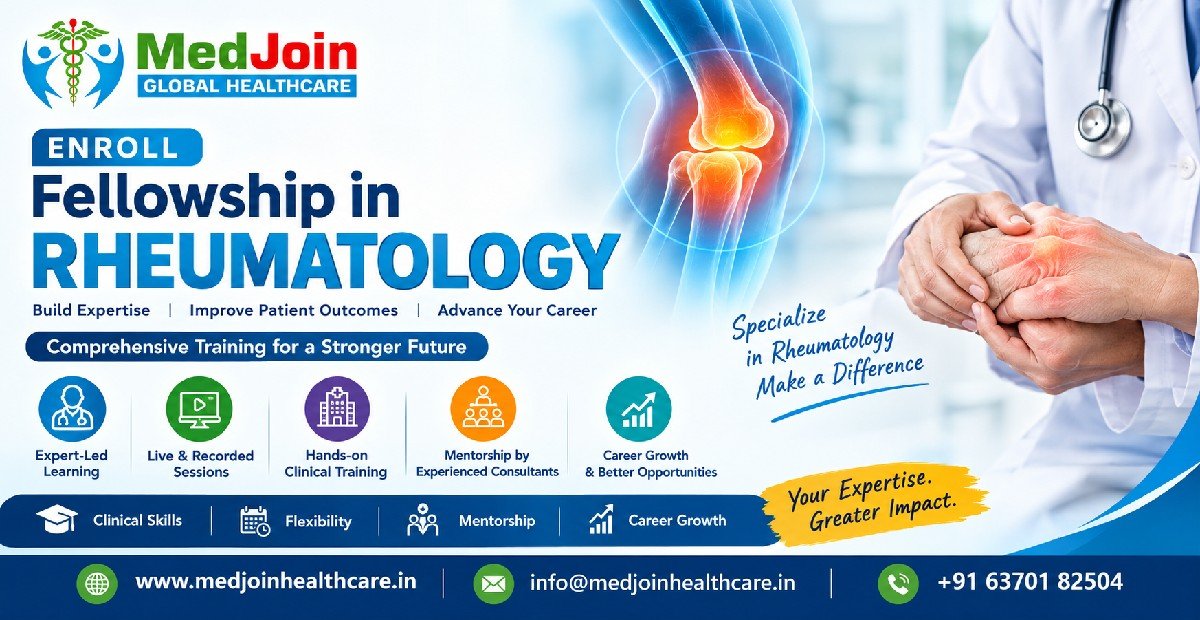
Rheumatology is one of the most important and rapidly developing areas of modern medicine. With increasing awareness of autoimmune diseases, inflammatory disorders, musculoskeletal conditions, osteoporosis, arthritis, and systemic rheumatic diseases, the demand for doctors with focused knowledge in rheumatology continues to grow.
For MBBS graduates who want to develop expertise in diagnosing and managing patients with joint, muscle, bone, and autoimmune conditions, a Fellowship in Rheumatology can provide a structured pathway to build advanced clinical knowledge and practical skills.
Unlike general medical practice, rheumatology involves the evaluation of complex symptoms that may affect multiple organs and systems. Conditions such as rheumatoid arthritis, systemic lupus erythematosus, ankylosing spondylitis, psoriatic arthritis, gout, vasculitis, systemic sclerosis, Sjögren's syndrome, osteoporosis, and other autoimmune diseases often require detailed clinical assessment and long-term management.
A focused fellowship can help MBBS doctors understand these conditions more systematically and develop greater confidence in clinical decision-making.
For doctors looking to expand their clinical knowledge after MBBS, a fellowship can also offer the flexibility of structured online learning combined with clinical training where applicable.
Rheumatology is a medical specialty focused on diseases involving the musculoskeletal system and a wide range of autoimmune and inflammatory conditions.
The field includes disorders affecting:
- Joints
- Muscles
- Bones
- Tendons
- Ligaments
- Connective tissues
- Blood vessels
- Immune system
- Multiple organ systems
Many rheumatological conditions are chronic and require long-term management.
Patients may initially present with symptoms such as:
- Joint pain
- Joint swelling
- Morning stiffness
- Back pain
- Muscle pain
- Fatigue
- Recurrent fever
- Skin manifestations
- Weakness
- Reduced mobility
- Recurrent joint inflammation
The challenge is that these symptoms can overlap with many other medical conditions.
Therefore, doctors need a systematic approach to history taking, physical examination, investigations, differential diagnosis, treatment planning, and follow-up.
A fellowship focused on rheumatology can help MBBS doctors develop a structured understanding of these areas.
A Fellowship in Rheumatology is a focused educational and clinical training program designed to provide doctors with advanced knowledge of rheumatic, autoimmune, inflammatory, and musculoskeletal disorders.
The program generally goes beyond basic undergraduate medical education and concentrates on practical application.
Depending on the program structure, learning may include:
- Online lectures
- Recorded educational modules
- Live interactive sessions
- Case discussions
- Clinical demonstrations
- Assignments
- Assessments
- Hospital-based clinical training
- Observership opportunities
- Mentor interaction
- Practical case-based learning
The exact curriculum, duration, clinical exposure, assessment structure, and certification depend on the institution or organization providing the fellowship.
For MBBS doctors, a structured fellowship can serve as a focused continuing medical education pathway.
Why Rheumatology Is Important in Modern Healthcare
Rheumatic diseases represent a broad group of conditions that can significantly affect quality of life.
Patients with chronic inflammatory and autoimmune diseases may experience:
- Pain
- Disability
- Reduced mobility
- Loss of productivity
- Sleep disturbance
- Psychological stress
- Work limitations
- Long-term complications
Early recognition and appropriate management are therefore important.
A doctor working in general practice, internal medicine, emergency care, family medicine, or hospital settings may encounter patients with rheumatological symptoms.
Understanding rheumatology can help doctors recognize when a patient requires:
- Further investigation
- Specialist consultation
- Urgent referral
- Long-term monitoring
- Multidisciplinary management
This makes rheumatology knowledge relevant not only to rheumatologists but also to doctors working across multiple clinical environments.
Why Should MBBS Doctors Consider Rheumatology?
MBBS provides a broad foundation in medicine. However, after graduation, many doctors want to develop focused expertise in a particular area.
Rheumatology may be attractive to doctors who enjoy:
- Clinical reasoning
- Differential diagnosis
- Long-term patient relationships
- Autoimmune medicine
- Internal medicine
- Musculoskeletal medicine
- Chronic disease management
- Evidence-based treatment
- Complex clinical cases
A fellowship provides an opportunity to concentrate on a specific clinical field rather than studying a broad range of medical specialties simultaneously.
Fellowship in Rheumatology After MBBS
For an MBBS doctor, a fellowship in rheumatology can provide structured exposure to important concepts within the specialty.
The program can be particularly useful for doctors who want to strengthen their knowledge of:
- Rheumatoid arthritis
- Osteoarthritis
- Gout
- Lupus
- Spondyloarthritis
- Psoriatic arthritis
- Osteoporosis
- Vasculitis
- Connective tissue diseases
- Autoimmune disorders
- Musculoskeletal examination
- Rheumatology investigations
- Long-term disease monitoring
Doctors should always verify the eligibility, recognition, curriculum, clinical requirements, and certification offered by the specific fellowship provider before enrollment.
Eligibility for a Rheumatology Fellowship
Eligibility varies between fellowship providers.
A typical fellowship intended for MBBS doctors may require:
- MBBS or equivalent medical qualification
- Registration with the relevant medical authority where applicable
- Completion of required internship
- Interest in clinical medicine
Some advanced programs may have additional eligibility requirements.
Duration of the Fellowship
The duration of rheumatology fellowship programs can differ significantly.
Programs may be offered in formats such as:
- Short-term certification
- Six-month programs
- One-year fellowships
- Extended clinical fellowships
- Online programs
- Hybrid programs
- Hospital-based programs
A one-year structured fellowship can provide sufficient time to cover the major areas of rheumatology while allowing doctors to continue professional responsibilities depending on the program format.
The exact duration should be confirmed with the institution before enrollment.
Online and Hybrid Learning Models
Modern medical education increasingly uses digital learning platforms.
An online or hybrid rheumatology fellowship may allow doctors to access educational content without relocating permanently.
Online learning may include:
- Learning management system access
- Recorded lectures
- Digital study materials
- PDF resources
- Assessments
- Live classes
- Case discussions
- Clinical presentations
A hybrid program can combine online academic education with structured clinical exposure.
This format may be useful for doctors who are working while pursuing additional education.
Clinical Training in Rheumatology
Clinical exposure is an important part of developing practical medical skills.
Where included in a fellowship, clinical training may expose doctors to:
- Patient history taking
- Musculoskeletal examination
- Joint examination
- Clinical case discussions
- Interpretation of investigations
- Treatment planning
- Follow-up assessment
- Chronic disease monitoring
Clinical training should be conducted under appropriate supervision and according to the policies of the training institution.
Doctors should also distinguish between an educational fellowship and formal postgraduate specialist qualifications.
What You Learn During the Fellowship
A structured Rheumatology Fellowship may cover multiple domains.
Core subjects can include:
- Principles of rheumatology
- Clinical immunology
- Autoimmune diseases
- Inflammatory arthritis
- Degenerative joint diseases
- Connective tissue disorders
- Vasculitis
- Crystal arthropathies
- Osteoporosis
- Musculoskeletal examination
- Rheumatology laboratory investigations
- Imaging
- Pharmacological management
- Biologic therapies
- Patient monitoring
- Rehabilitation
- Multidisciplinary care
The exact curriculum depends on the fellowship provider.
Basic Rheumatology Concepts
The first stage of rheumatology education involves understanding the difference between various types of musculoskeletal disease.
Mechanical conditions
These may be associated with:
- Activity-related pain
- Degenerative changes
- Structural abnormalities
Inflammatory conditions
These may involve:
- Morning stiffness
- Joint swelling
- Systemic symptoms
- Elevated inflammatory markers
Autoimmune conditions
These occur when immune system dysfunction contributes to disease.
Metabolic conditions
Examples include:
- Gout
- Osteoporosis
- Certain metabolic bone diseases
Recognizing these broad patterns can help doctors develop appropriate differential diagnoses.
Biologic and Targeted Therapies
Modern rheumatology has been transformed by biologic and targeted therapies.
Depending on the condition, treatment may involve targeted inhibition of specific immune pathways.
Educational programs may introduce doctors to concepts such as:
- TNF inhibitors
- IL-6 pathway inhibition
- IL-17 pathway therapies
- B-cell targeted therapies
- JAK inhibitors
- Other targeted agents
Doctors should understand patient selection, monitoring, infection risks, vaccination considerations, and safety issues.
Career Scope After a Rheumatology Fellowship
Career scope depends on a doctor's qualifications, registration, experience, additional training, and local regulations.
A rheumatology-focused fellowship can strengthen knowledge useful in areas such as:
Hospitals
Doctors may work in:
- Multispecialty hospitals
- Medical departments
- Rheumatology departments
- Internal medicine departments
- Chronic disease clinics
Clinics
Doctors may provide care related to:
- Joint disorders
- Musculoskeletal complaints
- Chronic inflammatory diseases
- Follow-up care
Primary Care
Rheumatology knowledge can help primary-care doctors recognize patients requiring specialist referral.
Medical Education
Doctors may use their knowledge for:
- Teaching
- CME activities
- Academic discussions
- Medical content development
Research
Doctors interested in academics may explore:
- Clinical research
- Observational studies
- Case reports
- Literature reviews
- Clinical audits
A fellowship itself should not be represented as equivalent to a recognized postgraduate specialist degree unless the issuing authority explicitly provides such recognition.
Opportunities in Hospitals
Hospital-based work may expose doctors to a broad patient population.
Rheumatology knowledge can be relevant in:
- Outpatient departments
- Internal medicine
- Emergency care
- Chronic disease clinics
- Inpatient consultation
- Multidisciplinary rounds
Doctors can apply their learning while working within their legally permitted scope of practice.
Opportunities in Clinics
Many patients initially approach general physicians with joint pain, back pain, fatigue, or musculoskeletal symptoms.
A focused fellowship can help doctors improve their approach to:
- Initial assessment
- Differential diagnosis
- Basic investigations
- Referral
- Follow-up
Continuing Professional Development
Medicine changes continuously.
New research, diagnostic techniques, medications, guidelines, and treatment strategies emerge regularly.
A fellowship can therefore be viewed as part of a broader professional development pathway rather than the end of medical education.
Doctors should continue with:
- CME
- Conferences
- Journal reading
- Workshops
- Case discussions
- Professional education
Benefits of a Rheumatology Fellowship
Potential benefits include:
1. Focused Knowledge
Doctors can study rheumatology in a structured manner.
2. Clinical Reasoning
Case-based learning can improve systematic clinical thinking.
3. Diagnostic Awareness
Doctors may become more familiar with patterns of inflammatory and autoimmune disease.
4. Practical Exposure
Where clinical training is included, doctors can gain supervised exposure.
5. Career Development
Additional focused education may complement existing medical qualifications and experience.
6. Professional Networking
Interaction with faculty and peers can support professional development.
7. Flexible Learning
Online education can make advanced learning more accessible to working doctors.
Is a Rheumatology Fellowship Suitable for Every MBBS Doctor?
Not necessarily.
The fellowship may be particularly relevant to doctors interested in:
- Internal medicine
- Primary care
- Musculoskeletal medicine
- Autoimmune disease
- Chronic disease management
- Clinical practice
Doctors primarily interested in other fields may prefer a fellowship aligned with their intended career direction.
Why Structured Learning Matters
Rheumatology is broad.
Without structured learning, doctors may study individual diseases without understanding how they connect.
A structured fellowship can organize learning from:
Symptoms → Clinical Examination → Differential Diagnosis → Investigations → Diagnosis → Treatment → Monitoring
This approach reflects how doctors approach real clinical problems.
How MedJoin Global Supports Learning
MedJoin Global Healthcare provides healthcare-focused educational programs designed for medical professionals.
A rheumatology fellowship offered through a structured learning platform can combine digital education with case-based learning and clinical exposure where applicable.
The objective is to provide doctors with a focused learning pathway while allowing them to continue their professional activities depending on the program format.
A Fellowship in Rheumatology after MBBS can provide doctors with a focused opportunity to study autoimmune, inflammatory, musculoskeletal, and rheumatic diseases in a structured manner.
The field covers a broad range of clinical conditions, from common disorders such as osteoarthritis and gout to complex systemic diseases such as systemic lupus erythematosus, systemic sclerosis, vasculitis, and inflammatory arthritis.
For MBBS doctors interested in internal medicine, primary care, chronic disease management, and musculoskeletal medicine, focused education in rheumatology can complement their existing medical knowledge.
The major areas of learning can include:
- Rheumatological history taking
- Musculoskeletal examination
- Autoimmune diseases
- Inflammatory arthritis
- Connective tissue disorders
- Crystal arthropathies
- Osteoporosis
- Vasculitis
- Rheumatology investigations
- Imaging
- Pharmacological treatment
- Biologic and targeted therapies
- Patient monitoring
- Multidisciplinary care
The career applications of this knowledge may extend across hospitals, clinics, primary care, medical education, research, and chronic disease management, depending on the doctor's qualifications and professional scope.
For doctors considering enrollment, the most important step is to evaluate the fellowship carefully. Review its curriculum, faculty, duration, clinical exposure, assessment system, certification, fees, and recognition before making a decision.
A focused fellowship should not be viewed simply as another certificate. The real value comes from structured learning, clinical reasoning, supervised exposure where available, continuous professional development, and the ability to apply knowledge responsibly in clinical practice.
If you are an MBBS doctor looking to expand your understanding of rheumatology and develop a more focused clinical knowledge base, exploring a structured Fellowship in Rheumatology can be one option within your continuing medical education journey.
Explore Fellowship Opportunities in Rheumatology
Fellowship in Rheumatology – MedJoin Global Healthcare
Designed for: MBBS doctors and eligible healthcare professionals
Learning: Online / Hybrid options as applicable
Focus: Rheumatology, autoimmune diseases, inflammatory arthritis and musculoskeletal medicine
Learning features: LMS, recorded lectures, live sessions, case-based discussions and assessments
Clinical exposure: Available according to the selected program model
Career focus: Clinical knowledge enhancement and professional development