
Completing an MBBS degree is a significant milestone in every doctor's professional journey. It provides a comprehensive foundation in anatomy, physiology, pathology, pharmacology, medicine, surgery, community medicine, diagnostics, emergency care, and patient management.
However, for many doctors, completing MBBS is only the beginning of their professional development.
After MBBS, doctors may consider several career pathways, including postgraduate medical education, hospital employment, research, healthcare administration, public health, clinical practice, and focused specialty-oriented training.
One increasingly relevant option is a Clinical Fellowship after MBBS.
A clinical fellowship can provide focused education in a selected medical discipline and, depending on the program, structured exposure to a hospital or clinical environment.
For doctors who specifically want practical learning, hands-on and offline clinical fellowship programs can provide an opportunity to connect academic knowledge with real-world clinical practice.
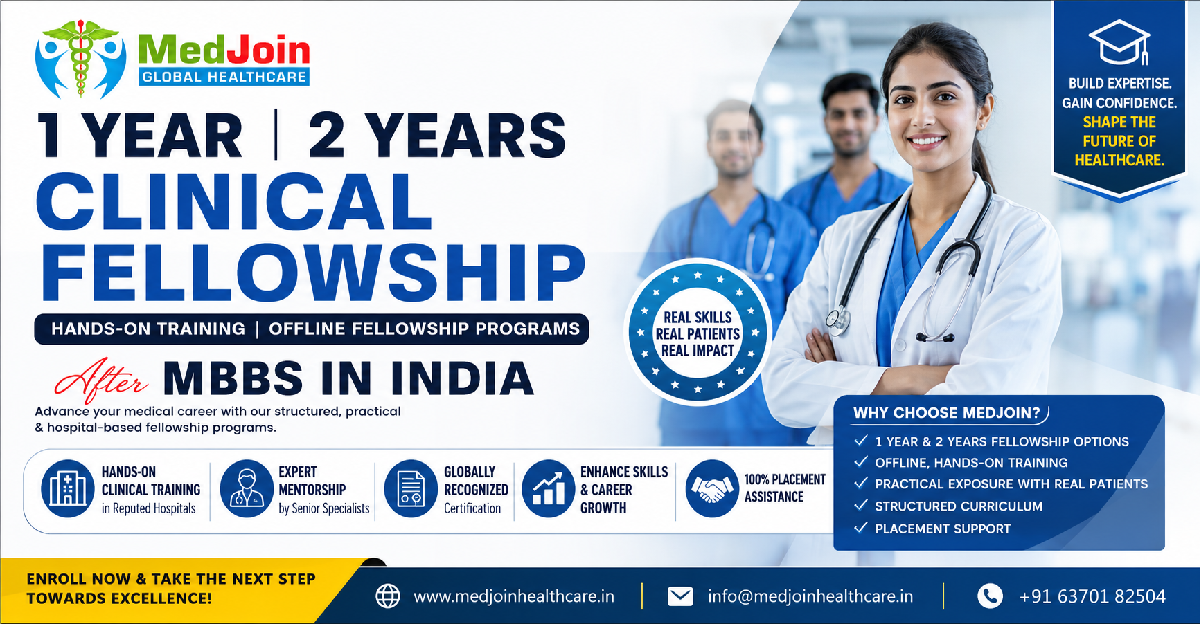
MedJoin Global Healthcare offers 1-Year and 2-Year Hands-On & Offline Clinical Fellowship Programs across a wide range of medical and healthcare disciplines.
"What should I do next?"
For some doctors, the answer is MD, MS, DNB, or another formal postgraduate qualification. Others may enter hospital practice, prepare for competitive examinations, pursue research, move into healthcare management, or explore focused clinical education.
For doctors who want to develop focused knowledge and practical exposure in a particular clinical area, a Clinical Fellowship after MBBS can be an additional educational pathway worth exploring.
Today, fellowship programs are available in a wide range of clinical disciplines. Depending on the institution and program structure, doctors may find 1-year Clinical Fellowship programs, 2-year Clinical Fellowship programs, hybrid programs combining online academic learning with hospital exposure, and offline fellowship programs involving structured clinical training.
Among these options, hands-on training is particularly important for doctors who want to connect theoretical learning with real-world clinical practice.
A well-designed fellowship can combine:
Structured Academic Education + Case-Based Learning + Hospital Exposure + Supervised Practical Training + Assessment + Mentorship
What Is a Clinical Fellowship After MBBS?
A Clinical Fellowship is a structured educational program that allows doctors to develop focused knowledge and clinical exposure in a particular medical discipline.
Unlike the broad MBBS curriculum, a fellowship concentrates on a defined area of medicine.
For example, an MBBS doctor interested in chronic disease management may choose a Clinical Fellowship in Diabetes Mellitus.
- A doctor interested in emergency care may choose Emergency Medicine.
- A doctor interested in cancer care may explore Clinical Oncology.
- A doctor interested in cardiovascular medicine may consider Clinical Cardiology or 2D Echocardiography.
- A doctor interested in kidney disease may explore Nephrology or Interventional Nephrology.
The objective is to provide specialty-focused continuing medical education and clinical exposure.
A fellowship may include:
- Lectures
- Recorded learning
- Live academic sessions
- Clinical case discussions
- Assignments
- Assessments
- Hospital postings
- Ward rounds
- OPD exposure
- Procedure observation
- Supervised practical learning
- Clinical logbook
- Final evaluation
The structure varies from one program to another.
Why Choose a Clinical Fellowship After MBBS?
The healthcare environment is becoming increasingly specialized.
Doctors are expected to understand not only general medicine but also focused areas of diagnosis, treatment, patient monitoring, emergency management, technology, and multidisciplinary care.
A clinical fellowship can help doctors pursue focused learning after MBBS.
Potential objectives include:
- Developing specialty-oriented knowledge.
- Gaining clinical exposure.
- Understanding real-world patient management.
- Learning from experienced clinicians.
- Improving case presentation skills.
- Understanding diagnostic approaches.
- Developing appropriate practical skills under supervision.
- Exploring a potential specialty.
- Continuing professional education.
The value of the fellowship depends on the quality of the curriculum, clinical exposure, faculty, supervision, assessment, and certification.
What Is the Difference Between a 1-Year and 2-Year Clinical Fellowship?
One of the most important decisions for doctors is choosing between a 1-year fellowship and a 2-year fellowship.
The difference is not simply duration.
The additional year can potentially provide more time for:
- Advanced academic learning.
- Repeated clinical exposure.
- Longitudinal case follow-up.
- Specialty-specific training.
- Practical observation.
- Case presentations.
- Research.
- Assessments.
- Professional development.
However, the value of a two-year program depends on how the additional year is structured.
A two-year program should not simply repeat the same curriculum twice.
Ideally, it should progress from:
Foundation → Intermediate → Advanced → Clinical Integration
One-Year Clinical Fellowship After MBBS
A 1-year Clinical Fellowship can be designed as an intensive focused learning program.
The one-year format may be particularly suitable for doctors who:
- Want focused specialty exposure.
- Are already working.
- Want a shorter structured program.
- Want to explore a specialty.
- Prefer a combination of academic and clinical learning.
- Want to develop additional knowledge without committing to a longer program.
A typical 12-month program could be divided into:
Months 1–3
Foundation and core clinical concepts.
Months 4–6
Disease-specific learning and clinical assessment.
Months 7–9
Advanced case discussions and practical exposure.
Months 10–12
Clinical integration, assessment, revision, and final evaluation.
The exact curriculum should be specialty-specific.
Two-Year Clinical Fellowship After MBBS
A 2-year Clinical Fellowship provides a longer period for focused education and clinical exposure.
The additional year may allow a deeper progression through:
Year 1
Foundation and intermediate learning.
Year 2
Advanced clinical learning, practical exposure, case management, research, and competency development.
A well-structured two-year fellowship may include increasing responsibility under supervision as the doctor progresses.
The goal should be progression—not repetition.
One-Year vs Two-Year Fellowship: Which Is Better?
There is no universal answer.
The right choice depends on:
- Career objective.
- Specialty.
- Available clinical exposure.
- Program curriculum.
- Financial investment.
- Time commitment.
- Existing clinical experience.
- Desired level of specialization.
- Future education plans.
Choose a 1-year program when:
You want focused training in a relatively short timeframe.
Consider a 2-year program when:
You want a longer and more comprehensive learning pathway with progressive clinical exposure.
The key question is not:
"Which is longer?"
It is:
"Which program provides meaningful learning and clinical exposure for my specific goal?"
What Is Hands-On Clinical Training?
Hands-on clinical training refers to supervised learning in an actual healthcare environment.
Depending on the fellowship, doctors may receive exposure to:
- OPD.
- Inpatient wards.
- Emergency departments.
- ICUs.
- Specialty departments.
- Diagnostic areas.
- Procedure rooms.
- Operating environments.
- Clinical laboratories.
Hands-on training can involve:
- Patient history taking.
- Clinical examination.
- Case presentation.
- Investigation review.
- Treatment discussions.
- Patient monitoring.
- Procedure observation.
- Supervised practical activities where appropriate.
The scope of practical participation depends on:
- Doctor's competence.
- Hospital policy.
- Faculty supervision.
- Patient safety.
- Applicable regulations.
- Institutional authorization.
Why Hands-On Training Matters
Medicine is both a science and a practical profession.
Reading a textbook can explain how a disease presents.
A lecture can explain a treatment protocol.
A case discussion can explain clinical reasoning.
But observing a real patient allows a doctor to understand how those concepts interact in practice.
For example, a doctor may learn theoretically about:
- Sepsis.
- Cancer.
- Diabetes.
- Heart failure.
- Respiratory failure.
- Stroke.
- Pediatric emergencies.
During hospital exposure, the doctor can see how patients actually present, how investigations are reviewed, how teams communicate, and how treatment plans evolve.
This creates an important learning cycle:
Theory → Observation → Discussion → Supervised Practice → Feedback → Improvement
What Is an Offline Fellowship Program?
An offline fellowship is a program in which doctors physically attend the designated training location.
Depending on the program, offline learning may involve:
- Hospital attendance.
- Face-to-face teaching.
- Clinical postings.
- Ward rounds.
- OPD exposure.
- Case discussions.
- Practical demonstrations.
- Procedure observation.
- Academic seminars.
- Assessments.
For doctors who want direct exposure to clinical environments, offline training can be highly valuable.
However, doctors should not assume that every "offline fellowship" automatically provides extensive hands-on training.
The actual clinical component should be verified.
Offline vs Online Clinical Fellowship
Online Fellowship
Online fellowships may provide:
- Recorded lectures.
- Live classes.
- Digital resources.
- Online assessments.
- Case discussions.
Benefits
- Flexible.
- Convenient.
- Suitable for working doctors.
- Accessible from different locations.
Limitation
The major limitation is the absence or reduction of physical patient exposure.
Offline Fellowship
Offline programs provide physical attendance.
Benefits
- Direct faculty interaction.
- Hospital exposure.
- Patient observation.
- Clinical rounds.
- Practical demonstrations.
- Team interaction.
Limitations
- Requires physical attendance.
- May require relocation.
- Higher travel/living costs.
- Less flexible for full-time working doctors.
Hybrid Clinical Fellowship
A hybrid fellowship combines online education with offline clinical training.
This model can be particularly useful for doctors who want both flexibility and practical exposure.
A possible structure is:
Online Academic Component
↓
Live Classes
↓
Case Discussions
↓
Offline Hospital Posting
↓
Hands-On Training
↓
Clinical Assessment
A hybrid program can provide the advantages of digital education while preserving an important physical clinical component.
Full 12-Month Offline Fellowship
A full-year offline fellowship can be structured around continuous clinical exposure.
Possible components include:
- Daily hospital attendance.
- Specialty department posting.
- OPD.
- Inpatient care.
- Ward rounds.
- Case presentations.
- Emergency exposure.
- Procedure observation.
- Academic sessions.
- Faculty mentorship.
- Clinical logbook.
- Periodic assessments.
This model can be suitable for doctors who want an immersive clinical learning environment.
Who Can Consider a Clinical Fellowship After MBBS?
Before applying, doctors should verify:
- MBBS qualification.
- Internship status.
- Medical registration.
- Experience requirements.
- Documentation.
- Program-specific eligibility.
What Documents May Be Required?
Typical documents may include:
- MBBS certificate.
- Internship completion certificate.
- Registration certificate.
- Academic records.
- Identity proof.
- Passport-size photographs.
- Experience certificate, if applicable.
International medical graduates may have additional requirements.
MedJoin 1-Year & 2-Year Hands-On and Offline Clinical Fellowship Programs
MedJoin Global Healthcare offers a broad range of specialty-focused Clinical Fellowship programs designed for doctors and healthcare professionals seeking structured clinical education and practical exposure.
The available fellowship programs includes the following.
- Clinical Fellowship in Family Medicine
- Clinical Fellowship in Diabetes Mellitus
- Clinical Fellowship in Obstetrics and Gynaecology
- Clinical Fellowship in Pediatrics
- Clinical Fellowship in 2D Echocardiography
- Clinical Fellowship in Clinical Cardiology
- Clinical Fellowship in Internal Medicine
- Clinical Fellowship in Critical Care Medicine
- Clinical Fellowship in Emergency Medicine
- Clinical Fellowship in Nephrology
- Clinical Fellowship in Dermatology
- Clinical Fellowship in Anaesthesiology
- Clinical Fellowship in Gastroenterology
- Clinical Fellowship in Urology
- Clinical Fellowship in Clinical Pharmacology
- Clinical Fellowship in Advanced Nursing Care
- Clinical Fellowship in Neonatology
- Clinical Fellowship in Orthopedics
- Clinical Fellowship in Intensive Care Medicine
- Clinical Fellowship in Facial Aesthetic and Cosmetology
- Clinical Fellowship in Rheumatology
- Clinical Fellowship in Radiology
- Clinical Fellowship in Interventional Nephrology
- Clinical Fellowship in Endoscopic Sinus Surgery
- Clinical Fellowship in Fertility
- Clinical Fellowship in IVF
- Clinical Fellowship in Reproductive Medicine
- Clinical Fellowship in Geriatric Medicine
- Clinical Fellowship in Clinical Oncology
- Clinical Fellowship in Clinical Research
- Clinical Fellowship in Ultrasonography
- Clinical Fellowship in Neurology
- Clinical Fellowship in Haematology
- Clinical Fellowship in ENT (Otorhinolaryngology)
- Clinical Fellowship in Endocrinology
- Clinical Fellowship in Clinical Nutrition
Clinical Logbook in a Fellowship
A clinical logbook can help document practical learning.
Possible fields include:
- Date.
- Department.
- Patient category.
- Case type.
- Procedure observed.
- Procedure assisted.
- Case discussion.
- Learning objective.
- Faculty feedback.
The logbook should be maintained according to institutional policy.
Importance of Case Presentations
Case presentations develop clinical reasoning.
Doctors should learn to present:
- Patient profile.
- Chief complaints.
- History.
- Examination.
- Investigations.
- Differential diagnosis.
- Final diagnosis.
- Treatment plan.
- Follow-up.
Regular presentations can improve communication and structured thinking.
Importance of Clinical Mentorship
Mentorship is one of the most valuable components of a fellowship.
A good mentor can:
- Explain difficult concepts.
- Discuss patient cases.
- Provide feedback.
- Identify learning gaps.
- Guide research.
- Improve clinical reasoning.
- Support professional development.
Before joining a fellowship, ask how frequently faculty interact with trainees.
Importance of Assessment
A fellowship should not be based entirely on attendance.
Assessment can include:
- MCQs.
- Assignments.
- Viva.
- Case presentations.
- Practical assessment.
- Logbook.
- Final examination.
Assessment helps ensure that the educational process has measurable outcomes.
Practical Skills vs Clinical Exposure
These terms are often confused.
Clinical Exposure
The doctor observes or participates in clinical activities.
Practical Skill
The doctor demonstrates the ability to perform a defined activity safely and appropriately.
A fellowship may provide clinical exposure without certifying independent procedural competency.
Doctors should understand this distinction.
Medical Ethics in Clinical Fellowship
Fellowship education should also cover:
- Informed consent.
- Patient confidentiality.
- Professional boundaries.
- Ethical prescribing.
- Patient autonomy.
- Communication.
- Research ethics.
- End-of-life care.
Clinical excellence requires both medical knowledge and ethical professionalism.
Accreditation and Recognition
Doctors should ask:
- Who recognizes the program?
- What exactly is recognized?
- For what purpose?
- Is there documentary evidence?
This is especially important if the doctor intends to use the fellowship for employment, further education, licensing, or professional credentialing.
Is a Fellowship Equivalent to MD/MS?
Generally, a fellowship should not automatically be treated as equivalent to an MD, MS, DNB, or another formal postgraduate medical qualification.
A fellowship can be a valuable additional educational experience, but the professional status of the qualification depends on the applicable framework.
Doctors seeking formal specialist qualifications should follow the appropriate recognized postgraduate pathway.
Can a Fellowship Make an MBBS Doctor a Specialist?
A fellowship alone should not be assumed to automatically confer specialist status.
Doctors must understand the difference between:
Focused Clinical Training
and
Recognized Specialist Qualification
A fellowship may provide additional education in a specialty-related field without changing the doctor's underlying statutory qualification.
This distinction should be communicated clearly by fellowship providers.
Career Benefits of a Clinical Fellowship
A good fellowship may contribute to professional development through:
Focused Knowledge
Deeper understanding of a selected field.
Clinical Exposure
Experience with real patient cases.
Practical Learning
Supervised exposure to appropriate clinical activities.
Case-Based Reasoning
Improved ability to analyze clinical situations.
Professional Confidence
Greater familiarity with clinical workflows.
Specialty Exploration
Better understanding of a potential career area.
Can a Fellowship Improve Employment Opportunities?
It may strengthen a doctor's profile, but employment outcomes cannot be guaranteed simply by completing a fellowship.
Employers may consider:
- Medical qualification.
- Registration.
- Clinical experience.
- Fellowship training.
- Skills.
- Communication.
- Institutional requirements.
- Specialty requirements.
Doctors should be cautious of programs promising guaranteed high salaries or guaranteed specialist employment without appropriate evidence.
Clinical Fellowship and Private Practice
Some doctors may pursue focused education relevant to outpatient practice.
For example:
- Diabetes.
- Family Medicine.
- Geriatric Medicine.
- Dermatology.
- Pediatrics.
However, doctors must practice within the scope permitted by their qualifications, registration, applicable laws, and professional regulations.
A fellowship does not automatically provide unrestricted rights to practice as a specialist.
Clinical Fellowship for Working Doctors
Working doctors may prefer flexible programs.
A hybrid model can potentially allow:
- Online theoretical learning.
- Weekend/live academic sessions.
- Scheduled clinical postings.
- Hospital-based practical exposure.
However, doctors must check whether the required clinical attendance is compatible with their employment.
Should You Choose a 1-Year or 2-Year Program?
Use the following decision framework.
Choose 1 year if:
- You want focused learning.
- You need a shorter commitment.
- You want specialty exposure.
- You are balancing work.
- You have an immediate professional learning objective.
Consider 2 years if:
- You want deeper longitudinal exposure.
- You want more advanced learning.
- You want extended hospital training.
- You are interested in research.
- You want a longer structured educational journey.
What Makes a Good 1-Year Fellowship?
A strong one-year fellowship should have:
- Clear curriculum.
- Specialty-focused modules.
- Qualified faculty.
- Regular teaching.
- Hospital exposure.
- Case discussions.
- Practical learning.
- Assessments.
- Clinical logbook.
- Transparent certification.
The one-year duration should be filled with progressive learning.
What Makes a Good 2-Year Fellowship?
A good two-year fellowship should offer:
- Deeper curriculum.
- Progressive responsibility under supervision.
- Advanced case exposure.
- Research opportunities.
- More extensive clinical experience.
- Continuous assessments.
- Mentorship.
- Final competency evaluation.
Simply extending a one-year curriculum to two years does not necessarily improve quality.
Questions to Ask About Hands-On Training
Before enrolling, ask:
- Which hospital provides training?
- How many months are offline?
- How many hours per week?
- Which departments are included?
- Who supervises trainees?
- How many patients are typically seen?
- Is there OPD exposure?
- Is there ward exposure?
- Is there emergency exposure?
- Are procedures observed?
- Can trainees assist under supervision?
- Is there a clinical logbook?
- Is practical assessment included?
Get the answers in writing wherever possible.
Questions to Ask About Offline Fellowship
Ask:
- What is the exact location?
- Is attendance mandatory?
- What are the working hours?
- Is accommodation available?
- Are there additional charges?
- What happens if a trainee misses clinical postings?
- What hospital departments are included?
- Who is responsible for supervision?
- Is there a fixed clinical rotation schedule?
About Fees
Doctors should confirm:
- Total program fee.
- GST.
- Registration fee.
- Examination fee.
- Hospital training fee.
- Certification fee.
- Payment schedule.
- EMI terms.
- Refund policy.
- Additional expenses.
A transparent fee structure is important.
About Clinical Training Location
If a fellowship advertises hospital training, confirm:
- Hospital Name
- City
- Department
- Duration
- Clinical Hours
- Faculty/Supervisor
- Training Activities
- Assessment
This prevents misunderstandings after admission.
How to Compare Two Fellowship Programs
Suppose two programs are available.
Program A
- 1 year.
- Lower fee.
- Mostly online.
- Limited clinical exposure.
Program B
- 1 year.
- Higher fee.
- Structured hospital training.
- Regular case discussions.
- Faculty mentorship.
- Practical assessment.
The better option depends on the doctor's objective.
If the primary goal is practical clinical exposure, Program B may offer greater educational value.
Cost Should Not Be the Only Factor
A fellowship is an investment in education.
Doctors should compare:
Fee ÷ Quality of Education ÷ Clinical Exposure ÷ Faculty Support ÷ Learning Outcomes
rather than simply comparing the total fee.
A cheaper course is not automatically better.
An expensive course is not automatically better either.
The question is:
What educational value do I receive for the investment?
Hospital-Based Learning Environment
An effective hospital learning environment should encourage:
- Questions.
- Observation.
- Case discussion.
- Feedback.
- Professionalism.
- Teamwork.
- Patient safety.
Trainees should not be treated merely as observers without meaningful educational interaction.
Importance of Faculty-to-Trainee Interaction
Doctors should investigate whether faculty are genuinely involved in the program.
Ask:
- Are live sessions conducted?
- Are case discussions available?
- Can trainees ask questions?
- Is individual feedback provided?
- Are clinical supervisors assigned?
- Are assessments conducted by qualified faculty?
Faculty engagement is a major quality indicator.
Research During a Two-Year Fellowship
The longer duration of a two-year fellowship may allow additional opportunities for:
- Research projects.
- Case reports.
- Literature reviews.
- Clinical audits.
- Presentations.
- Publications.
Doctors interested in academics may find this particularly useful.
Clinical Audit and Quality Improvement
A fellowship can introduce doctors to healthcare quality improvement.
Possible projects include:
- Infection control audit.
- Antibiotic stewardship.
- Diabetes control audit.
- ICU quality indicators.
- Patient safety.
- Documentation quality.
- Readmission analysis.
Such projects can help doctors understand healthcare systems beyond individual patient treatment.
Simulation-Based Learning
Some fellowships may incorporate simulation.
Simulation can be used for:
- Resuscitation.
- Airway management.
- Emergency response.
- Procedural skills.
- Communication.
- Teamwork.
Simulation allows doctors to practice in a controlled environment before applying skills under appropriate clinical supervision.
Digital Learning in 1-Year and 2-Year Programs
Digital learning can support:
- Recorded lectures.
- Revision.
- Online tests.
- Digital reading.
- Case libraries.
- Live webinars.
- Discussion forums.
- Learning management systems.
For longer programs, digital resources can provide continuous academic support alongside hospital training.
Role of AI in Fellowship Education
AI is becoming increasingly relevant in medical education.
Doctors may learn about AI applications in:
- Radiology.
- Pathology.
- Clinical decision support.
- Medical documentation.
- Research.
- Data analysis.
- Healthcare administration.
However, AI-generated information must be critically evaluated.
Clinical judgment, professional responsibility, and patient safety remain essential.
Evidence-Based Medicine in Fellowship
A good fellowship should encourage evidence-based thinking.
Doctors should learn to:
- Search medical literature.
- Evaluate guidelines.
- Understand study designs.
- Read research papers.
- Interpret evidence.
- Consider risks and benefits.
- Apply evidence to individual patients.
Communication Skills
Clinical communication is essential.
Fellowships can help doctors improve:
- Patient counselling.
- Breaking difficult news.
- Explaining investigations.
- Discussing treatment.
- Communicating with families.
- Team communication.
- Case presentation.
Good communication can improve patient understanding and healthcare teamwork.
Documentation Skills
Doctors should understand the importance of:
- Clinical notes.
- Medication records.
- Discharge summaries.
- Referral notes.
- Procedure documentation.
- Consent documentation.
Good documentation supports continuity of care and patient safety.
Infection Control Training
Every clinical fellowship should emphasize infection prevention.
Important topics include:
- Hand hygiene.
- PPE.
- Sterile technique.
- Biomedical waste.
- Isolation.
- Healthcare-associated infections.
- Environmental hygiene.
This becomes particularly important during hands-on hospital training.
Emergency Preparedness
Regardless of specialty, doctors should understand how to identify deteriorating patients.
Training may include:
- Basic assessment.
- Recognition of shock.
- Airway emergencies.
- Respiratory distress.
- Cardiac arrest.
- Seizures.
- Stroke.
- Sepsis.
Specialty-specific emergency training can then be added.
Longitudinal Patient Learning
One advantage of longer fellowships is the possibility of following patient journeys.
Doctors may observe:
Initial Presentation → Diagnosis → Treatment → Response → Follow-Up
This can provide a deeper understanding of chronic disease management and treatment outcomes.
Why Repeated Exposure Matters
Clinical learning improves through repetition.
A doctor may encounter a condition once and understand it theoretically.
After seeing it repeatedly, patterns become easier to recognize.
Repeated exposure can improve:
- Clinical observation.
- Differential diagnosis.
- Investigation selection.
- Communication.
- Management planning.
This is one potential advantage of longer clinical fellowships.
Clinical Fellowship as a Specialty Exploration Tool
An MBBS doctor may be uncertain about which specialty to pursue.
A fellowship can provide an opportunity to experience a particular clinical environment.
For example:
Interested in oncology?
Observe oncology OPD, wards, chemotherapy-related care, tumor boards, and palliative care.
Interested in critical care?
Experience ICU workflows and critically ill patient management.
Interested in cardiology?
Observe cardiology consultations, ECG interpretation, cardiac imaging, and emergency cases.
Such exposure can help doctors make better-informed career decisions.
Building a Professional Network
Clinical fellowships can provide opportunities to interact with:
- Consultants.
- Specialists.
- Hospital administrators.
- Fellow doctors.
- Researchers.
- Nursing professionals.
- Allied healthcare professionals.
Professional relationships can support future learning and collaboration.
However, networking should always remain professional and patient-centred.
Fellowship and Lifelong Learning
Medicine does not stop changing after fellowship completion.
Doctors should continue:
- Reading.
- Attending CME programs.
- Reviewing guidelines.
- Participating in clinical discussions.
- Learning new technologies.
- Updating treatment knowledge.
A fellowship should be viewed as one stage in lifelong professional development.
How Fellowship Programs Can Add Value
A professionally designed fellowship ecosystem can combine:
Academic Learning
Clinical Exposure
Hospital Training
Faculty Mentorship
Assessment
Professional Development
For an MBBS doctor, the objective should be to create a structured learning journey rather than simply issue a certificate.
A program can be designed around the doctor's progression:
Learn → Observe → Discuss → Practice Under Supervision → Assess → Improve
1-Year Fellowship Structure
A one-year program can potentially include:
Months 1–3
Foundation
- Core concepts.
- Specialty anatomy.
- Pathophysiology.
- Clinical assessment.
Months 4–6
Clinical Management
- Disease management.
- Investigations.
- Treatment.
- Case discussions.
Months 7–9
Practical Exposure
- Hospital training.
- Ward rounds.
- OPD.
- Procedures.
- Case presentations.
Months 10–12
Advanced Integration
- Complex cases.
- Emergency care.
- Final assessments.
- Clinical portfolio.
2-Year Fellowship Structure
Year 1
Foundation
- Core medical concepts.
- Specialty fundamentals.
- Clinical assessment.
Clinical Development
- Common conditions.
- Diagnostic evaluation.
- Treatment planning.
Year 2
Advanced Clinical Learning
- Complex cases.
- Complications.
- Advanced diagnostics.
Practical Development
- Extended hospital exposure.
- Supervised practical activities.
- Case management.
Academic Development
- Research.
- Clinical audit.
- Presentation.
- Final assessment.
What Should the Final Assessment Include?
A comprehensive final assessment may include:
Written Examination
Test theoretical knowledge.
Case Presentation
Evaluate clinical reasoning.
Practical Assessment
Evaluate appropriate practical competencies.
Viva
Test understanding.
Logbook Review
Evaluate clinical exposure.
Assignment/Research Project
Evaluate academic application.
This creates a more complete assessment model.
How Doctors Can Measure Fellowship Success
At the end of the program, ask yourself:
Knowledge
Do I understand the specialty better?
Clinical Reasoning
Can I analyze cases more systematically?
Practical Exposure
Did I receive meaningful hospital exposure?
Communication
Have my case presentation skills improved?
Professional Development
Did the program contribute meaningfully to my career plan?
If the answer is yes, the fellowship has achieved an important educational objective.
1-Year Clinical Fellowship: Key Advantages
Potential advantages include:
- Shorter commitment.
- Focused learning.
- Specialty exploration.
- Clinical exposure.
- Professional development.
- Flexible learning options.
- Opportunity to combine theory and practical training.
2-Year Clinical Fellowship: Key Advantages
Potential advantages include:
- Longer clinical exposure.
- Deeper specialty learning.
- More case repetition.
- Longitudinal patient exposure.
- Research opportunities.
- Advanced case discussions.
- More time for mentorship.
- Greater opportunity for progressive learning.
Potential Limitations of Fellowships
Doctors should also understand the limitations.
A fellowship may:
- Not be equivalent to MD/MS/DNB.
- Not confer specialist status.
- Not guarantee employment.
- Not guarantee independent procedural privileges.
- Not automatically satisfy regulatory requirements.
- Vary significantly in quality.
Therefore, informed decision-making is essential.
FAQs About 1-Year and 2-Year Clinical Fellowships
1. Can I pursue a Clinical Fellowship after MBBS?
Depending on the program, MBBS doctors who meet eligibility requirements may enroll in clinical fellowship programs.
2. What is a 1-year Clinical Fellowship?
It is a focused educational and clinical training program conducted over approximately 12 months, depending on the provider.
3. What is a 2-year Clinical Fellowship?
It is a longer fellowship pathway that can provide additional time for advanced academic and clinical learning.
4. Is a 2-year fellowship better than a 1-year fellowship?
Not automatically. Quality, curriculum, supervision, clinical exposure, and learning outcomes matter more than duration alone.
5. What is hands-on training?
It is supervised practical learning in a clinical environment.
6. What is an offline fellowship?
A fellowship requiring physical attendance at the designated training location.
7. Can a fellowship be online and offline?
Yes. Hybrid models combine online academic learning with offline clinical training.
8. Can I work while doing a fellowship?
This depends on the program's attendance and clinical requirements.
9. Is clinical fellowship equivalent to MD?
Generally, no.
10. Can a fellowship make me a specialist?
A fellowship should not automatically be interpreted as conferring statutory specialist status.
11. Can I perform procedures during training?
Only where appropriate, supervised, authorized, and consistent with your competence and applicable requirements.
12. How do I verify the fellowship?
Review the curriculum, hospital, faculty, assessment, certification, and recognition claims.
13. What specialties are available?
Availability varies, but programs may exist in areas such as Clinical Oncology, Critical Care, Cardiology, Diabetes, Pediatrics, Emergency Medicine, Family Medicine, Dermatology, Gastroenterology, Urology, Orthopedics, Anaesthesiology, Neonatology, Rheumatology, ENT, Radiology, Clinical Research, and other disciplines.
14. Is hands-on training important?
It can be highly valuable for connecting theoretical learning with real clinical practice.
15. Is offline training better than online training?
Offline training provides physical clinical exposure; online learning offers flexibility. A hybrid approach can combine both.
16. What should a good fellowship include?
A strong program should ideally have curriculum, faculty, case-based learning, clinical exposure, supervision, assessments, and transparent certification.
FAQs About One-Year Fellowship Programs
How many months is a one-year fellowship?
Typically around 12 months, although the exact structure varies.
Is one year enough to learn a specialty?
A one-year fellowship can provide focused education and exposure, but it should not automatically be considered equivalent to a full postgraduate specialist training pathway.
Can I choose hands-on training?
Some programs offer hands-on or offline clinical components. Verify the exact structure before enrollment.
Can working doctors join?
Some programs are designed to accommodate working doctors, particularly hybrid programs.
FAQs About Two-Year Fellowships
Why choose two years?
A longer duration can provide more time for advanced learning and clinical exposure.
Does two years mean specialist qualification?
No. Duration alone does not determine statutory recognition.
Can two-year programs include research?
Some programs may include research, audits, or academic projects.
Is two years worth the investment?
It depends on the curriculum, clinical exposure, faculty, assessment, and your career objectives.
The Future of Offline Clinical Fellowships in India
The demand for practical healthcare education is likely to remain important.
As healthcare becomes more complex, doctors need opportunities to develop:
- Clinical reasoning.
- Practical skills.
- Communication.
- Technology awareness.
- Evidence-based practice.
- Multidisciplinary teamwork.
Future fellowship programs may increasingly combine:
Hospital Training + Simulation + Digital Education + AI + Research + Competency-Based Assessment
This could create more comprehensive professional learning pathways.
Why Clinical Training Should Be Competency-Focused
Modern medical education increasingly emphasizes what learners can actually demonstrate.
Instead of asking only:
"Did the doctor complete the course?"
a better question is:
"What can the doctor appropriately demonstrate after training?"
Competency-based learning can include:
- Knowledge.
- Clinical reasoning.
- Communication.
- Practical skills.
- Professionalism.
- Patient safety.
Building a Strong Clinical Fellowship Experience
The best learning happens when academic and clinical education work together.
A doctor studies a concept online.
- Then sees a related patient.
- Then discusses the case with faculty.
- Then reviews investigations.
- Then observes management.
- Then reflects on the case.
- Then receives feedback.
This integrated learning cycle can make fellowship education more meaningful.
Why Hospital Exposure Is More Than Procedures
Some doctors assume hands-on training means only performing procedures.
It is much broader.
Clinical exposure includes learning:
- How patients communicate symptoms.
- How doctors take histories.
- How examination is performed.
- How investigations are selected.
- How diagnoses are developed.
- How treatment decisions are communicated.
- How teams work.
- How patients are followed.
These are essential professional skills.
Clinical Fellowship and Professional Maturity
Medical maturity develops through experience.
A doctor gradually learns:
- When to investigate.
- When to observe.
- When to treat.
- When to refer.
- When to escalate.
- How to communicate uncertainty.
- How to recognize deterioration.
A structured clinical fellowship can contribute to this development through supervised exposure.
Making the Most of Hospital Training
During clinical postings:
Observe actively
Don't simply stand in the ward.
Ask relevant questions
Connect questions to cases.
Record learning points
Maintain a structured notebook.
Present cases
Practice clinical communication.
Seek feedback
Ask faculty where you can improve.
Review cases later
Use textbooks and guidelines to deepen understanding.
How to Build a Personal Fellowship Study Plan
A doctor can divide weekly study into:
Academic Study
3–5 sessions per week.
Case Review
Review clinical cases encountered during training.
Practical Learning
Observe relevant procedures.
Revision
Review previous modules.
Research
Read selected papers or guidelines.
This structure can help maintain consistency.
One-Year Fellowship Completion Strategy
During a one-year program:
First Quarter
Build the foundation.
Second Quarter
Strengthen clinical knowledge.
Third Quarter
Focus on practical and complex cases.
Fourth Quarter
Integrate learning and prepare for final assessment.
Avoid leaving revision until the final month.
Two-Year Fellowship Completion Strategy
For two-year programs:
Year 1
Build strong fundamentals.
Year 2
Develop advanced knowledge and practical exposure.
Maintain your logbook throughout the entire program.
Professional Development Beyond Fellowship
After completing the program, doctors can continue learning through:
- CME.
- Conferences.
- Workshops.
- Journal clubs.
- Research.
- Professional associations.
- Clinical audits.
- Online education.
- Specialty updates.
Professional development should continue throughout a doctor's career.
A Practical Career Roadmap After MBBS
A doctor could consider a pathway such as:
MBBS
↓
Clinical Experience
↓
1-Year Focused Fellowship
↓
Specialty Exposure
↓
Career Decision
↓
Further Qualification / Practice / Research
Alternatively:
MBBS
↓
2-Year Clinical Fellowship
↓
Advanced Clinical Exposure
↓
Professional Development
↓
Further Specialization or Career Pathway
The best route depends on the individual doctor.
Choosing Between Fellowship and Postgraduate Entrance Preparation
If your primary goal is a formal postgraduate medical qualification, entrance preparation may be your priority.
If your goal is focused clinical education while developing practical exposure, a fellowship may complement your professional development.
The two goals should not be confused.
A fellowship can also be considered alongside long-term postgraduate career planning where schedules permit.
Is a Fellowship Suitable for Every MBBS Doctor?
No.
A fellowship may not be the right choice for someone whose immediate goal is solely to obtain a recognized postgraduate degree.
It may be more suitable for doctors who:
- Want focused learning.
- Want clinical exposure.
- Want specialty exploration.
- Want professional development.
- Want to supplement existing education.
The Importance of Transparent Communication
Fellowship providers should clearly communicate:
- What the program includes.
- What it does not include.
- Where training occurs.
- What the certificate represents.
- What recognition applies.
- What clinical activities are permitted.
- What outcomes cannot be guaranteed.
Transparency protects both doctors and training organizations.
Clinical Fellowship: Education First
The most important principle is simple:
Education should come before marketing.
A strong fellowship should prioritize:
- Patient safety.
- Clinical education.
- Faculty mentorship.
- Structured learning.
- Competency development.
- Professional ethics.
The certificate should document the learning—not replace it.
Guide for Choosing a 1-Year or 2-Year Fellowship
Before making your decision, consider these five questions:
Question 1
What specialty do I want to learn?
Question 2
How much practical exposure do I need?
Question 3
Can I commit to one year or two years?
Question 4
What does the program actually certify?
Question 5
How does this fellowship fit into my long-term career plan?
If you can answer these questions clearly, choosing the right program becomes much easier.
Why Choose a Hands-On Fellowship After MBBS?
For doctors who want practical clinical exposure, a hands-on fellowship can provide a structured environment to connect medical knowledge with clinical practice.
The combination of:
- Academic Learning
- Clinical Case Discussions
- Hospital Exposure
- Supervised Practical Training
- Faculty Mentorship
- Assessment
can create a comprehensive professional learning experience.
A 1-year program can provide focused training within a defined timeframe, while a 2-year program may offer greater opportunity for advanced and longitudinal exposure.
Build Your Next Chapter After MBBS
Completing MBBS is the beginning of a lifelong medical learning journey.
A 1-year or 2-year Clinical Fellowship after MBBS in India can provide doctors with an opportunity to explore a focused medical discipline, develop additional knowledge, participate in structured clinical education, and gain practical hospital exposure.
For doctors seeking practical learning, hands-on and offline fellowship programs can offer an important connection between classroom concepts and real-world clinical environments.
However, choosing the right fellowship requires careful research.
Before enrolling, evaluate:
- Eligibility
- Curriculum
- Duration
- Faculty
- Hospital
- Hands-On Training
- Offline Clinical Exposure
- Assessment
- Certification
- Recognition
- Fees
- Career Relevance
Do not select a fellowship solely because it is inexpensive, heavily advertised, or marketed with impressive claims.
Instead, ask what you will actually learn, where you will train, who will supervise you, how your learning will be assessed, and what the qualification represents.
For an MBBS doctor, the right fellowship can become an important part of continuing professional education.
The goal should not simply be:
"Complete a fellowship."
The goal should be:
"Learn more. Gain meaningful clinical exposure. Develop appropriate skills. Learn from experienced professionals. Continue growing as a doctor."
Looking for a 1-Year or 2-Year Clinical Fellowship After MBBS?
Explore focused fellowship opportunities designed around structured academic learning and clinical exposure. Then explore suitable 1-Year and 2-Year Hands-On & Offline Clinical Fellowship Programs after MBBS in India and select a specialty that matches your professional interests and long-term career goals.
Whether your interest is:
Clinical Oncology | Critical Care | Cardiology | Diabetes | Pediatrics | Neonatology | Emergency Medicine | Family Medicine | Dermatology | Gastroenterology | Urology | Orthopedics | Anaesthesiology | Rheumatology | Geriatric Medicine | ENT | Radiology | Ultrasonography | Clinical Research | Interventional Nephrology
choose a program based on your career objectives and learning requirements.
Explore. Learn. Train. Grow.