
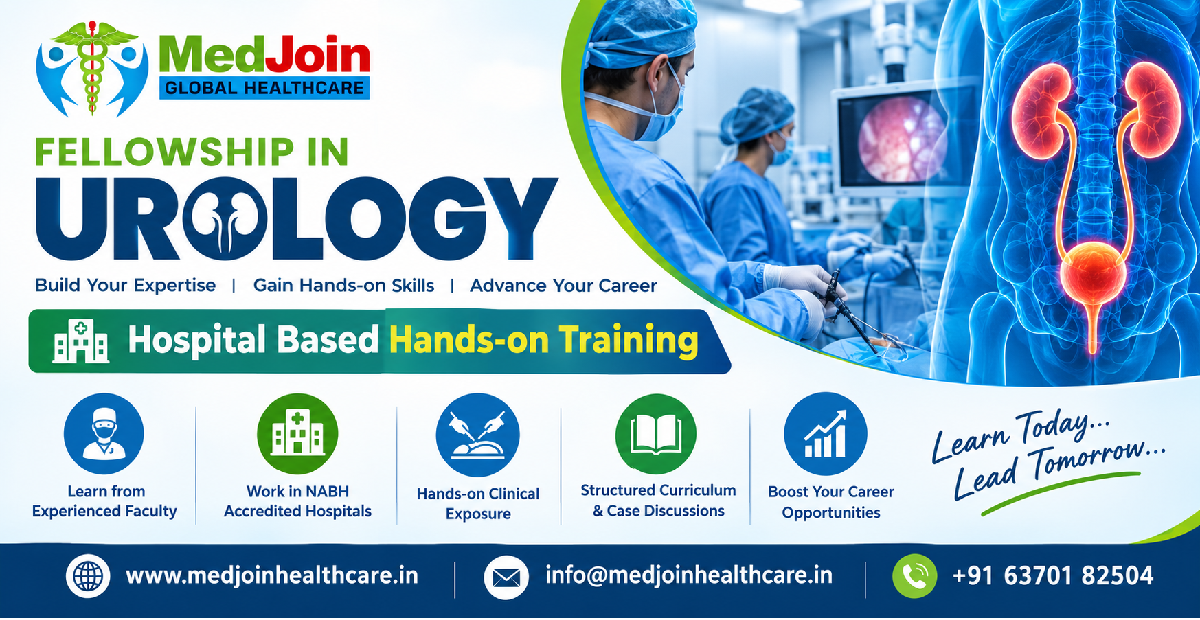
Explore how a Fellowship in Urology can help medical graduates and practising doctors strengthen their understanding of urological diseases, diagnostic approaches, treatment planning, and clinical practice through structured hospital-based training. Discover the benefits, eligibility considerations, learning opportunities, and career scope of urology-focused fellowship programs with MedJoin Global Healthcare.
Introduction: Why Choose a Fellowship in Urology?
Urology is an important and evolving specialty of medicine that focuses on the urinary tract in males and females and the male reproductive system. It encompasses the evaluation and management of conditions affecting the kidneys, ureters, urinary bladder, urethra, prostate, testes, and related structures.
From urinary tract infections and kidney stones to prostate disorders, urinary obstruction, male infertility, and urological cancers, urology involves a wide range of clinical conditions. Advances in diagnostic imaging, endoscopic procedures, minimally invasive surgery, laser technology, and robotic-assisted surgery have further expanded the field.
For doctors who want to develop a stronger understanding of this specialty, a Fellowship in Urology may provide a structured learning opportunity to explore urological diseases, clinical assessment, diagnostic investigations, treatment principles, and patient management.
Hospital-based hands-on training can be particularly valuable because it introduces learners to the practical environment in which urological conditions are evaluated and managed. Depending on the program, training may include supervised clinical observation, case discussions, outpatient exposure, ward rounds, operating-room observation, and demonstrations of relevant procedures.
MedJoin Global Healthcare aims to provide educational opportunities that help doctors expand their clinical knowledge and explore specialty-focused learning pathways.
However, it is important to understand that a fellowship certificate alone does not confer specialist registration, surgical privileges, or independent practice rights. Eligibility for clinical responsibilities depends on the doctor's existing qualifications, applicable regulations, institutional credentialing, and the nature of the training program.
This guide explores the Fellowship in Urology in detail, including its learning objectives, hospital-based training, potential benefits, eligibility, curriculum, career opportunities, and factors to consider before enrolling.
1. What Is a Fellowship in Urology?
A Fellowship in Urology is a structured educational or clinical training program designed to develop knowledge of diseases and disorders affecting the urinary system and male reproductive health.
The duration, curriculum, eligibility criteria, and practical exposure vary by institution and program. Some offerings focus on theoretical learning and clinical case discussions, while others provide supervised exposure in a hospital setting.
A hospital-based program may allow doctors to observe how urology teams evaluate patients, interpret investigations, discuss treatment options, and coordinate care across specialties.
Depending on the program's design, the educational experience may cover:
- Anatomy and physiology of the urinary tract.
- Common urological symptoms and presentations.
- Evaluation of kidney and urinary tract disorders.
- Urinary stone disease and its management principles.
- Benign prostatic enlargement and lower urinary tract symptoms.
- Urinary infections and obstruction.
- Urological emergencies.
- Male reproductive and sexual health conditions.
- Urological oncology.
- Diagnostic imaging and endoscopic techniques.
- Perioperative care and postoperative monitoring.
- Patient counselling and multidisciplinary case management.
A fellowship may be relevant to doctors seeking additional knowledge in a focused area of medicine, but its professional value depends on the curriculum, clinical supervision, teaching faculty, institutional recognition, and the learner's existing qualifications.
Fellowship in Urology vs. Formal Specialist Training
A fellowship and a formally recognised postgraduate specialty qualification are not necessarily equivalent.
Formal specialist training generally follows a defined regulatory and educational pathway. A private educational fellowship may instead provide additional knowledge, supervised exposure, or professional development.
Before enrolling, doctors should verify whether the program is academic, observational, skills-based, or a recognised specialist-training pathway. They should also confirm whether the credential is accepted for their intended professional purpose.
2. Why Is Urology an Important Medical Specialty?
Urological conditions can significantly affect a patient's comfort, kidney function, urinary health, reproductive health, and quality of life. Some conditions require routine outpatient management, while others demand urgent assessment or specialist intervention.
Urology combines medical knowledge, diagnostic reasoning, procedural skills, and, in appropriately qualified specialists, surgical expertise.
2.1 Increasing Need for Urological Evaluation
Many urological problems become more common with advancing age, although they can affect people of all ages. Kidney stones, urinary infections, prostate disorders, urinary incontinence, and certain urinary tract abnormalities are encountered across a range of clinical settings.
Doctors in general practice, emergency medicine, internal medicine, nephrology, geriatrics, and other specialties may benefit from understanding common urological presentations and recognising when referral is necessary.
2.2 Advances in Diagnostic Technology
Modern urology uses a variety of diagnostic methods, including ultrasound, CT imaging, MRI when indicated, laboratory testing, uroflowmetry, cystoscopy, and selected urodynamic investigations.
Understanding the purpose, limitations, and clinical interpretation of these investigations can help doctors develop a more systematic approach to patient evaluation.
2.3 Minimally Invasive Treatment Approaches
Many urological procedures use endoscopic or minimally invasive techniques. Examples include ureteroscopy, cystoscopy, transurethral procedures, and selected laparoscopic or robotic-assisted operations.
Exposure to these techniques can help learners understand procedural indications, patient preparation, potential complications, and postoperative care. Performing such procedures, however, requires appropriate qualifications, supervised competency development, and institutional authorisation.
2.4 Multidisciplinary Patient Care
Urological patients may require coordinated care involving radiologists, nephrologists, oncologists, anaesthesiologists, emergency physicians, and critical care teams.
Learning how these professionals collaborate is an important aspect of comprehensive clinical education.
3. What Is Hospital-Based Hands-On Training in Urology?
Hospital-based training introduces learners to the clinical environment in which urological conditions are assessed and managed.
The term “hands-on training” can describe different levels of practical exposure. It may include bedside learning, supervised clinical activities, simulation, procedure demonstrations, or participation in approved clinical tasks. It should not automatically be interpreted as permission to perform surgery or invasive procedures independently.
A high-quality program should clearly explain the nature and extent of its clinical exposure before admission.
3.1 Clinical Observation in Urology Outpatient Departments
Outpatient departments provide opportunities to understand how urologists evaluate patients with urinary symptoms and reproductive health concerns.
Under appropriate supervision, learners may observe the process of obtaining a medical history, assessing symptoms, reviewing investigations, and developing a differential diagnosis.
Common presentations discussed may include:
- Pain during urination.
- Blood in the urine.
- Recurrent urinary tract infections.
- Renal or ureteric colic.
- Increased urinary frequency.
- Difficulty initiating urination.
- Weak urinary stream.
- Urinary retention.
- Urinary incontinence.
- Scrotal pain or swelling.
- Elevated prostate-specific antigen (PSA) results requiring assessment.
The learning emphasis should be on clinical reasoning, patient safety, communication, and appropriate referral.
3.2 Ward Rounds and Inpatient Management
Hospital-based exposure may include supervised ward rounds and discussions about patients admitted for urological conditions.
Learners can explore how teams assess a patient's clinical progress, review laboratory results, monitor renal function, evaluate urinary output, and identify potential complications.
Topics may include catheter care, postoperative monitoring, pain management, infection prevention, fluid balance, and discharge planning.
The exact activities depend on the hospital, the program's structure, patient consent, and the learner's authorised role.
3.3 Operating Theatre Observation
Operating theatre observation can introduce learners to the organisation and safety requirements of urological surgery.
Depending on access and the program, doctors may observe selected procedures and learn about:
- Preoperative patient assessment.
- Indications and contraindications.
- Surgical preparation and sterile technique.
- Team roles in the operating theatre.
- Anaesthesia and patient monitoring.
- Basic principles of endoscopic urological procedures.
- Postoperative observation.
- Complication prevention and management principles.
Observation is not equivalent to operative competence. Any participation in procedures must be authorised, appropriately supervised, and consistent with local laws and institutional credentialing requirements.
3.4 Diagnostic Investigation Review
A structured fellowship may include discussions about diagnostic investigations and how their results influence clinical decisions.
Examples include:
- Urinalysis and urine culture.
- Renal function tests.
- Ultrasound of the kidneys, bladder, and prostate.
- CT imaging for suspected urinary stone disease when indicated.
- Selected MRI applications.
- Uroflowmetry and post-void residual measurement.
- Cystoscopy findings.
- Urodynamic studies in appropriate cases.
- Histopathology and laboratory results in suspected malignancy.
Learning should focus on interpreting findings in their clinical context rather than relying on isolated test results.
3.5 Clinical Case Discussions
Case-based learning connects theoretical knowledge with actual clinical decision-making.
A typical discussion may examine a patient presenting with flank pain and haematuria. Learners could review the differential diagnosis, identify urgent warning signs, consider appropriate investigations, and discuss when specialist intervention may be necessary.
Other cases may involve acute urinary retention, recurrent infections, suspected prostate disease, or a patient with a possible urological malignancy.
Case discussions are particularly useful for developing structured reasoning and understanding how treatment decisions vary according to the patient's condition, medical history, investigation findings, and preferences.
3.6 Simulation and Skills Demonstrations
Where available, simulation can provide a controlled environment for learning selected procedural concepts.
Training may use models, demonstration equipment, videos, or supervised practice stations to introduce instrument handling and procedural principles.
Simulation does not replace the supervised clinical experience, formal competency assessment, or credentialing required for invasive procedures.
3.7 Patient Safety and Professional Conduct
Clinical education must place patient safety at the centre of the learning process.
Important principles include informed consent, confidentiality, infection prevention, appropriate documentation, respectful communication, and recognition of professional boundaries.
Learners should understand that access to patients, records, and clinical procedures is governed by hospital policy, patient consent, and applicable laws.
4. Major Areas Covered in a Fellowship in Urology
A comprehensive program may cover the following areas, depending on its approved curriculum.
4.1 Urological Anatomy and Physiology
A strong foundation in anatomy and physiology helps learners understand the causes, presentations, and management principles of urinary tract disorders.
Key topics include the kidneys, ureters, urinary bladder, urethra, prostate, testes, and associated structures. Relevant physiological concepts include urine production, urinary drainage, bladder storage and emptying, and aspects of male reproductive function.
4.2 Urinary Tract Infections
Urinary tract infections range from uncomplicated infections to complicated infections involving systemic illness or obstruction.
An educational module may cover clinical presentation, risk factors, appropriate investigations, antimicrobial stewardship, prevention, and recognition of severe infection.
Learners should understand when suspected infection requires urgent evaluation, particularly when accompanied by sepsis, obstruction, or significant clinical deterioration.
4.3 Kidney Stones and Urinary Stone Disease
Urinary stone disease is a common reason for urological consultation.
Training may cover the pathophysiology of stone formation, typical symptoms, diagnostic imaging, pain management principles, metabolic risk factors, and recurrence prevention.
Procedural topics may include the indications and principles of extracorporeal shock wave lithotripsy, ureteroscopy, and percutaneous nephrolithotomy.
The appropriate treatment depends on stone size, location, composition, obstruction, infection, renal function, and patient-specific factors.
4.4 Benign Prostatic Hyperplasia
Benign prostatic hyperplasia (BPH) can contribute to lower urinary tract symptoms, particularly in older men.
Relevant learning areas include symptom assessment, differential diagnosis, examination, appropriate investigations, medication principles, and indications for specialist referral or procedural treatment.
Learners should also understand that urinary symptoms can have causes other than BPH and should not automatically be attributed to prostate enlargement.
4.5 Urological Emergencies
Recognising time-sensitive urological conditions is essential for safe clinical practice.
Educational topics may include acute urinary retention, infected urinary obstruction, testicular torsion, significant urinary tract trauma, and other urgent presentations.
A program should teach recognition of warning signs, initial assessment within the learner's professional scope, stabilisation principles, and timely escalation to qualified specialists.
4.6 Urological Oncology
Urological oncology focuses on cancers affecting organs such as the prostate, bladder, kidney, and testis.
A curriculum may cover presenting symptoms, risk factors, diagnostic investigations, staging concepts, pathology reports, treatment options, and multidisciplinary care.
The objective is to understand the diagnostic and treatment pathway, including the roles of surgery, systemic therapies, radiotherapy, and surveillance where appropriate.
4.7 Male Reproductive and Sexual Health
Some urology curricula include male infertility, erectile dysfunction, testicular disorders, and other reproductive health concerns.
Learners may explore history-taking, relevant investigations, counselling, referral pathways, and the relationship between reproductive symptoms and broader health conditions.
Sensitive consultations require privacy, respectful communication, and appropriate consent.
4.8 Female Urology and Urinary Incontinence
Female urology may include urinary incontinence, recurrent infections, bladder dysfunction, and selected pelvic floor-related problems.
Training may cover the clinical assessment of symptoms, relevant investigations, conservative treatment principles, and indications for specialist referral.
4.9 Paediatric Urology
Depending on the curriculum, learners may be introduced to congenital urinary tract abnormalities, vesicoureteral reflux, undescended testes, hypospadias, and selected paediatric urinary problems.
Paediatric care requires age-appropriate assessment, family-centred communication, and referral to appropriately trained specialists.
4.10 Endourology and Minimally Invasive Techniques
Endourology involves the use of endoscopic instruments and related techniques to diagnose or treat selected urinary tract conditions.
An educational program may introduce cystoscopy, ureteroscopy, transurethral procedures, and other minimally invasive approaches.
The curriculum should distinguish clearly between theoretical teaching, observation, simulation, supervised procedural exposure, and independently assessed competency.
5. Potential Benefits of a Fellowship in Urology
The benefits of a fellowship depend on the learner's background, program quality, clinical access, and intended career pathway.
5.1 Improved Understanding of Urological Diseases
A structured curriculum can help doctors organise their knowledge of common and complex urological presentations.
Learners may become more familiar with differential diagnosis, relevant investigations, treatment principles, and indications for specialist referral.
5.2 Exposure to Hospital-Based Clinical Practice
Hospital-based education provides a setting in which learners can connect academic concepts with clinical workflows.
Where permitted, exposure to outpatient consultations, ward rounds, procedure demonstrations, and multidisciplinary meetings can help doctors understand how urological services function in practice.
5.3 Development of Clinical Reasoning
Case-based learning can strengthen a doctor's ability to evaluate symptoms systematically, identify red flags, consider differential diagnoses, and interpret investigations in context.
These skills may be useful in several clinical settings, including general practice, emergency medicine, internal medicine, and other specialties that encounter patients with urinary symptoms.
5.4 Understanding Diagnostic Pathways
Doctors can learn how different investigations contribute to the assessment of urinary tract disorders.
Understanding the appropriate use and limitations of diagnostic tests may support more informed clinical discussions and referrals.
5.5 Familiarity With Modern Urological Procedures
Exposure to demonstrations or supervised observation of endoscopic and minimally invasive procedures can help learners understand procedural indications, preparation, safety considerations, and postoperative care.
Actual procedural competence requires training appropriate to the procedure, formal assessment, and the necessary professional authorisation.
5.6 Improved Patient Communication
Urological complaints can involve sensitive subjects, including urinary function, sexual health, and reproductive concerns.
Structured learning can help doctors develop respectful communication skills, explain investigations, address patient concerns, and understand the importance of privacy and informed consent.
5.7 Multidisciplinary Learning
Urology frequently overlaps with nephrology, oncology, radiology, emergency medicine, geriatrics, and critical care.
Learning about multidisciplinary decision-making can help doctors appreciate the value of coordinated patient care.
5.8 Continuing Professional Development
A fellowship may form part of a doctor's broader professional development plan.
Before enrolling, doctors should check whether the program provides recognised continuing professional development credits or any other formal recognition. Such recognition should never be assumed from the word “fellowship” alone.
5.9 Career Exploration
For doctors considering a future interest in urology, a structured educational program may help them assess whether the specialty aligns with their interests.
It can also clarify the difference between gaining additional clinical knowledge and pursuing the formal qualifications required to become a practising urologist.
5.10 Greater Confidence Within Existing Professional Scope
Relevant education may help doctors feel better prepared to identify urological concerns, discuss common conditions, and recognise when referral is appropriate.
Confidence should always be supported by demonstrated competence, current clinical guidance, and adherence to the boundaries of the doctor's qualifications.
6. Who Should Consider a Fellowship in Urology?
The suitability of a program depends on its stated eligibility criteria and the candidate's professional goals.
Potentially relevant groups include:
MBBS-qualified doctors: Doctors interested in developing a foundation in urological presentations, diagnostic approaches, and referral pathways may consider programs that explicitly accept their qualifications.
General practitioners and family physicians: Additional knowledge of urinary symptoms, common urological disorders, and referral indications may be relevant to primary care.
Doctors in internal medicine: Understanding renal and urinary presentations can complement broader medical assessment, while recognising the distinction between nephrology and urology.
Emergency medicine doctors: Educational exposure to acute urinary retention, suspected testicular torsion, urinary obstruction, and other urgent presentations may support emergency assessment and escalation.
Surgical trainees and qualified surgeons: Depending on eligibility and curriculum, selected educational programs may offer relevant background in urological conditions and perioperative care.
Doctors exploring a formal urology career: A fellowship may offer an introduction to the specialty, but candidates should separately investigate the recognised postgraduate qualifications required for specialist practice.
A program should not imply that all medical graduates are eligible for independent urological practice after completing a short or private fellowship.
7. Eligibility Criteria for a Fellowship in Urology
Eligibility criteria vary across institutions and countries. Candidates should review the written admission requirements of the specific program.
Typical considerations may include:
- An MBBS degree or another explicitly accepted medical qualification.
- Valid medical registration where required.
- Relevant postgraduate qualifications or clinical experience for advanced programs.
- Compliance with the hospital's clinical observership and training requirements.
- Identity and qualification verification.
- Professional indemnity and occupational health requirements, where applicable.
- Language proficiency and documentation for international applicants.
International candidates planning clinical exposure in India should confirm the applicable visa, registration, observership, and institutional requirements before making travel arrangements.
Important: Completion of a private fellowship does not automatically qualify a doctor for specialist registration or independent surgical practice in India or another country. Applicants should verify the status of the qualification with the relevant medical regulator and prospective employer.
8. Online vs. Hospital-Based Fellowship in Urology
The appropriate learning mode depends on the candidate's schedule, location, educational goals, and need for clinical exposure.
Online Fellowship
An online fellowship in urology program may be suitable for doctors seeking structured theoretical learning while continuing their existing professional responsibilities.
Depending on the course, learning resources may include recorded lectures, live sessions, reading materials, assessments, and clinical case discussions.
Potential advantages include flexibility, reduced travel requirements, and the ability to revisit educational content.
However, online education alone cannot provide the same environment as direct hospital observation or supervised clinical training.
Hospital-Based Fellowship
Hospital-based training can offer exposure to clinical workflows, patient assessment, inpatient care, diagnostic pathways, and procedural demonstrations, subject to the institution's arrangements.
Potential advantages include:
- Learning in a real clinical environment.
- Opportunities to observe consultations and case discussions.
- Exposure to relevant investigations and treatment planning.
- Understanding of hospital protocols and patient safety.
- Opportunities for interaction with clinical faculty.
- Better appreciation of multidisciplinary care.
The actual experience varies by hospital, department, duration, case availability, and the learner's permitted level of participation.
Hybrid Fellowship
A hybrid program combines online academic learning with a defined period of hospital-based exposure.
This model may help doctors build theoretical knowledge before applying it to supervised case observation and clinical discussions.
Before admission, candidates should confirm the number of online and hospital-based months, the training location, the nature of practical exposure, the assessment method, and the exact certificates awarded.
9. What to Expect During Hospital-Based Training
A well-organised hospital-based learning experience should have clearly stated objectives, defined supervision arrangements, and a structured schedule.
The following is an illustrative framework rather than a representation of a specific MedJoin Global course schedule.
Phase 1: Orientation and Foundations
The initial phase may introduce learners to hospital protocols, patient confidentiality, infection prevention, urological anatomy, and common clinical presentations.
Learning objectives can include understanding the patient journey from initial consultation through investigation, treatment planning, and follow-up.
Phase 2: Outpatient Department Exposure
Learners may observe consultations and discuss cases involving kidney stones, urinary symptoms, prostate disorders, and other common presentations.
Teaching should focus on structured history-taking, relevant examination concepts, differential diagnosis, and appropriate investigations.
Phase 3: Inpatient and Ward-Based Learning
Where available, ward-based learning may cover patient monitoring, urinary catheter care principles, postoperative observation, fluid balance, infection prevention, and escalation of clinical concerns.
Phase 4: Procedure and Investigation Observation
Depending on access, learners may observe selected endoscopic procedures, review diagnostic imaging, or attend discussions about operative and non-operative treatment options.
All clinical activity must remain within the learner's authorised role.
Phase 5: Case Presentations and Assessment
Learners may present selected cases, discuss management pathways, complete written assessments, or participate in faculty-led reviews.
Assessment methods should be explained before enrolment and should reflect the program's stated educational objectives.
Phase 6: Feedback and Completion
A structured program should provide feedback on learning progress and explain its completion requirements.
Candidates should confirm whether they receive an attendance certificate, a course-completion certificate, a clinical observership certificate, or another credential. These documents can have different meanings and should not be described interchangeably.
10. Illustrative Curriculum for a Fellowship in Urology
The following topics can serve as a curriculum-planning framework. They are not a claim that every subject is included in a particular MedJoin Global program.
| Module | Suggested learning areas |
|---|---|
| Module 1 | Urological anatomy and physiology |
| Module 2 | Clinical history-taking and examination principles |
| Module 3 | Urinary tract infections and antimicrobial stewardship |
| Module 4 | Kidney stones and urinary obstruction |
| Module 5 | Benign prostatic hyperplasia and lower urinary tract symptoms |
| Module 6 | Urological emergencies and referral pathways |
| Module 7 | Diagnostic imaging and laboratory interpretation |
| Module 8 | Endourology and minimally invasive procedure principles |
| Module 9 | Urological oncology |
| Module 10 | Male reproductive and sexual health |
| Module 11 | Female urology and urinary incontinence |
| Module 12 | Perioperative care, complications, and patient safety |
| Module 13 | Clinical case discussions and multidisciplinary care |
| Module 14 | Assessment, feedback, and professional development |
The final curriculum should be adapted to the learner's qualifications, program duration, teaching resources, and intended educational outcomes.
11. Career Scope After a Fellowship in Urology
The career opportunities available after a fellowship depend on the doctor's existing qualifications, professional registration, experience, and the status of the fellowship credential.
A fellowship can support additional learning, but it does not automatically establish eligibility for employment as a specialist urologist.
11.1 General Clinical Practice
Doctors who already practise in primary care or another medical setting may find selected urology-focused education useful for understanding common urinary symptoms and referral pathways.
The course should complement, not replace, the doctor's recognised qualifications and scope of practice.
11.2 Emergency and Acute Care Settings
Doctors working in emergency or acute care environments may benefit from learning about the initial assessment of urinary retention, suspected obstruction, testicular emergencies, and other time-sensitive presentations.
The purpose is to support appropriate assessment, stabilisation within scope, and timely specialist involvement.
11.3 Hospital-Based Medical Roles
Some doctors may pursue roles involving general clinical care, patient assessment, or coordination of care, depending on their qualifications and the employer's requirements.
A private fellowship certificate should not be assumed to meet the credentialing criteria for a specialist urology post.
11.4 Urology Department Observerships and Further Training
A fellowship may help candidates explore the specialty and prepare for additional formal education.
Doctors seeking a career as a urologist should investigate recognised postgraduate training pathways, eligibility requirements, entrance examinations where applicable, and licensing rules in their intended country.
11.5 Academic and Educational Activities
Doctors with suitable experience may use their additional knowledge in educational discussions, clinical presentations, or continuing learning activities.
Academic appointments and teaching responsibilities depend on institutional criteria, recognised qualifications, and relevant experience.
11.6 Research and Clinical Audit
Where appropriate, doctors may pursue research or clinical audit related to urinary tract disorders, patient pathways, outcomes, or quality improvement.
Research roles require suitable supervision, ethical approval where applicable, and adherence to data protection and publication standards.
11.7 Further Specialisation
Doctors who wish to develop a specialist career in urology should identify the formal qualifications required in their jurisdiction.
A focused fellowship may provide educational context, but advanced clinical responsibilities require the appropriate training, competency assessment, licensing, and institutional privileges.
12. Career Scope of Urology in India
India has a broad healthcare system comprising government hospitals, private hospitals, teaching institutions, multispecialty centres, and independent clinical practices.
Urology services are relevant to the diagnosis and management of urinary tract disorders, kidney stones, prostate conditions, urinary dysfunction, and urological cancers.
Doctors interested in the field should consider both the healthcare demand for urological services and the qualifications required to deliver them.
12.1 Hospital and Multispecialty Settings
Urologists may work in hospitals that provide outpatient consultations, diagnostic services, endourology, surgical care, oncology-related services, and follow-up.
Access to such positions depends on recognised specialist qualifications and the hospital's credentialing standards.
12.2 Teaching and Academic Institutions
Academic urology involves clinical care, teaching, research, and supervision of trainees. Such positions typically have formal qualification and experience requirements.
12.3 Independent Practice
Independent specialist practice requires the relevant recognised qualifications, registration, infrastructure, and compliance with applicable laws.
Completing an educational fellowship alone should not be interpreted as permission to establish an independent specialist urology service.
12.4 Career Planning for MBBS Doctors
For MBBS-qualified doctors, the most important step is to distinguish between short-term professional development and the formal pathway to becoming a urologist.
A fellowship may help them learn about the specialty, but they should confirm the recognised postgraduate qualifications required for their long-term goals.
13. International Career Considerations
Doctors outside India may consider urology-focused educational programs to expand their knowledge or explore further training opportunities.
However, professional recognition differs between countries.
Before enrolling, international applicants should check:
- Whether the institution and credential are recognised for their intended purpose.
- Whether their medical registration permits the planned clinical activity.
- Whether hospital-based exposure is observational or involves supervised practice.
- Whether local licensing authorities recognise the qualification.
- Whether the program provides formal credits, and whether those credits are accepted by relevant bodies.
- Whether visa and clinical placement requirements can be met.
International students should obtain written clarification before paying fees or travelling. No fellowship should be marketed as a guaranteed route to specialist registration, employment, immigration benefits, or independent surgical practice unless the relevant outcome is explicitly and verifiably authorised.
14. How to Choose the Right Fellowship in Urology
Choosing a program requires more than comparing course titles or advertised discounts. Doctors should evaluate the educational value, practical access, faculty, hospital arrangements, and credential awarded.
14.1 Review the Curriculum
Look for a curriculum that explains what you will study and how the learning objectives relate to your experience and goals.
Check whether it covers relevant urological conditions, diagnostic methods, patient safety, case discussions, and procedural principles.
14.2 Verify Hospital Affiliation
If hospital-based training is advertised, ask for the name and location of the hospital, the department responsible for training, and written confirmation of the placement arrangements.
Do not assume that every advertised course includes guaranteed operating theatre access or unrestricted patient contact.
14.3 Understand the Meaning of Hands-On Training
Ask for a clear description of practical activities.
For example, clarify whether the program includes clinical observation, simulation, bedside learning, supervised participation, or procedural demonstrations.
Ask which activities are permitted and how competency is assessed.
14.4 Evaluate Faculty and Supervision
Review the qualifications and experience of the faculty responsible for academic teaching and clinical supervision.
A credible program should explain who supervises learners, how feedback is delivered, and whom students can contact regarding clinical or academic concerns.
14.5 Confirm the Certificate
Check the exact name of the awarding institution, the certificate title, completion requirements, and any formal recognition or accreditation claimed.
Request documentary evidence of any stated accreditation and verify it with the relevant awarding or regulatory body.
14.6 Understand the Duration and Schedule
Confirm the total course duration, online learning hours, hospital placement dates, attendance requirements, and assessment schedule.
If you are a practising doctor, consider whether the schedule is compatible with your current clinical responsibilities.
14.7 Review Fees and Additional Costs
Ask for a written fee breakdown covering tuition, assessments, certificates, hospital placement, accommodation, travel, and any additional charges.
Clarify the refund policy, instalment schedule, and conditions under which a hospital placement may be rescheduled.
14.8 Ask About Learning Outcomes
A good program should describe what learners are expected to understand or demonstrate at completion.
Avoid relying on vague promises of guaranteed specialist status, guaranteed employment, or unrestricted surgical practice.
15. Why Consider MedJoin Global Healthcare?
MedJoin Global Healthcare provides specialty-focused educational opportunities for doctors and healthcare professionals. Its learning approach is designed to help participants strengthen clinical knowledge, explore focused areas of medicine, and pursue professional development around their existing responsibilities.
Doctors considering a urology-focused program should contact MedJoin Global Healthcare to confirm the current availability and exact structure of any Fellowship in Urology offering.
Before registration, request the following details:
- Current course availability and intake dates.
- Eligibility criteria and required documents.
- Course duration and delivery mode.
- Detailed academic curriculum.
- Hospital name and clinical training location, if applicable.
- Duration and nature of hospital-based exposure.
- Faculty and supervision arrangements.
- Assessment methods and completion criteria.
- Certificate title and awarding institution.
- Total fees, payment schedule, and refund policy.
If a hospital-based placement is available, request written confirmation of the placement, the scope of activities, and any additional requirements.
16. Who Should Choose Hospital-Based Training Instead of Online Learning?
Hospital-based training may be more suitable for doctors who want to understand clinical workflows and observe how urological teams evaluate and manage patients.
Online learning may be more practical for candidates who need scheduling flexibility or cannot travel for a placement.
The choice should depend on the candidate's learning objectives.
Choose a hospital-based option when:
- You want exposure to the clinical environment.
- You learn effectively through supervised observation and case discussions.
- You can attend the specified hospital and dates.
- You want to understand the practical organisation of urological services.
- The program clearly defines its clinical activities and supervision.
Choose an online option when:
- You need to study around your current work.
- You want to build theoretical knowledge first.
- You cannot travel to the training location.
- The course provides suitable educational resources and case-based learning.
Neither format should be assumed to confer specialist registration or independent procedural privileges.
17. Common Challenges in Urology and the Value of Structured Learning
Urology involves a diverse range of presentations, and doctors must understand how to identify common conditions while recognising potentially serious disease.
Challenge 1: Overlapping Symptoms
Urinary frequency, pain, haematuria, and difficulty urinating can have multiple causes.
Structured learning can help doctors develop a systematic differential diagnosis and understand when further investigation is necessary.
Challenge 2: Identifying Urgent Conditions
Some presentations, such as suspected testicular torsion or infected urinary obstruction, require urgent assessment.
Educational programs can help learners recognise warning signs and understand escalation pathways.
Challenge 3: Selecting Appropriate Investigations
The value of a test depends on the clinical question and the patient's circumstances.
Learning about indications, limitations, and interpretation can help doctors understand diagnostic decision-making.
Challenge 4: Understanding Procedural Treatment
Many urological conditions have medical, endoscopic, and surgical treatment options.
Case discussions and procedural observation can help learners understand how treatment choices depend on clinical findings, risks, patient preferences, and specialist assessment.
Challenge 5: Communicating Sensitive Information
Urinary and reproductive symptoms can be difficult for patients to discuss.
Training in respectful communication, confidentiality, and informed consent can help doctors provide more patient-centred care.
18. Frequently Asked Questions About a Fellowship in Urology
Q1. What is a Fellowship in Urology?
A Fellowship in Urology is a structured educational program focused on diseases of the urinary tract and male reproductive system. Its curriculum and clinical exposure depend on the institution and the specific program.
Q2. Is hospital-based hands-on training available in a Fellowship in Urology?
Some programs offer hospital-based clinical exposure, which may include supervised observation, case discussions, ward rounds, diagnostic review, and procedure demonstrations. Availability and the exact activities must be confirmed with the provider.
Q3. Can an MBBS doctor enrol in a Fellowship in Urology?
Eligibility depends on the specific course. Some educational programs may accept MBBS-qualified doctors, while advanced clinical programs may require additional qualifications or experience. Candidates should review the written admission criteria.
Q4. Does a Fellowship in Urology make me a qualified urologist?
No. A private fellowship certificate does not automatically confer recognised specialist status. Becoming a practising urologist requires the relevant recognised qualifications, registration, and compliance with the regulations of the country where the doctor intends to practise.
Q5. What is the difference between an online and hospital-based fellowship?
An online fellowship primarily provides academic learning through digital resources and case discussions. A hospital-based program may add clinical observation and supervised exposure to the hospital environment. Neither format should be assumed to provide independent procedural privileges.
Q6. What subjects are covered in a Fellowship in Urology?
Depending on the curriculum, subjects may include urinary tract infections, kidney stones, prostate disorders, urological emergencies, diagnostic imaging, urological oncology, male reproductive health, urinary incontinence, and endourological principles.
Q7. How long does a Fellowship in Urology take?
The duration varies by provider. Candidates should verify the advertised course length, attendance requirements, clinical placement period, and assessment schedule before enrolling.
Q8. What career opportunities are available after the fellowship?
The fellowship may support professional development and further learning. Career opportunities depend on existing qualifications, registration, experience, and employer requirements. Specialist urology positions generally require recognised specialist training.
Q9. Can I perform urological surgery after completing a fellowship?
Completion of a fellowship alone does not authorise independent surgery. Surgical practice requires appropriate qualifications, supervised competency development, registration, and hospital privileges.
Q10. Does the fellowship include a hospital certificate?
Certificate arrangements vary. Ask the provider to confirm the awarding institution, exact certificate title, completion requirements, and whether the hospital issues a separate clinical observership or training certificate.
Q11. Is the fellowship recognised by the National Medical Commission (NMC)?
Recognition should be verified for the specific credential and intended purpose. Do not assume that a private fellowship is an NMC-recognised postgraduate specialist qualification. Ask for written evidence of any recognition claimed and verify it with the relevant authority.
Q12. Can international doctors apply?
International applicants should confirm eligibility, document requirements, and whether their qualifications are accepted. They must also verify the registration, visa, observership, and hospital requirements applicable to any clinical placement.
Q13. Is a fellowship useful for general practitioners?
A suitable urology-focused educational program may help general practitioners strengthen their understanding of urinary symptoms, common urological conditions, and referral indications. It does not expand their legal scope of practice automatically.
Q14. What should I check before joining?
Review the curriculum, eligibility, faculty, hospital placement, clinical activities, assessment, certificate, recognition claims, total fee, refund policy, and written terms of enrolment.
Q15. How can I enquire about a Fellowship in Urology with MedJoin Global Healthcare?
Visit the MedJoin Global Healthcare website or contact its team to ask about current course availability, eligibility, learning mode, clinical exposure, fees, and certificate details.
19. Final Thoughts: Is a Fellowship in Urology Worth Considering?
A Fellowship in Urology may be a useful educational option for doctors who want to deepen their understanding of urinary tract disorders, diagnostic reasoning, clinical management, and modern urological care.
Hospital-based training can add value by introducing learners to real clinical workflows, case discussions, diagnostic pathways, and the role of multidisciplinary teams. The quality of that experience depends on the hospital, supervision, curriculum, and the actual activities permitted during the placement.
The most important consideration is to select a program that aligns with your career goals and clearly explains what you will learn, what clinical exposure is included, and what credential you will receive.
For doctors seeking to become practising urologists, a private fellowship should be viewed as supplementary education rather than a replacement for the recognised specialist-training pathway.
With careful evaluation and realistic expectations, focused education can form part of a broader plan for clinical learning and professional development.
Enquire About a Fellowship in Urology With MedJoin Global Healthcare
Are you a doctor interested in expanding your knowledge of urological conditions and exploring specialty-focused clinical education?
Connect with MedJoin Global Healthcare to enquire about available programs and request details of the curriculum, eligibility, hospital-based exposure, course duration, assessment, and certification.
Website: https://www.medjoinhealthcare.in
Email: info@medjoinhealthcare.in
Phone: +91 63701 82504
Contact the team to discuss your educational goals and identify a suitable learning pathway based on your qualifications and professional requirements.