
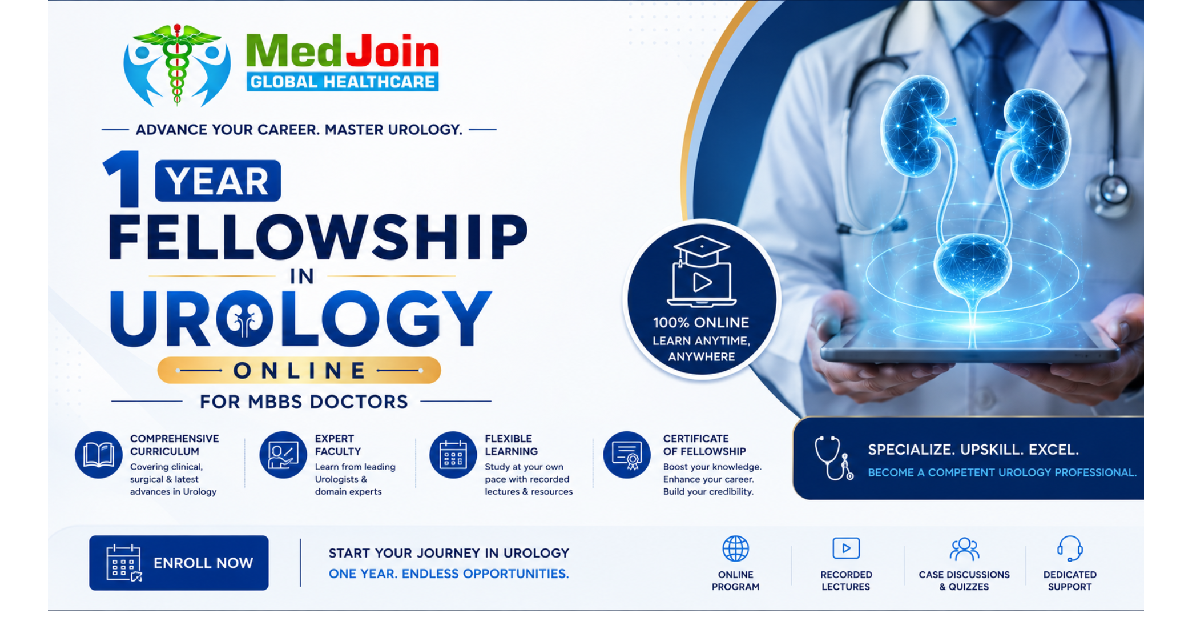
The field of Urology has emerged as one of the most technologically advanced and clinically rewarding specialties in modern medicine. With increasing prevalence of kidney stones, urinary tract disorders, prostate diseases, male infertility, urologic cancers, and minimally invasive surgical procedures, there is a growing demand for doctors trained in urological sciences. For MBBS doctors seeking specialization without pursuing long-duration super-specialty programs immediately, a 1-year online Fellowship in Urology offers an excellent pathway to enhance clinical expertise, surgical understanding, and career opportunities.
Modern fellowship programs combine online learning, live webinars, case-based discussions, virtual clinical exposure, and hospital observerships, enabling working doctors to continue their practice while upgrading their skills. These fellowships are designed to bridge the gap between general medicine and super-specialty urology training by providing practical exposure to diagnosis, investigations, emergency management, and procedural understanding in urological disorders.
Introduction to Urology
Urology is the branch of medicine dealing with diseases of the urinary tract system in both males and females and disorders of the male reproductive system. The specialty includes medical as well as surgical management of conditions involving:
- Kidneys
- Ureters
- Urinary bladder
- Urethra
- Prostate gland
- Penis
- Testes
- Adrenal glands
Urologists manage a wide spectrum of disorders ranging from urinary tract infections and kidney stones to complex cancers and reconstructive surgeries.
The specialty integrates:
- Diagnostic medicine
- Imaging
- Endoscopy
- Minimally invasive surgery
- Laser procedures
- Robotic surgery
- Emergency management
- Male reproductive health
The increasing burden of lifestyle diseases such as diabetes, obesity, hypertension, and metabolic syndrome has significantly contributed to the rise in urological disorders worldwide.
Why MBBS Doctors Should Pursue a Fellowship in Urology
1. Growing Demand for Urological Care
India and many developing nations are witnessing a sharp increase in:
- Kidney stone disease
- Benign Prostatic Hyperplasia (BPH)
- Chronic kidney disease
- Male infertility
- Erectile dysfunction
- Urological cancers
This has created a strong need for doctors trained in early diagnosis and management of urological conditions.
2. Opportunity to Upskill Without Leaving Practice
Traditional super-specialty programs like MCh or DNB Urology require years of dedicated training. Online fellowships provide:
- Flexible schedules
- Weekend classes
- Recorded lectures
- Online assessments
- Clinical observerships
This enables practicing doctors to continue their clinical work while upgrading their knowledge.
3. Enhanced Career Opportunities
A fellowship in urology can help doctors:
- Work in multispecialty hospitals
- Join urology clinics
- Assist in endourology procedures
- Improve emergency management skills
- Build referral-based practice
- Enhance academic profile
4. Better Clinical Confidence
Doctors gain confidence in:
- Interpreting urological imaging
- Managing urinary emergencies
- Evaluating hematuria
- Catheterization techniques
- Understanding surgical indications
- Managing male reproductive disorders
5. Exposure to Advanced Technologies
Modern urology is heavily technology-driven. Fellowship programs introduce learners to:
- Laparoscopic urology
- Laser surgery
- Endoscopy
- Robotic surgery concepts
- Ultrasound-guided procedures
- Urodynamic studies
What is a 1-Year Online Fellowship in Urology?
A 1-year online fellowship in urology is a structured postgraduate medical training program designed for MBBS doctors and healthcare professionals interested in developing expertise in urological sciences.
The program usually includes:
- Online live classes
- Recorded modules
- Case discussions
- Clinical assignments
- MCQ-based assessments
- Hospital-based observerships
- Mentorship by urologists
The duration is typically 12 months, often divided into:
- 8–10 months of online academic learning
- 1–2 months of clinical training or observership
Many programs are CPD accredited and designed for working professionals.
Eligibility Criteria
Most fellowship programs accept:
- MBBS graduates
- Medical officers
- General practitioners
- MD/MS doctors
- DNB doctors
- Final-year MBBS students
- International medical graduates
- AYUSH practitioners in selected programs
Eligibility may vary depending on the institution.
Objectives of the Fellowship Program
The major goals include:
- Understanding urological anatomy and physiology
- Learning diagnostic approaches in urology
- Managing common urological emergencies
- Understanding indications for surgery
- Developing imaging interpretation skills
- Learning evidence-based management
- Understanding minimally invasive procedures
- Improving patient counseling abilities
- Enhancing interdisciplinary coordination
Program Structure
1. Online Didactic Learning
Theoretical teaching is delivered through:
- Live online lectures
- Recorded video sessions
- Webinars
- Interactive discussions
- Clinical presentations
2. Case-Based Learning
Real clinical scenarios help doctors understand:
- Diagnostic reasoning
- Treatment planning
- Referral strategies
- Emergency stabilization
3. Clinical Observership
Hands-on exposure may include:
- OPD exposure
- OT assistance
- Endoscopy observation
- Catheterization techniques
- Ward rounds
- Imaging interpretation
4. Assessments
Evaluation methods include:
- MCQs
- Assignments
- Case presentations
- Viva voce
- Final examination
Detailed Curriculum of Fellowship in Urology
Module 1: Anatomy and Physiology
Topics Covered
- Anatomy of kidney
- Anatomy of ureter
- Anatomy of bladder
- Anatomy of prostate
- Anatomy of urethra
- Male reproductive anatomy
- Adrenal gland anatomy
- Renal physiology
Learning Outcomes
Doctors learn:
- Functional anatomy
- Neurovascular supply
- Pelvic floor anatomy
- Urinary continence mechanisms
Module 2: Urological Investigations
Imaging Techniques
Ultrasound
- KUB ultrasound
- Scrotal ultrasound
- Prostate ultrasound
CT Scan
- CT urography
- Stone protocol CT
MRI
- Prostate MRI
- Renal tumor imaging
Fluoroscopic Studies
- MCU
- RGU
- IVU
Endoscopic Evaluation
- Cystoscopy
- Ureteroscopy
Programs emphasize interpretation of imaging findings in common clinical conditions.
Module 3: Kidney Stone Disease
Kidney stones are among the most common urological disorders.
Topics Include
- Pathophysiology
- Stone composition
- Metabolic evaluation
- Imaging
- Medical management
- Prevention strategies
Procedural Concepts
- PCNL
- URSL
- ESWL
- RIRS
Emergency Conditions
- Obstructive uropathy
- Pyonephrosis
- Acute renal colic
Module 4: Urinary Tract Infections
Covered Topics
- Cystitis
- Pyelonephritis
- Recurrent UTI
- Catheter-associated infections
- Urosepsis
Clinical Skills
- Urine interpretation
- Antibiotic selection
- Prevention strategies
Module 5: Benign Prostatic Hyperplasia (BPH)
Clinical Areas
- LUTS evaluation
- IPSS scoring
- PSA interpretation
- Medical therapy
- TURP indications
Procedural Understanding
- TURP
- Laser prostate surgery
- HoLEP basics
Module 6: Urologic Oncology
One of the most important sections of the fellowship.
Renal Cancer
- Diagnosis
- TNM staging
- Surgical approaches
Bladder Cancer
- Hematuria workup
- TURBT concepts
- Chemotherapy overview
Prostate Cancer
- Screening
- MRI prostate
- Biopsy techniques
- Hormonal therapy
Testicular Cancer
- Tumor markers
- Orchiectomy concepts
Penile Cancer
- Risk factors
- Diagnosis
- Surgical principles
Fellowship programs emphasize early detection and referral planning.
Module 7: Male Sexual Health
Topics
- Erectile dysfunction
- Premature ejaculation
- Male infertility
- Hypogonadism
- Peyronie’s disease
Clinical Learning
- Counseling
- Hormonal evaluation
- Pharmacotherapy
- Referral indications
Module 8: Urological Emergencies
Acute Conditions
- Acute urinary retention
- Torsion testis
- Priapism
- Trauma
- Urosepsis
Emergency Procedures
- Foley catheterization
- Suprapubic catheter concepts
- Emergency stabilization
Module 9: Pediatric Urology
Common Conditions
- PUJ obstruction
- Vesicoureteral reflux
- Hypospadias
- Posterior urethral valves
- Undescended testes
Module 10: Reconstructive Urology
Topics Covered
- Urethral strictures
- Bladder reconstruction
- Urinary diversion
- Trauma repair concepts
Module 11: Endourology and Minimally Invasive Surgery
Modern urology relies heavily on minimally invasive techniques.
Areas Covered
- Endoscopic procedures
- Laser technologies
- Laparoscopic surgery
- Robotic surgery concepts
Advantages Discussed
- Reduced morbidity
- Faster recovery
- Better visualization
- Precision surgery
Module 12: Renal Transplantation Basics
Educational Areas
- Donor evaluation
- Recipient selection
- Immunosuppression basics
- Transplant complications
Learning Methodologies
1. Live Interactive Classes
Faculty members conduct:
- Weekly webinars
- Interactive lectures
- Q&A sessions
2. Recorded Lectures
Benefits include:
- Self-paced learning
- Revision flexibility
- Better retention
3. Virtual Simulations
Some advanced programs offer:
- Surgical simulations
- Procedure demonstrations
- Digital anatomy modules
4. Clinical Discussions
Case discussions improve:
- Decision-making
- Differential diagnosis
- Management planning
Skills Gained After Fellowship
After completion, doctors become proficient in:
- Evaluating urinary symptoms
- Interpreting radiology
- Identifying surgical conditions
- Managing common emergencies
- Counseling patients
- Coordinating specialist referrals
- Managing postoperative care
Advantages of Online Fellowship Programs
Flexibility
Doctors can learn without leaving practice.
Accessibility
Doctors from rural and remote areas can access quality education.
Cost-Effective Learning
Online programs are generally more affordable than full-time super-specialty training.
Updated Curriculum
Programs are frequently aligned with current clinical guidelines and technological advances.
Clinical Training Component
Many institutions provide hospital observerships where participants can observe:
- OPD consultations
- Endoscopic procedures
- Laser surgeries
- Ward management
- Urological emergencies
Clinical exposure remains a crucial part of fellowship training.
Role of Technology in Modern Urology
Modern urology is rapidly evolving with:
- AI-assisted imaging
- Robotic surgery
- Laser lithotripsy
- Telemedicine
- 3D laparoscopy
Doctors trained through fellowship programs become familiar with these evolving technologies.
Career Opportunities After Fellowship
1. Multispecialty Hospitals
Doctors may work in:
- Urology departments
- Emergency departments
- Surgical units
2. Private Practice
General practitioners can:
- Manage basic urology cases
- Improve referral networks
- Expand patient services
3. Day-Care Surgical Centers
Many minimally invasive procedures are now performed in day-care settings.
4. Academic Roles
Doctors can participate in:
- Teaching
- Research
- Clinical presentations
5. Telemedicine and Digital Health
Online consultation platforms increasingly require doctors with specialty exposure.
Fellowship vs MCh Urology
| Feature | Fellowship in Urology | MCh/DNB Urology |
|---|---|---|
| Duration | 1 year | 3 years |
| Mode | Online + observership | Full-time |
| Flexibility | High | Limited |
| Eligibility | MBBS/MD/MS | MS General Surgery |
| Focus | Clinical upskilling | Comprehensive super-specialty |
| Surgical exposure | Limited to observership | Extensive hands-on |
Importance of Early Urological Diagnosis
Many urological diseases remain undiagnosed due to lack of awareness.
Early diagnosis improves:
- Cancer survival
- Kidney preservation
- Fertility outcomes
- Quality of life
MBBS doctors trained in urology can significantly improve early detection.
Challenges in Urology Practice
Common Challenges
- Limited specialist availability
- Delayed diagnosis
- Rural healthcare gaps
- Increasing stone disease burden
- Aging population
Fellowship-trained doctors help bridge these healthcare gaps.
Scope of Urology in India
India has immense demand for urological services because of:
- Large population
- Increasing diabetes prevalence
- Rising kidney stone cases
- Aging male population
- Increased awareness about men’s health
The specialty offers excellent long-term career growth.
Importance of Evidence-Based Practice
Modern fellowship programs emphasize:
- Clinical guidelines
- Evidence-based management
- Rational antibiotic use
- Appropriate referral systems
This improves patient safety and healthcare quality.
Faculty and Mentorship
Most reputed programs are led by:
- Senior urologists
- Surgeons
- Radiologists
- Academic faculty
Mentorship helps doctors:
- Clarify doubts
- Discuss complex cases
- Improve confidence
Research Opportunities
Participants may engage in:
- Clinical audits
- Case reports
- Journal clubs
- Research methodology
Academic exposure strengthens future career prospects.
How to Choose the Right Fellowship Program
Consider the Following:
Accreditation
Look for:
- CPD accreditation
- University affiliation
- Recognized certification
Curriculum Quality
Ensure coverage of:
- Imaging
- Oncology
- Endourology
- Emergencies
Clinical Exposure
Prefer programs offering:
- Observerships
- Hospital rotations
- Procedure demonstrations
Faculty Expertise
Programs led by experienced urologists offer better mentorship.
Flexibility
Choose programs suitable for working professionals.
Future of Urology
The future of urology is highly promising due to:
- Robotic surgery expansion
- AI-driven diagnostics
- Personalized oncology
- Regenerative medicine
- Tele-urology
- Advanced lasers
Doctors trained today will become part of a rapidly evolving specialty.
Community Insights and Career Discussions
Medical communities frequently discuss the growing importance of fellowship and subspecialty exposure in urology, particularly in minimally invasive surgery, robotics, and endourology. Discussions among doctors also highlight increasing opportunities in private hospitals, academic centers, and corporate healthcare setups.
A 1-year online Fellowship in Urology for MBBS doctors is an excellent opportunity to gain structured knowledge and practical exposure in one of the most advanced branches of medicine. These programs combine flexibility, affordability, clinical relevance, and technological integration, making them highly suitable for working doctors and young medical graduates.
The fellowship equips doctors with the skills required to evaluate, diagnose, stabilize, and manage a wide range of urological conditions while enhancing their understanding of minimally invasive procedures, oncology, imaging, and male reproductive health.
As the burden of urological disorders continues to rise globally, fellowship-trained doctors will play a crucial role in improving patient outcomes, early diagnosis, emergency management, and specialized referral care.
Doctors who aspire to build expertise in urinary tract diseases, surgical sciences, and men’s health while maintaining their ongoing practice can greatly benefit from pursuing a structured online fellowship in urology.