
Kidney diseases have become one of the fastest-growing public health concerns worldwide. Millions of people suffer from chronic kidney disease (CKD), acute kidney injury (AKI), hypertension-related renal disorders, diabetic nephropathy, glomerular diseases, and electrolyte imbalances. With the increasing prevalence of diabetes, hypertension, obesity, cardiovascular diseases, and an aging population, the demand for qualified nephrology professionals has reached unprecedented levels.
For MBBS graduates and practicing physicians, developing expertise in nephrology is no longer limited to pursuing a traditional super-specialty degree. Fellowship programs have emerged as one of the most practical and career-focused pathways to acquire specialized knowledge, clinical competence, and hands-on experience in managing kidney diseases.
A 1-Year Fellowship in Nephrology equips doctors with the skills required to diagnose, treat, and manage renal disorders confidently. From understanding renal physiology to managing dialysis patients and transplant recipients, the fellowship prepares medical professionals to meet the growing healthcare demands in hospitals, dialysis centers, critical care units, and private practice.
At MedJoin Global Healthcare, the fellowship combines structured online learning with expert-led live sessions and optional hands-on clinical training under experienced nephrologists. The curriculum is designed to bridge the gap between theoretical education and real-world clinical practice, helping doctors become confident and competent nephrology practitioners.
Whether you are an MBBS doctor, general physician, emergency physician, or an early-career medical professional looking to expand your expertise, this fellowship provides a valuable opportunity to accelerate your career and improve patient outcomes.
Why Nephrology Has Become One of the Most Important Medical Specialties
Nephrology is the branch of medicine that focuses on the diagnosis, prevention, and treatment of kidney diseases. The kidneys play a critical role in maintaining homeostasis by regulating fluid balance, electrolytes, blood pressure, acid-base equilibrium, and waste elimination. Even minor dysfunction can have widespread systemic effects, making nephrology a cornerstone of modern medicine.
Over the past decade, kidney diseases have increased dramatically due to:
- Rising prevalence of diabetes mellitus
- Increasing hypertension cases
- Lifestyle-related metabolic disorders
- Population aging
- Cardiovascular diseases
- Obesity
- Autoimmune disorders
- Drug-induced nephrotoxicity
- Environmental and occupational exposures
This surge has created an urgent need for healthcare professionals trained in nephrology.
The Expanding Role of Nephrologists
Modern nephrologists manage far more than dialysis. Their responsibilities include:
- Early detection of kidney disease
- Prevention of CKD progression
- Management of electrolyte disorders
- Acid-base disturbances
- Hypertension control
- Glomerular diseases
- Critical care nephrology
- Dialysis management
- Kidney transplantation
- Renal emergencies
- Multidisciplinary patient care
As healthcare systems increasingly emphasize preventive care and chronic disease management, nephrology specialists are becoming indispensable.
Global Burden of Kidney Disease
Kidney disease is often referred to as a "silent epidemic" because many patients remain asymptomatic until the disease reaches an advanced stage.
Key Statistics
- Approximately 850 million people worldwide are affected by kidney diseases.
- Chronic Kidney Disease (CKD) affects nearly 10% of the global population.
- Diabetes and hypertension account for the majority of CKD cases.
- Millions require dialysis or kidney transplantation annually.
- CKD is among the leading causes of premature mortality worldwide.
The increasing burden of renal disease underscores the need for more trained nephrology professionals capable of delivering timely and effective care.
Kidney Disease in India
India faces a rapidly growing burden of kidney disease due to urbanization, changing lifestyles, and increasing rates of diabetes and hypertension.
Contributing Factors
- High prevalence of type 2 diabetes
- Poor hypertension control
- Limited awareness of kidney health
- Late diagnosis of CKD
- Rising obesity rates
- Increasing life expectancy
- Limited access to specialist care in rural areas
As a result, hospitals, dialysis centers, and healthcare organizations are actively seeking physicians with specialized nephrology training.
Why MBBS Doctors Should Pursue a Fellowship in Nephrology
Completing an MBBS degree provides a strong foundation in medicine, but today's healthcare environment increasingly values specialization. A fellowship in nephrology allows doctors to deepen their knowledge, refine clinical skills, and stand out in a competitive job market.
Benefits of Specialization
- Enhanced clinical expertise
- Better diagnostic abilities
- Improved patient management
- Increased confidence in treating complex renal disorders
- Greater employability
- Opportunities in multispecialty hospitals
- Higher earning potential
- Professional recognition
- Career advancement
Growing Demand
Specialized nephrology skills are needed in:
- Corporate hospitals
- Government hospitals
- Dialysis centers
- Intensive Care Units
- Emergency departments
- Organ transplant centers
- Medical colleges
- Research organizations
- Telemedicine platforms
- Private clinics
Doctors with fellowship training are often preferred because they can independently manage a wide range of renal conditions.
What Is a 1-Year Fellowship in Nephrology?
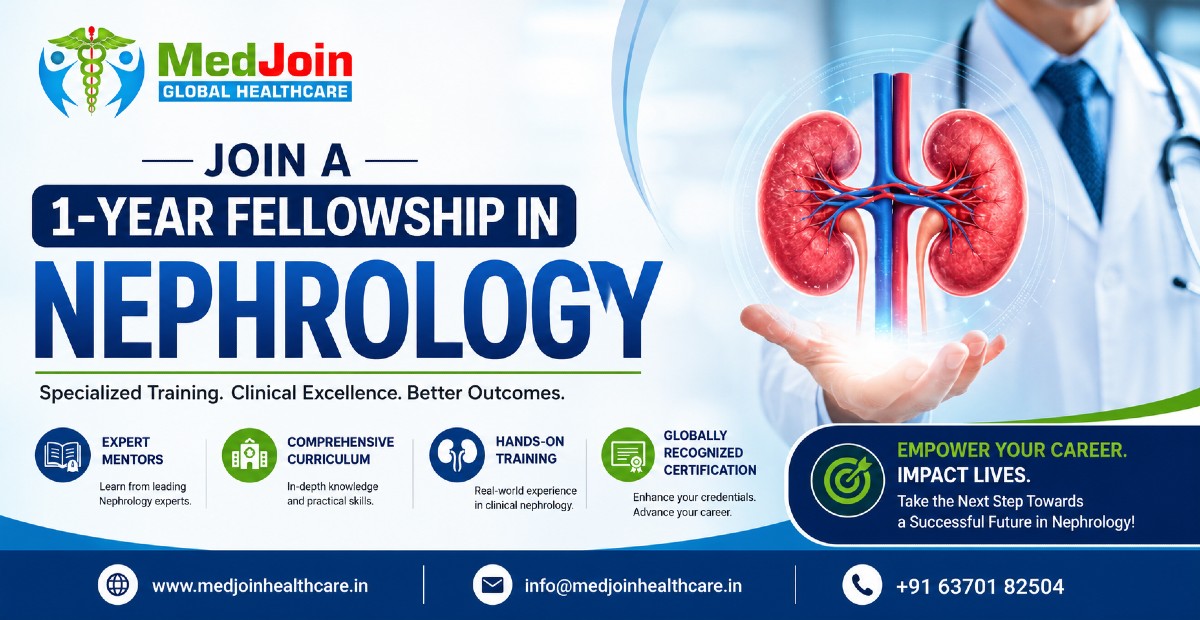
A 1-Year Fellowship in Nephrology is a structured postgraduate training program designed to provide comprehensive education in kidney diseases and renal medicine.
The program integrates theoretical learning with practical clinical exposure, enabling participants to develop competence in:
- Renal anatomy and physiology
- Acute Kidney Injury (AKI)
- Chronic Kidney Disease (CKD)
- Glomerular diseases
- Tubulointerstitial disorders
- Dialysis
- Renal transplantation
- Hypertension
- Electrolyte disorders
- Acid-base balance
- Renal pharmacology
- Critical care nephrology
- Evidence-based clinical practice
By the end of the fellowship, participants are equipped to deliver high-quality renal care across various healthcare settings.
Who Should Join This Fellowship?
This fellowship is ideal for:
- MBBS graduates
- General physicians
- Medical officers
- Emergency medicine practitioners
- Internal medicine doctors
- Critical care physicians
- Doctors preparing for specialization
- Healthcare professionals seeking career advancement
Whether you are beginning your medical career or looking to enhance your expertise, the fellowship offers a pathway to advanced clinical competence.
Why Choose MedJoin Global Healthcare?
MedJoin Global Healthcare has established itself as a trusted provider of industry-focused fellowship programs tailored for medical professionals. The nephrology fellowship is designed to combine academic rigor with practical applicability, ensuring participants gain skills that directly translate into improved patient care.
Key Features
- Comprehensive Curriculum: Covers foundational concepts to advanced nephrology topics.
- Flexible Learning: Online modules allow doctors to learn while continuing their clinical practice.
- Live Interactive Sessions: Regular expert-led discussions, case reviews, and Q&A sessions.
- Optional Hands-on Clinical Training: Opportunity to gain supervised experience in partner hospitals and dialysis units.
- Expert Faculty: Learn from experienced nephrologists and clinicians with extensive academic and practical backgrounds.
- Case-Based Learning: Real-world clinical scenarios to strengthen diagnostic reasoning and treatment planning.
- Assessment and Certification: Structured evaluations to reinforce learning and validate competency.
- Career-Oriented Approach: Designed to enhance employability and prepare doctors for roles in hospitals, dialysis centers, and specialty clinics.
Learning Methodology
The fellowship follows a blended approach:
- Self-paced online learning
- Recorded lectures
- Downloadable study materials
- Live interactive classes
- Clinical case discussions
- Practical demonstrations
- Optional hands-on hospital training
- Continuous assessments
- Final evaluation and certification
This integrated learning model ensures that participants develop both theoretical knowledge and practical clinical skills.
Program Highlights
- Duration: 1 Year
- Mode: Blended learning (Online + Optional Hands-on Clinical Training)
- Target Audience: MBBS doctors and medical practitioners
- Focus Areas: Kidney diseases, dialysis, renal emergencies, transplantation, hypertension, electrolyte disorders, and critical care nephrology
- Clinical Exposure: Opportunity to observe and participate in supervised nephrology practice
- Outcome: Advanced knowledge, enhanced clinical confidence, and career progression in nephrology
Why This Fellowship Matters
Kidney diseases are increasingly common, and their management requires a nuanced understanding of complex physiological processes and evidence-based treatment strategies. By undertaking a structured fellowship in nephrology, doctors can broaden their scope of practice, improve patient outcomes, and position themselves as skilled professionals in a high-demand specialty.
Whether your goal is to work in a tertiary care hospital, establish a specialized clinic, or enhance your capabilities in internal medicine, this fellowship provides the knowledge, practical skills, and confidence to succeed.