
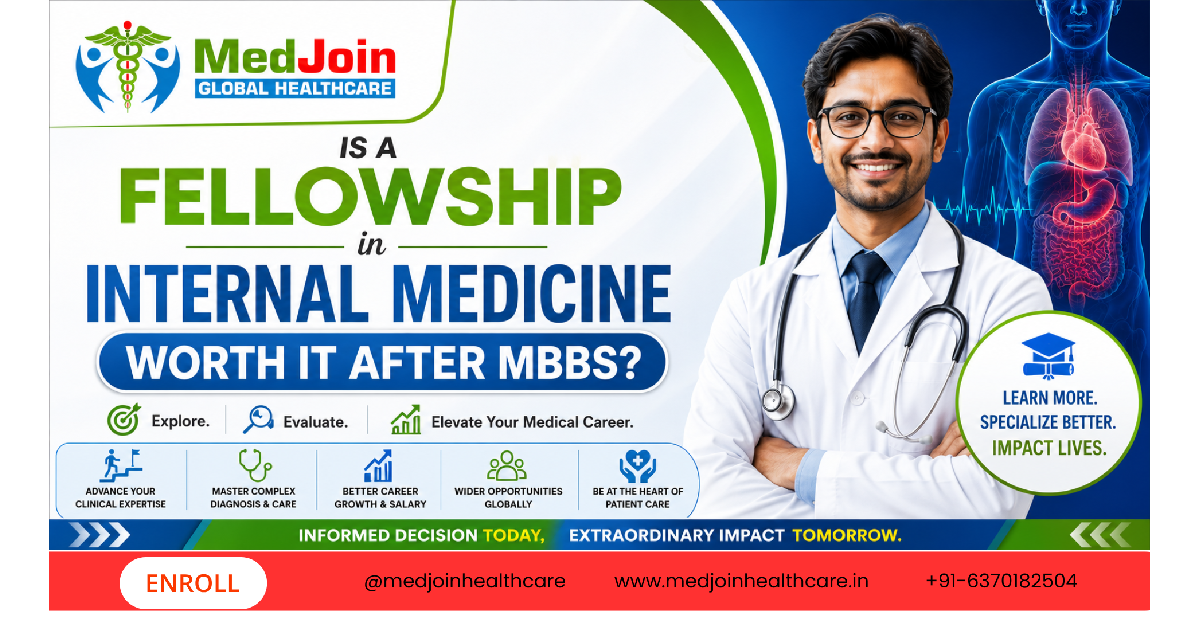
The journey after completing an MBBS degree is one of the most important phases in a doctor’s professional life. For many medical graduates, the next question becomes: “What should I do after MBBS?” Some doctors prepare for postgraduate entrance examinations, some begin practicing as general physicians, while others explore specialized fellowship programs that can accelerate their career growth.
Among the most popular options today is a Fellowship in Internal Medicine. With the rapid evolution of healthcare systems, increasing patient loads, lifestyle diseases, and the demand for highly skilled physicians, Internal Medicine has emerged as one of the most respected and rewarding branches in modern medicine.
However, many MBBS doctors still wonder:
- Is a Fellowship in Internal Medicine really worth it?
- Will it improve career opportunities?
- Does it help in getting better salaries?
- Can it strengthen clinical knowledge and confidence?
- Is it useful for doctors planning to work in India or abroad?
- How is it different from MD Medicine?
The answer depends on career goals, professional aspirations, and the desire for advanced clinical expertise. A Fellowship in Internal Medicine is not just another certification; it is an opportunity to gain structured training, practical exposure, clinical confidence, and specialization-oriented learning.
This detailed article explores every important aspect of pursuing a Fellowship in Internal Medicine after MBBS, including career scope, benefits, challenges, salary opportunities, skills gained, industry demand, future growth, and how fellowship programs are transforming the careers of modern doctors.
Understanding Internal Medicine
Internal Medicine is the branch of medicine that focuses on the prevention, diagnosis, and treatment of adult diseases. Physicians trained in Internal Medicine are known as internists. They manage complex medical conditions affecting multiple organ systems and are often considered the backbone of hospital medicine.
Internal Medicine deals with conditions such as:
- Diabetes mellitus
- Hypertension
- Thyroid disorders
- Respiratory diseases
- Infectious diseases
- Gastrointestinal disorders
- Cardiac conditions
- Kidney diseases
- Autoimmune disorders
- Critical care management
- Metabolic diseases
- Geriatric medicine
- Lifestyle disorders
An internist is trained to understand the entire body rather than focusing on only one organ system.
This broad-spectrum expertise makes Internal Medicine one of the most versatile and clinically intensive specialties.
Why MBBS Doctors Consider Fellowship Programs
After MBBS, many doctors feel uncertain about the next step. Several factors influence this uncertainty:
1. Intense Competition for PG Seats
In countries like India, postgraduate medical entrance exams are extremely competitive. Thousands of students compete for limited MD/MS seats every year.
As a result:
- Many talented doctors lose years preparing repeatedly.
- Career progression becomes delayed.
- Clinical confidence may decline during prolonged preparation.
- Financial independence gets postponed.
Fellowship programs provide an alternative route for skill enhancement and career development.
2. Need for Clinical Confidence
Many MBBS graduates feel they need more hands-on clinical exposure before independent practice.
A Fellowship in Internal Medicine offers:
- Clinical case discussions
- Practical exposure
- Patient management experience
- Emergency handling skills
- Diagnostic reasoning
- Exposure to hospital protocols
This helps doctors become more confident in real-world medical settings.
3. Rising Demand for Skilled Physicians
Modern healthcare systems need physicians who can:
- Handle multi-system disorders
- Manage chronic illnesses
- Interpret investigations effectively
- Coordinate patient care
- Manage emergencies
- Communicate efficiently with multidisciplinary teams
Internal Medicine training prepares doctors for these responsibilities.
4. Career Differentiation
The healthcare sector is highly competitive.
A fellowship adds value to a doctor’s profile by:
- Demonstrating advanced training
- Showing commitment to specialization
- Improving employability
- Enhancing professional credibility
What Is a Fellowship in Internal Medicine?
A Fellowship in Internal Medicine is an advanced clinical training program designed to strengthen a doctor’s expertise in adult medicine.
These programs typically focus on:
- Comprehensive patient evaluation
- Diagnostic medicine
- Chronic disease management
- Critical care basics
- Emergency medicine principles
- Clinical decision-making
- Hospital-based patient care
- Evidence-based medicine
Depending on the institution, fellowship programs may include:
- Online learning modules
- Clinical rotations
- Hands-on training
- Live case discussions
- Simulation-based learning
- Research projects
- Mentorship programs
- Assessments and certification
The duration can vary from 6 months to 2 years.
Is a Fellowship in Internal Medicine Worth It?
The simple answer is yes — for many MBBS doctors, it can be highly valuable.
However, the value depends on:
- Career goals
- Learning mindset
- Institution quality
- Clinical exposure
- Practical implementation
Let us explore the major reasons why it is worth pursuing.
1. Enhances Clinical Knowledge
One of the biggest advantages of an Internal Medicine fellowship is the expansion of clinical understanding.
MBBS provides broad foundational medical knowledge, but fellowship training helps doctors:
- Interpret symptoms more effectively
- Build differential diagnoses
- Understand disease progression
- Manage complicated cases
- Develop evidence-based treatment approaches
Doctors become more systematic and analytical in clinical practice.
Example
A patient presenting with fatigue could have:
- Anemia
- Hypothyroidism
- Depression
- Chronic kidney disease
- Diabetes
- Heart failure
- Autoimmune disease
Internal Medicine training helps doctors connect symptoms with systemic disease processes.
This diagnostic depth is extremely valuable in real-world medicine.
2. Builds Diagnostic Expertise
Modern medicine depends heavily on accurate diagnosis.
A fellowship sharpens skills in:
- Clinical examination
- History taking
- Laboratory interpretation
- ECG analysis
- Imaging correlation
- Risk assessment
- Differential diagnosis formulation
Doctors learn how to think like physicians rather than simply prescribing medications.
This diagnostic mindset improves patient outcomes significantly.
3. Improves Confidence in Patient Management
Many MBBS graduates initially lack confidence when handling complicated patients independently.
A fellowship helps bridge this gap.
Doctors learn:
- How to manage OPD patients
- Inpatient care protocols
- ICU basics
- Emergency stabilization
- Referral criteria
- Follow-up strategies
- Chronic disease management
This exposure gradually transforms hesitant graduates into confident clinicians.
4. Increases Employability
Healthcare organizations increasingly prefer doctors with additional certifications and specialized training.
A Fellowship in Internal Medicine can improve opportunities in:
- Hospitals
- Multispecialty clinics
- Emergency departments
- Telemedicine platforms
- Corporate healthcare
- Medical education
- Healthcare startups
- Rural healthcare programs
Employers often value fellowship-trained doctors because they require less supervision.
5. Creates Better Career Opportunities
Internal Medicine is one of the broadest and most flexible medical specialties.
After completing a fellowship, doctors can explore multiple career pathways.
Hospital-Based Physician
Doctors can work in:
- General medicine departments
- Emergency medicine units
- Critical care support teams
- Observation units
- Medical wards
Primary Care Specialist
Internists are highly effective in outpatient chronic disease management.
Academic Roles
Some fellowship-trained doctors enter:
- Teaching institutions
- Clinical training programs
- Medical education platforms
Telemedicine Careers
The rise of digital healthcare has created opportunities in:
- Virtual consultations
- Remote monitoring
- Chronic disease management
- AI-assisted healthcare systems
International Opportunities
Internal Medicine training is highly respected globally.
6. Helps During PG Preparation
Many doctors pursue fellowships while preparing for postgraduate entrance examinations.
This approach offers several advantages:
- Continued clinical exposure
- Better conceptual clarity
- Reduced career gaps
- Improved confidence
- Financial support through clinical work
Doctors remain connected to medicine rather than losing touch during preparation years.
7. Financial Benefits
While salary varies depending on experience and location, fellowship-trained doctors often earn more than fresh MBBS graduates.
Factors influencing salary include:
- Institution reputation
- Clinical skills
- Experience
- Geographic location
- Hospital type
- Additional certifications
Career Growth Potential
Doctors with Internal Medicine expertise may progress into:
- Senior physician roles
- Clinical coordinator positions
- ICU support teams
- Consultant pathways
- Administrative leadership
Over time, this can significantly improve earning potential.
8. Strong Foundation for Super-Specialization
Internal Medicine forms the basis for many super-specialties.
A strong foundation helps doctors later pursue:
- Cardiology
- Nephrology
- Gastroenterology
- Endocrinology
- Pulmonology
- Rheumatology
- Infectious diseases
- Critical care medicine
Doctors gain broader understanding before narrowing into subspecialties.
9. Develops Evidence-Based Practice Skills
Modern healthcare increasingly emphasizes evidence-based medicine.
Fellowship programs teach doctors how to:
- Read medical literature
- Understand clinical guidelines
- Evaluate research
- Apply evidence to practice
- Improve patient safety
This scientific approach enhances clinical decision-making.
10. Increases Respect and Professional Credibility
Patients and healthcare institutions often trust doctors who demonstrate continuous learning.
A fellowship shows:
- Dedication to medicine
- Commitment to advanced training
- Seriousness about clinical excellence
- Professional growth mindset
Enroll Now & Elevate Your Medical Career.