
Fellowship in Family Medicine: Fee, Career Scope & Benefits
Family Medicine is one of the most important areas of modern healthcare because it focuses on comprehensive, continuous, patient-centered care for individuals and families. As healthcare systems increasingly emphasize preventive medicine, early diagnosis, chronic disease management, community healthcare, and accessible primary care, doctors with broad clinical knowledge are becoming increasingly valuable.
For MBBS graduates, general practitioners, medical officers, and practicing doctors who want to strengthen their clinical knowledge, a Fellowship in Family Medicine can provide structured learning across multiple areas of medicine. Rather than focusing on a single organ system, Family Medicine develops a broader approach to patient assessment and management.
A well-structured fellowship can help doctors improve their understanding of internal medicine, pediatrics, women's health, geriatrics, preventive medicine, lifestyle disorders, mental health, emergency care, and other commonly encountered clinical areas.
According to the World Health Organization (WHO), primary healthcare provides the first level of contact between people and the healthcare system and encompasses promotive, preventive, curative, rehabilitative, and palliative services. WHO also emphasizes that strong primary healthcare is essential for achieving universal health coverage and improving population health.
This makes Family Medicine highly relevant to the future of healthcare.
In this comprehensive guide, we will discuss:
- What is Family Medicine?
- What is a Fellowship in Family Medicine?
- Why should doctors join a Fellowship in Family Medicine?
- Who is eligible?
- What does the fellowship curriculum cover?
- What clinical skills can doctors develop?
- Family Medicine fellowship fee
- Duration and learning mode
- Career scope after Family Medicine fellowship
- Benefits of Family Medicine fellowship
- Family physician career opportunities
- Private practice opportunities
- Hospital and clinic career options
- Telemedicine opportunities
- Preventive and lifestyle medicine
- Community healthcare opportunities
- Family Medicine and chronic disease management
- Future of Family Medicine
- Frequently asked questions
What Is Family Medicine?
Family Medicine is a broad medical discipline focused on providing comprehensive healthcare to individuals and families throughout different stages of life.
Unlike highly specialized branches that concentrate primarily on a particular organ, disease, or patient population, Family Medicine takes a wider view of the patient.
A family physician may encounter:
- Children
- Adolescents
- Adults
- Elderly patients
- Patients with acute illnesses
- Patients with chronic diseases
- Patients requiring preventive healthcare
- Patients requiring lifestyle counselling
- Patients requiring referral to specialists
The family physician therefore needs a broad clinical foundation and the ability to identify when a condition can be managed in primary care and when specialist evaluation is required.
Family Medicine combines clinical medicine with preventive healthcare, health education, continuity of care, and patient counselling.
The objective is not simply to treat an individual episode of illness but to understand the patient's overall health needs.
Why Is Family Medicine Important?
Healthcare is becoming increasingly complex.
Patients may have multiple diseases simultaneously. An adult patient may have diabetes, hypertension, obesity, dyslipidemia, and cardiovascular risk factors. An elderly patient may have several chronic conditions and may be taking multiple medications. A child may present with an acute infection while requiring preventive assessment and vaccination review.
This means doctors working in primary care need more than disease-specific knowledge.
They need to understand the patient as a whole.
Family Medicine supports this approach.
A family physician can contribute to:
- Early diagnosis
- Disease prevention
- Chronic disease management
- Health screening
- Lifestyle modification
- Patient education
- Medication monitoring
- Follow-up care
- Referral coordination
- Community healthcare
- Continuity of care
The importance of primary healthcare is also reflected in WHO's approach to health systems. Primary healthcare brings integrated services closer to communities and addresses health needs across the life course.
What Is a Fellowship in Family Medicine?
A Fellowship in Family Medicine is a structured professional education and clinical upskilling program designed to help eligible healthcare professionals develop broader knowledge and practical understanding of primary and family healthcare.
The fellowship may cover multiple areas of medicine rather than concentrating on one narrow specialty.
A typical Family Medicine curriculum can include:
- Internal Medicine
- Pediatrics
- Obstetrics and Gynecology
- Geriatric Medicine
- Emergency Medicine
- Preventive Medicine
- Lifestyle Medicine
- Psychiatry and mental health
- Dermatology
- Nutrition
- Infectious diseases
- Chronic disease management
- Community healthcare
- Clinical diagnosis
- Rational prescription
- Patient counselling
- Family practice management
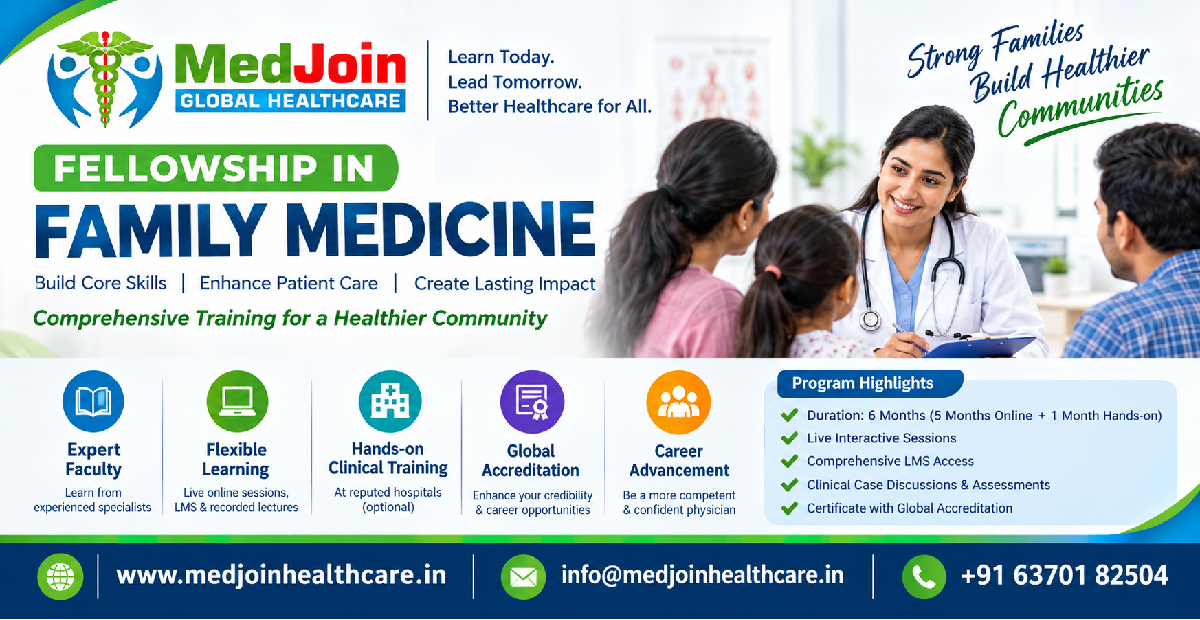
The current MedJoin Global Healthcare Family Medicine program is presented as a 12-month online fellowship, with online learning resources and a multidisciplinary curriculum.
The exact curriculum, faculty, clinical exposure, assessment method, certification structure, and fee should always be confirmed with the institution before enrollment.
Why Should You Join a Fellowship in Family Medicine?
There are many reasons doctors consider Family Medicine as a career-development pathway.
1. Develop Broad Clinical Knowledge
One of the biggest advantages of Family Medicine is its breadth.
Doctors encounter patients with different symptoms, age groups, risk factors, medical histories, and clinical presentations.
A fellowship can help doctors revise and strengthen their knowledge across multiple disciplines.
Instead of learning only about one disease or one organ system, the doctor develops a broader framework for evaluating patients.
This may include:
- History taking
- Physical examination
- Differential diagnosis
- Investigation selection
- Interpretation of common reports
- Treatment planning
- Follow-up
- Preventive care
- Referral decisions
Broad knowledge can be especially valuable for doctors working in outpatient departments, clinics, primary healthcare centers, emergency settings, and community healthcare.
2. Improve Clinical Decision-Making
Clinical medicine frequently involves uncertainty.
A patient may present with:
- Fever
- Chest discomfort
- Headache
- Abdominal pain
- Fatigue
- Breathlessness
- Dizziness
- Joint pain
- Weight loss
- Recurrent infections
The symptoms themselves may not immediately reveal the underlying diagnosis.
Family Medicine training emphasizes systematic clinical evaluation.
Doctors can learn to:
- Identify important symptoms.
- Take a structured medical history.
- Perform an appropriate examination.
- Develop differential diagnoses.
- Select relevant investigations.
- Interpret findings in clinical context.
- Develop a management plan.
- Identify red flags.
- Decide when specialist referral is required.
- Plan follow-up.
This structured approach can strengthen clinical confidence.
3. Learn to Manage Common Diseases Seen in Primary Care
Family physicians frequently encounter common medical conditions.
These may include:
- Hypertension
- Diabetes
- Obesity
- Thyroid disorders
- Asthma
- COPD
- Respiratory infections
- Gastrointestinal disorders
- Urinary tract infections
- Musculoskeletal conditions
- Skin disorders
- Common pediatric illnesses
- Menstrual problems
- Common gynecological conditions
- Geriatric health problems
A Family Medicine fellowship can help doctors organize their approach to these conditions and understand when further evaluation or specialist referral is appropriate.
4. Develop a Patient-Centered Approach
Modern healthcare is moving beyond disease-centered treatment.
Patients want doctors who listen to them, understand their concerns, explain treatment options, and support them over time.
Family Medicine emphasizes continuity and patient-centered care.
A family physician may know:
- The patient's medical history
- Family history
- Lifestyle
- Occupation
- Dietary habits
- Previous treatments
- Medication adherence
- Risk factors
- Social circumstances
- Long-term health goals
This broader understanding can support more personalized healthcare.
5. Strengthen Preventive Healthcare Skills
Prevention is an essential component of modern medicine.
Family physicians can play an important role in identifying risk factors before they become serious disease.
Preventive healthcare may include:
- Blood pressure screening
- Diabetes screening
- Obesity assessment
- Cardiovascular risk assessment
- Cancer screening awareness
- Vaccination
- Lifestyle counselling
- Smoking cessation
- Alcohol-risk counselling
- Nutrition counselling
- Physical activity counselling
- Mental health screening
- Geriatric assessment
WHO describes primary healthcare as including health promotion, disease prevention, treatment, rehabilitation, and palliative care.
Therefore, Family Medicine is closely aligned with the broader objective of improving health before disease becomes advanced.
6. Improve Chronic Disease Management
Chronic diseases are a major component of modern clinical practice.
Patients may require long-term management for:
- Diabetes mellitus
- Hypertension
- Dyslipidemia
- Obesity
- Asthma
- COPD
- Thyroid disorders
- Chronic kidney disease
- Cardiovascular disease
- Osteoarthritis
Family physicians often play an important role in monitoring these patients.
A structured Family Medicine program can help doctors understand:
- Risk-factor assessment
- Long-term monitoring
- Medication adherence
- Lifestyle modification
- Preventive screening
- Recognition of complications
- Patient education
- Referral requirements
The emphasis is on continuity rather than treating each consultation as an isolated event.
7. Gain Knowledge Across Different Age Groups
Family Medicine is unique because patients may belong to different age groups.
Doctors may encounter:
Pediatric patients
Including:
- Common childhood infections
- Growth and development
- Nutrition
- Immunization
- Common respiratory illnesses
- Gastrointestinal illnesses
Adult patients
Including:
- Diabetes
- Hypertension
- Cardiovascular risk
- Respiratory disease
- Gastrointestinal conditions
- Lifestyle disorders
Elderly patients
Including:
- Polypharmacy
- Mobility issues
- Cognitive concerns
- Chronic diseases
- Falls
- Frailty
- Functional limitations
Understanding these different age groups makes Family Medicine a broad and versatile clinical discipline.
8. Build Skills for Private Practice
Many doctors aspire to establish their own clinic.
Family Medicine can be particularly relevant to doctors interested in primary-care practice because the discipline covers a broad range of common healthcare needs.
A family-oriented clinic may provide services such as:
- General consultation
- Chronic disease follow-up
- Preventive health assessment
- Lifestyle counselling
- Health screening
- Basic clinical procedures
- Pediatric primary care
- Women's health counselling
- Geriatric care
- Referral coordination
However, doctors should practice within the scope permitted by their registration, applicable laws, institutional policies, and professional regulations.
A fellowship should therefore be viewed as a clinical education and skill-development pathway, not as a substitute for any legally required medical degree, registration, or statutory qualification.
9. Expand Career Flexibility
Family Medicine is broad, which can create multiple professional directions.
Depending on qualifications, registration, experience, and local regulations, doctors may explore opportunities in:
- Hospitals
- Clinics
- Polyclinics
- Primary healthcare centers
- Corporate healthcare
- Occupational health
- Telemedicine
- Community healthcare
- Rural healthcare
- Home healthcare
- Preventive health programs
- Healthcare organizations
- Medical education
- Healthcare administration
This flexibility is one of the reasons many doctors consider Family Medicine for career development.
10. Prepare for the Future of Primary Healthcare
Healthcare is changing.
Several trends are reshaping medicine:
- Aging populations
- Increasing chronic diseases
- Rising healthcare costs
- Preventive healthcare
- Digital health
- Telemedicine
- Remote monitoring
- Artificial intelligence
- Electronic health records
- Patient-centered care
These trends increase the importance of doctors who can integrate information and manage patients holistically.
Family Medicine is well positioned within this changing healthcare environment because it connects patients with the wider healthcare system.
Fellowship in Family Medicine: Course Duration
The duration of a Family Medicine fellowship depends on the institution and program structure.
The current MedJoin Family Medicine course page lists a 12-month duration and an online mode.
A one-year structure can provide sufficient time for doctors to work through multiple modules rather than attempting to cover Family Medicine through a very short course.
Before enrollment, applicants should verify:
- Course duration
- Learning mode
- Curriculum
- Assessment
- Examination
- Faculty
- Clinical exposure
- Certification
- Eligibility
- Fee
- Refund policy
- Any optional clinical training
- Applicable terms and conditions
Is EMI Available for a Family Medicine Fellowship?
Flexible payment options can make professional education more accessible to working doctors.
Where available, EMI plans can allow eligible learners to divide the course payment into manageable installments rather than paying the complete amount at once.
Doctors should confirm:
- Number of installments
- EMI eligibility
- Processing charges
- Payment schedule
- Late-payment conditions
- Refund conditions
- Financing partner terms
with the program provider before enrollment.
Fellowship in Family Medicine for MBBS Doctors
MBBS doctors often encounter patients with a wide variety of complaints.
After undergraduate education, some doctors may feel that they need greater confidence in:
- Clinical decision-making
- Primary care
- Chronic disease management
- Patient counselling
- Preventive medicine
- Pediatric assessment
- Geriatric medicine
- Women's health
- Emergency response
- Long-term patient follow-up
A Family Medicine fellowship can provide structured academic exposure to these areas.
It can therefore be considered a professional upskilling pathway for doctors who want to broaden their clinical perspective.
Clinical Skills Developed During a Family Medicine Fellowship
A strong program should help learners develop a systematic approach to clinical practice.
Potential skills include:
History Taking
Understanding the patient's presenting complaint, past medical history, family history, medication history, lifestyle, and relevant social factors.
Clinical Examination
Performing an appropriate physical examination based on the presenting complaint.
Differential Diagnosis
Considering possible diagnoses rather than immediately focusing on a single explanation.
Investigation Selection
Understanding which investigations may be clinically appropriate.
Interpretation
Learning to interpret common laboratory and diagnostic findings in clinical context.
Management Planning
Developing appropriate management and follow-up strategies within professional scope.
Patient Counselling
Communicating clearly with patients and families.
Referral
Recognizing when specialist or emergency referral is required.
Benefits of Fellowship in Family Medicine
1. Broader Clinical Knowledge
The fellowship exposes doctors to multiple medical disciplines.
2. Better Clinical Confidence
Structured learning can improve confidence in approaching common cases.
3. Improved Patient Communication
Doctors learn the importance of listening, counselling, and shared decision-making.
4. Preventive Healthcare Skills
The program emphasizes prevention and early detection.
5. Chronic Disease Management
Doctors can strengthen their approach to long-term diseases.
6. Career Flexibility
Family Medicine can support multiple healthcare career pathways.
7. Support for Primary Care Practice
Doctors interested in clinics can develop a broader clinical framework.
8. Community Healthcare Exposure
Family Medicine is closely connected with community health.
9. Long-Term Patient Relationships
Continuity of care allows physicians to build stronger relationships with patients.
10. Professional Development
A structured fellowship can demonstrate continued professional learning.
Career Scope After Fellowship in Family Medicine
Career scope depends on a doctor's primary qualification, registration, experience, location, employer requirements, and applicable regulations.
Potential professional environments include:
Hospitals
Doctors may work in general medicine, outpatient services, primary-care units, or other appropriate roles.
Clinics
Family Medicine-trained doctors may work in clinics providing primary and preventive care.
Polyclinics
Multidisciplinary healthcare centers can benefit from physicians who can provide initial evaluation and coordinate referrals.
Corporate Healthcare
Organizations may require doctors for employee healthcare, occupational health, preventive programs, and health screening.
Telemedicine
Digital healthcare platforms can create opportunities for remote consultations, subject to applicable rules.
Community Healthcare
Family Medicine skills can be relevant to community health initiatives and primary healthcare programs.
Rural Healthcare
Doctors with broad clinical knowledge may be valuable in settings where access to multiple specialists is limited.
Can You Open a Clinic After a Family Medicine Fellowship?
Doctors frequently ask whether a fellowship can help them establish a private clinic.
A Family Medicine fellowship can provide useful clinical education for doctors interested in primary care.
However, a fellowship does not automatically grant a new statutory license or replace mandatory medical registration.
Doctors must comply with:
- Medical registration requirements
- Local healthcare regulations
- Scope-of-practice requirements
- Clinical establishment regulations
- Prescription rules
- Documentation requirements
- Applicable professional standards
Therefore, the fellowship should be considered an educational and professional-development qualification rather than an automatic authorization to practice outside existing legal scope.
Family Medicine and Telemedicine
Digital healthcare is changing the way patients access medical services.
Family Medicine is particularly relevant to telemedicine because many primary-care consultations involve:
- Follow-up
- Chronic disease monitoring
- Lifestyle counselling
- Medication review
- Health education
- Preventive healthcare
- Initial assessment
Telemedicine can also help connect patients in underserved areas with qualified healthcare professionals.
However, telemedicine practice must follow the applicable laws, professional regulations, platform requirements, and clinical limitations of remote consultations.
Why Family Medicine Is a Good Career Choice for Doctors
- Family Medicine can be attractive to doctors who enjoy variety.
- Every consultation may be different.
- One patient may have hypertension.
- Another may have a respiratory infection.
- Another may require diabetes follow-up.
- A child may present with fever.
- An elderly patient may need medication review.
- A young adult may need lifestyle counselling.
- This diversity makes Family Medicine intellectually engaging.
- It also creates opportunities for doctors to develop a broad clinical identity.
Why Doctors Choose Family Medicine Over a Very Narrow Clinical Path
Doctors may choose Family Medicine because they:
- Enjoy interacting with different types of patients
- Want broad clinical knowledge
- Prefer continuity of care
- Enjoy preventive healthcare
- Want to work in primary care
- Want to build long-term patient relationships
- Are interested in community medicine
- Want flexibility in career settings
- Want to combine clinical care with health education
The right career choice ultimately depends on the doctor's professional goals and qualifications.
Online Fellowship in Family Medicine
Online medical education has become increasingly relevant for working professionals.
An online program may allow learners to access:
- Recorded lectures
- Learning modules
- Digital study materials
- Online assessments
- Case discussions
- Live teaching sessions
- Academic resources
The current MedJoin Family Medicine program is listed as a 12-month online fellowship.
Online learning can be particularly useful for doctors who cannot leave their current employment for a full-time academic program.
However, learners should carefully verify whether a particular program includes practical or clinical exposure and whether any clinical component is optional, mandatory, or independently arranged.
Advantages of Flexible Learning
Working doctors often have demanding schedules.
A flexible program can allow them to:
- Study after clinical hours
- Revisit recorded lectures
- Learn at their own pace
- Prepare for assessments
- Continue professional work
- Manage family responsibilities
This flexibility can make structured professional education more accessible.
Career Opportunities in Family Medicine
A Family Medicine-trained doctor may explore different career environments depending on qualifications and applicable regulations.
1. Primary Care Physician
Primary care remains one of the most important areas for Family Medicine.
2. Family Practice
Doctors interested in longitudinal patient care may develop family-oriented practices.
3. Hospital Outpatient Department
Family Medicine knowledge can be useful in outpatient clinical settings.
4. Polyclinics
Doctors may work in multidisciplinary facilities where patients receive first-contact care and referrals.
5. Corporate Healthcare
Corporate healthcare programs may require doctors for employee health services.
6. Telemedicine
Digital healthcare can provide additional professional opportunities.
7. Community Healthcare
Family physicians can participate in community-oriented healthcare.
8. Preventive Health Programs
Doctors can contribute to screening, health education, and lifestyle programs.
9. Home Healthcare
Primary-care knowledge can be useful in appropriate home-care models.
10. Healthcare Administration
Experienced clinicians may also explore healthcare management and quality-improvement roles.
Global Relevance of Family Medicine
Family Medicine is important in healthcare systems around the world because primary care is essential to accessible and coordinated healthcare.
Countries may have different:
- Training pathways
- Registration requirements
- Specialist recognition systems
- Licensing examinations
- Scope-of-practice rules
Therefore, completion of a fellowship in one country does not automatically mean that a doctor is licensed or recognized as a specialist in another country.
Doctors planning international careers should independently verify the requirements of the destination country's medical regulator and employer.
Future of Family Medicine
The future of Family Medicine is closely connected to the future of primary healthcare.
Several trends are likely to influence the field.
Digital Healthcare
Telemedicine and digital health platforms can extend access to primary care.
Artificial Intelligence
AI-assisted tools may support clinical workflows, documentation, risk assessment, and decision support, while doctors remain responsible for clinical judgment.
Preventive Healthcare
Healthcare systems are increasingly interested in early detection and risk reduction.
Chronic Disease Management
Long-term diseases require coordinated care.
Aging Population
Geriatric care needs are expected to increase in many regions.
Personalized Healthcare
Patients increasingly expect care tailored to their individual circumstances.
These developments create opportunities for doctors who can combine broad medical knowledge with modern healthcare technologies.
Is Fellowship in Family Medicine Worth It?
Whether a fellowship is worth the investment depends on the doctor's goals.
It may be particularly valuable for doctors who want:
- Broader clinical knowledge
- Structured learning
- Primary-care skills
- Preventive healthcare knowledge
- Chronic disease management skills
- Career flexibility
- Professional development
- Family practice knowledge
However, doctors should evaluate a program based on its curriculum, faculty, learning structure, certification, clinical exposure, cost, and relevance to their career goals.
A fellowship should not be selected solely because of its title.
The quality and relevance of the educational experience matter.
How Family Medicine Can Strengthen Clinical Confidence
Confidence in medicine should be based on knowledge, experience, appropriate supervision, and good clinical judgment.
A structured learning program can help doctors organize their approach to clinical cases.
For example:
Patient presents with headache.
The doctor should consider:
- Onset
- Duration
- Severity
- Location
- Associated symptoms
- Neurological symptoms
- Fever
- Trauma
- Blood pressure
- Medication history
- Red flags
This systematic approach is more valuable than memorizing isolated disease lists.
Choosing MedJoin Global Healthcare for Family Medicine
MedJoin Global Healthcare currently presents a Fellowship in Family Medicine with a 12-month online structure. The course page highlights an expert-driven curriculum, flexible online learning, academic support, interactive learning, case studies, assignments, virtual simulations, and networking opportunities.
The course page also lists multiple areas of Family Medicine education, including foundational Family Medicine concepts and clinical subjects.
Doctors considering the program should review the current course page and confirm the latest:
- Fee
- Eligibility
- Batch dates
- Curriculum
- Faculty
- Learning format
- Assessment
- Certification
- Clinical exposure
- Terms and conditions
before admission.
Why Choose a 12-Month Family Medicine Fellowship?
A 12-month structure provides sufficient time for systematic learning.
Instead of attempting to learn all aspects of Family Medicine within a few weeks, doctors can progress through different clinical subjects over an extended period.
A year-long learning pathway may provide opportunities for:
- Topic revision
- Case discussions
- Assessments
- Clinical application
- Repeated learning
- Self-study
- Professional development
The MedJoin course page currently lists the Family Medicine fellowship as a 12-month online program.
10 Major Benefits of Joining a Fellowship in Family Medicine
Benefit 1: Comprehensive Clinical Learning
Understand multiple areas of medicine.
Benefit 2: Better Diagnostic Approach
Develop systematic clinical reasoning.
Benefit 3: Chronic Disease Management
Strengthen long-term care skills.
Benefit 4: Preventive Healthcare
Learn to identify and reduce health risks.
Benefit 5: Patient-Centered Care
Develop better communication and continuity of care.
Benefit 6: Career Flexibility
Explore hospitals, clinics, telemedicine, corporate healthcare, and community settings.
Benefit 7: Primary Care Skills
Strengthen first-contact healthcare capabilities.
Benefit 8: Professional Development
Continue structured learning after medical graduation.
Benefit 9: Community Impact
Support preventive and accessible healthcare.
Benefit 10: Future-Ready Skills
Prepare for digital, preventive, and patient-centered healthcare models.
15 Reasons to Join a Fellowship in Family Medicine
If you are still considering whether Family Medicine is right for you, these reasons may help:
- Family Medicine covers a broad range of clinical conditions.
- It supports comprehensive primary care.
- It emphasizes continuity of care.
- It includes preventive healthcare.
- It addresses chronic diseases.
- It covers different age groups.
- It supports patient education.
- It can strengthen clinical reasoning.
- It can support private primary-care ambitions.
- It is relevant to community healthcare.
- It can complement telemedicine.
- It can support corporate healthcare roles.
- It encourages multidisciplinary thinking.
- It provides structured professional learning.
- It aligns closely with the growing importance of primary healthcare.
Why Join a Fellowship in Family Medicine?
Family Medicine represents one of the most comprehensive approaches to modern healthcare.
A family physician does not focus exclusively on one organ, one disease, or one age group. Instead, Family Medicine encourages doctors to understand the patient as a whole.
From children and adults to elderly patients, from preventive health to chronic disease management, from lifestyle counselling to appropriate specialist referral, Family Medicine encompasses a broad range of healthcare responsibilities.
For doctors who want to strengthen their clinical knowledge, develop a primary-care mindset, improve patient communication, understand preventive medicine, and explore broader career opportunities, a Fellowship in Family Medicine can be an important professional-development option.
The growing importance of primary healthcare further strengthens the relevance of this field. WHO recognizes primary healthcare as a comprehensive approach that brings health services closer to communities and addresses health needs throughout people's lives.
A Family Medicine fellowship may therefore be particularly valuable for doctors who want to build a career around:
- Comprehensive patient care
- Preventive medicine
- Chronic disease management
- Community healthcare
- Primary care
- Long-term patient relationships
- Lifestyle medicine
- Digital healthcare
- Flexible clinical practice
At MedJoin Global Healthcare, the current Family Medicine program is presented as a 12-month online fellowship with multidisciplinary learning and flexible access to educational resources.
Before enrolling, doctors should carefully verify the latest eligibility criteria, curriculum, fee, certification, clinical training arrangements, and applicable professional requirements.
Ultimately, the value of a Fellowship in Family Medicine is not only the certificate at the end of the program. The greater objective is to develop a broader clinical perspective, strengthen decision-making, improve patient communication, and become better prepared to contribute to primary and comprehensive healthcare.
If your goal is to expand your clinical knowledge and build stronger capabilities in primary and family healthcare, Family Medicine can be a meaningful direction for your professional development.