
Cardiovascular diseases (CVDs) continue to be the leading cause of mortality worldwide, accounting for millions of deaths every year. In India, the burden of heart disease is increasing rapidly due to changing lifestyles, diabetes, hypertension, obesity, smoking, sedentary habits, and an aging population. As a result, there is an ever-growing demand for healthcare professionals with specialized expertise in diagnosing and managing cardiac disorders using advanced, non-invasive imaging techniques.
Among the various diagnostic tools available today, 2D Echocardiography has emerged as one of the most reliable, cost-effective, safe, and widely used imaging modalities in modern cardiology. It provides real-time visualization of the heart's structure and function without exposing patients to radiation, making it an indispensable tool in both emergency and routine clinical practice.
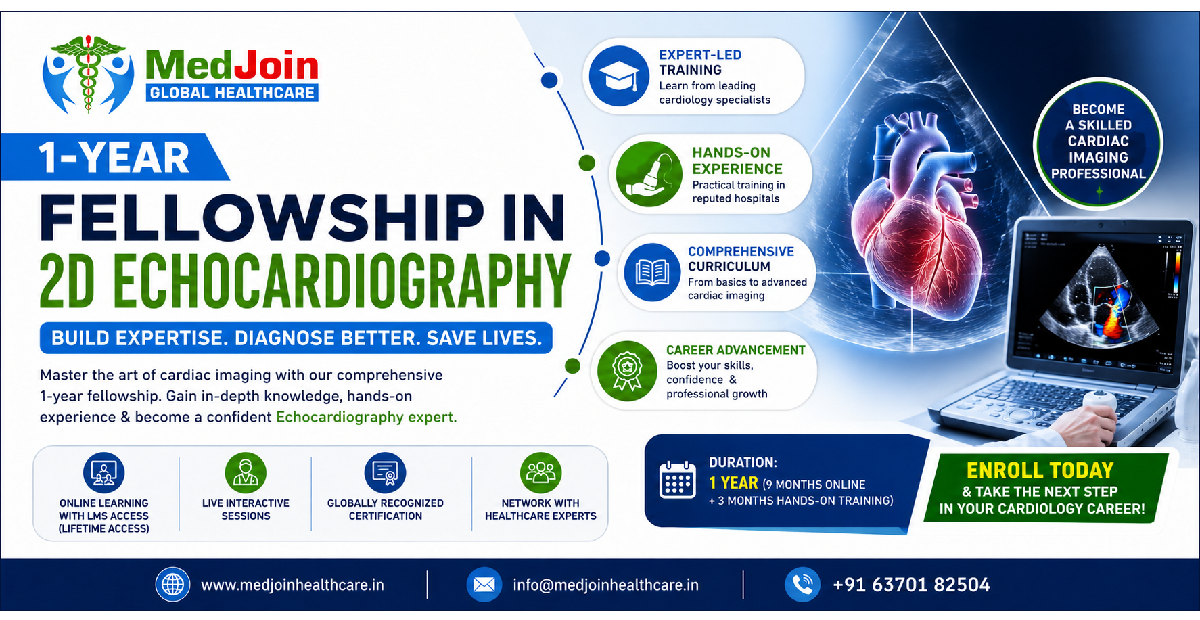
For doctors seeking to enhance their clinical expertise and build a rewarding career in cardiovascular medicine, enrolling in a 1-Year Fellowship in 2D Echocardiography is an excellent career investment. This comprehensive fellowship equips medical professionals with advanced theoretical knowledge, practical scanning skills, and the confidence to independently perform and interpret echocardiographic examinations.
Whether you are an MBBS graduate, a physician, an emergency medicine specialist, an intensivist, an anesthesiologist, or a healthcare professional interested in cardiac imaging, this fellowship provides an opportunity to develop specialized skills that significantly improve patient care while opening doors to numerous career opportunities in India and abroad.
What is 2D Echocardiography?
2D Echocardiography (Two-Dimensional Echocardiography) is a non-invasive diagnostic imaging technique that uses high-frequency ultrasound waves to create real-time images of the heart. It enables clinicians to evaluate cardiac anatomy, ventricular function, valvular abnormalities, congenital heart diseases, pericardial disorders, and many other cardiovascular conditions.
Unlike invasive diagnostic procedures, echocardiography is painless, radiation-free, repeatable, portable, and can be performed at the bedside. These advantages make it one of the most frequently requested investigations in cardiology, emergency medicine, intensive care, anesthesia, internal medicine, and critical care.
The technology allows physicians to visualize:
- Cardiac chambers
- Heart valves
- Myocardial wall motion
- Left ventricular function
- Right ventricular function
- Pericardium
- Great vessels
- Blood flow using Doppler imaging
- Cardiac hemodynamics
Today, almost every tertiary care hospital, multispecialty hospital, cardiac center, emergency department, and ICU relies heavily on echocardiography for clinical decision-making.
Why is Echocardiography Important in Modern Healthcare?
Modern medicine increasingly emphasizes early diagnosis, accurate clinical assessment, and timely intervention. Echocardiography fulfills all these requirements by providing detailed information about cardiac function within minutes.
It plays a vital role in diagnosing:
- Coronary artery disease
- Heart failure
- Cardiomyopathies
- Valvular heart diseases
- Congenital heart diseases
- Pulmonary hypertension
- Pericardial effusion
- Infective endocarditis
- Cardiac tumors
- Aortic diseases
- Hypertensive heart disease
Physicians can use echocardiography to monitor disease progression, evaluate treatment effectiveness, guide interventions, and assess prognosis.
What is a 1-Year Fellowship in 2D Echocardiography?
A 1-Year Fellowship in 2D Echocardiography is an advanced, industry-oriented training program designed to provide doctors with in-depth knowledge and practical expertise in performing and interpreting echocardiographic examinations.
Unlike short workshops or certificate courses, a structured one-year fellowship offers comprehensive exposure to:
- Cardiac anatomy
- Ultrasound physics
- Imaging principles
- Doppler techniques
- Clinical cardiology
- Disease interpretation
- Image acquisition
- Report writing
- Hands-on scanning
- Case discussions
- Clinical decision-making
The fellowship combines theoretical learning with practical clinical exposure, enabling participants to become proficient in echocardiographic imaging.
Why Choose a 1-Year Fellowship Instead of Short-Term Training?
Many healthcare professionals initially opt for weekend workshops or short certification programs. While these provide basic exposure, they often lack extensive hands-on training and comprehensive clinical learning.
A one-year fellowship offers several distinct advantages:
Comprehensive Curriculum
Participants gain systematic knowledge covering every aspect of cardiac imaging rather than isolated topics.
Practical Clinical Experience
Real patient exposure enhances confidence in performing scans independently.
Expert Mentorship
Participants learn directly from experienced cardiologists and echocardiography specialists.
Case-Based Learning
Exposure to diverse cardiac pathologies improves diagnostic accuracy.
Career Advancement
Hospitals increasingly prefer candidates with structured fellowship training over those with only short-term certifications.
Objectives of the Fellowship
The fellowship is designed to help participants:
- Understand normal cardiac anatomy and physiology.
- Learn ultrasound physics relevant to echocardiography.
- Master standard echocardiographic views.
- Perform complete cardiac examinations.
- Assess ventricular function accurately.
- Evaluate valvular heart diseases.
- Interpret Doppler findings.
- Diagnose congenital heart diseases.
- Identify cardiomyopathies.
- Detect pericardial diseases.
- Understand emergency echocardiography.
- Generate structured echocardiography reports.
- Improve clinical decision-making.
- Develop independent scanning skills.
Who Should Enroll?
The fellowship is ideal for healthcare professionals seeking specialization in cardiac imaging.
Suitable candidates include:
- MBBS Doctors
- MD General Medicine
- DNB General Medicine
- Emergency Medicine Physicians
- Internal Medicine Specialists
- Critical Care Physicians
- Anesthesiologists
- Family Physicians
- Intensivists
- Cardiology Aspirants
- Physicians working in ICUs
- Doctors working in emergency departments
Why Learn 2D Echocardiography?
Healthcare is rapidly shifting toward point-of-care diagnostics. Physicians capable of performing bedside echocardiography enjoy a significant clinical advantage.
Learning echocardiography enables doctors to:
- Diagnose heart disease earlier.
- Improve treatment planning.
- Reduce unnecessary investigations.
- Enhance patient outcomes.
- Build confidence in emergency settings.
- Expand career opportunities.
- Increase professional credibility.
- Improve earning potential.
- Work in multispecialty hospitals.
- Pursue advanced cardiology training.
Scope of 2D Echocardiography in India
India has witnessed tremendous growth in cardiovascular healthcare infrastructure over the last decade.
Today, echocardiography services are routinely available in:
- Corporate hospitals
- Government hospitals
- Medical colleges
- Cardiac centers
- Diagnostic centers
- Emergency departments
- Intensive Care Units
- Primary cardiac clinics
- Rural healthcare initiatives
- Telemedicine services
The increasing prevalence of hypertension, diabetes, obesity, and ischemic heart disease has created a growing demand for trained echocardiography professionals.
Hospitals increasingly seek doctors who possess practical echocardiography skills, making fellowship-trained professionals highly employable.
Global Demand for Echocardiography Professionals
The demand for skilled echocardiography professionals extends beyond India. Countries across the Middle East, Africa, Southeast Asia, Australia, Europe, and North America continue to invest in cardiovascular care, creating opportunities for doctors with advanced cardiac imaging expertise.
Specialized training in 2D Echocardiography can strengthen a physician’s profile for roles in hospitals, cardiac centers, academic institutions, and diagnostic facilities worldwide.
Benefits of Enrolling in a Fellowship in 2D Echocardiography
Key advantages include:
- Comprehensive curriculum
- Expert faculty guidance
- Clinical case discussions
- Practical skill development
- Hands-on echocardiography training
- Flexible learning options
- Enhanced diagnostic confidence
- Better career opportunities
- Stronger professional profile
- Improved patient care outcomes
A well-designed 1-Year Fellowship in 2D Echocardiography goes far beyond learning how to operate an ultrasound machine. It develops the knowledge, technical proficiency, and clinical judgment required to perform and interpret echocardiographic examinations confidently.
The curriculum integrates classroom learning, online lectures, case-based discussions, practical demonstrations, and supervised hands-on training to prepare participants for real-world clinical practice.
Skills Developed During the Fellowship
By the end of the program, participants should be able to:
- Independently perform complete 2D echocardiographic studies.
- Acquire optimal imaging windows.
- Assess systolic and diastolic function.
- Evaluate valvular heart disease.
- Interpret Doppler findings.
- Detect congenital cardiac anomalies.
- Recognize emergency cardiac conditions.
- Generate structured echocardiography reports.
- Integrate echocardiographic findings into clinical decision-making.
1-Year Fellowship in 2D Echocardiography | Hands-on Clinical Training, Career Opportunities & Why Choose MedJoin Global Healthcare
Hands-on Clinical Training: Transforming Knowledge into Clinical Expertise
Theoretical knowledge forms the foundation of echocardiography, but practical experience is what transforms a healthcare professional into a confident echocardiographer. A structured 1-Year Fellowship in 2D Echocardiography places significant emphasis on supervised clinical training, allowing participants to apply classroom concepts to real-world patient care.
Hands-on exposure enables learners to understand patient positioning, probe manipulation, image optimization, measurement techniques, and clinical interpretation. Repeated practice under expert supervision helps develop consistency, accuracy, and confidence.
Key Components of Clinical Training
Participants receive training in:
- Patient preparation and counseling
- Infection prevention and safety protocols
- Machine setup and optimization
- Probe handling techniques
- Standard imaging windows
- Image acquisition
- Doppler evaluation
- Cardiac measurements
- Structured reporting
- Clinical interpretation
- Case presentation
Regular feedback from experienced faculty allows participants to refine their scanning techniques and improve diagnostic accuracy.
Learning Through Real Clinical Cases
Case-based learning is an essential component of fellowship training. Exposure to a wide variety of cardiac conditions helps participants recognize disease patterns and correlate echocardiographic findings with clinical symptoms.
Common Cases Covered
- Hypertension
- Ischemic heart disease
- Heart failure
- Rheumatic heart disease
- Dilated cardiomyopathy
- Hypertrophic cardiomyopathy
- Congenital heart disease
- Pulmonary hypertension
- Pericardial effusion
- Infective endocarditis
- Prosthetic valve assessment
- Post-operative cardiac evaluation
Interactive discussions encourage clinical reasoning and evidence-based decision-making.
Development of Practical Skills
By the end of the fellowship, participants should be able to:
- Perform a complete 2D echocardiographic examination independently.
- Acquire and optimize standard echocardiographic views.
- Assess left and right ventricular function.
- Evaluate valvular heart disease using Doppler techniques.
- Identify pericardial pathology.
- Detect congenital cardiac abnormalities.
- Interpret common echocardiographic findings accurately.
- Prepare comprehensive echocardiography reports.
- Integrate imaging findings into patient management.
Clinical Rotations
Clinical exposure is designed to familiarize participants with diverse healthcare settings.
Outpatient Cardiology Clinics
Participants observe the evaluation of patients presenting with:
- Chest pain
- Shortness of breath
- Palpitations
- Syncope
- Hypertension
Inpatient Cardiology Wards
Training focuses on patients with:
- Acute coronary syndrome
- Heart failure
- Valvular heart disease
- Cardiomyopathies
Intensive Care Units
Participants learn bedside echocardiography for critically ill patients, including:
- Septic shock
- Cardiogenic shock
- Pulmonary embolism
- Cardiac tamponade
- Ventilator management
Emergency Department
Emergency echocardiography is invaluable in rapidly assessing unstable patients and guiding immediate treatment decisions.
Career Opportunities After a Fellowship in 2D Echocardiography
The demand for physicians trained in cardiac imaging continues to grow across hospitals, diagnostic centers, and academic institutions.
Potential Career Paths
Graduates can pursue roles such as:
- Echocardiography Physician
- Cardiac Imaging Specialist
- Clinical Associate in Cardiology
- ICU Physician with Echocardiography Skills
- Emergency Medicine Physician
- Cardiology Registrar
- Critical Care Specialist
- Medical Officer in Cardiac Units
- Academic Faculty
- Clinical Research Associate
- Telemedicine Consultant
- Point-of-Care Ultrasound (POCUS) Practitioner
Employment Opportunities
Professionals with echocardiography expertise are sought after in:
- Corporate hospitals
- Government hospitals
- Medical colleges
- Super-specialty cardiac centers
- Multispecialty hospitals
- Diagnostic imaging centers
- Critical care units
- Emergency departments
- Rural health initiatives
- Telemedicine platforms
Scope in India
India's expanding healthcare infrastructure has significantly increased the demand for physicians skilled in cardiac imaging. The rise in lifestyle-related diseases such as hypertension, diabetes, obesity, and coronary artery disease has made echocardiography an indispensable diagnostic tool.
As hospitals continue to invest in advanced imaging technology, fellowship-trained professionals enjoy enhanced career prospects and opportunities for specialization.
International Opportunities
Training in 2D echocardiography can strengthen a physician's profile for opportunities in regions including:
- Middle East
- Southeast Asia
- Africa
- Australia
- Europe
- North America
Eligibility requirements vary by country and may include additional licensing or registration.
Benefits of Pursuing This Fellowship
A structured fellowship offers several advantages:
- Advanced knowledge in cardiac imaging
- Practical scanning experience
- Improved diagnostic confidence
- Enhanced clinical decision-making
- Increased employability
- Opportunities for career progression
- Better patient outcomes
- Exposure to expert mentorship
- Foundation for further specialization in cardiology
The increasing burden of cardiovascular disease has made advanced cardiac imaging an essential component of modern medical practice. Among available diagnostic tools, 2D Echocardiography remains one of the most valuable because it provides rapid, accurate, and non-invasive assessment of cardiac anatomy and function.
A 1-Year Fellowship in 2D Echocardiography equips doctors with comprehensive theoretical knowledge, practical scanning skills, and the confidence to integrate echocardiographic findings into patient care. Through structured learning, supervised clinical exposure, and case-based training, participants can enhance their clinical competence and expand their career opportunities.
Whether you are an MBBS graduate, physician, intensivist, emergency medicine specialist, or aspiring cardiology professional, investing in advanced echocardiography training can be a significant step toward professional growth and improved patient outcomes.