
Healthcare is evolving rapidly, and with it, the demand for doctors with specialized clinical expertise continues to grow. Among all medical specialties, Urology has emerged as one of the most rewarding and high-demand fields due to the increasing prevalence of kidney disorders, urinary tract diseases, prostate conditions, male reproductive health issues, and minimally invasive surgical procedures.
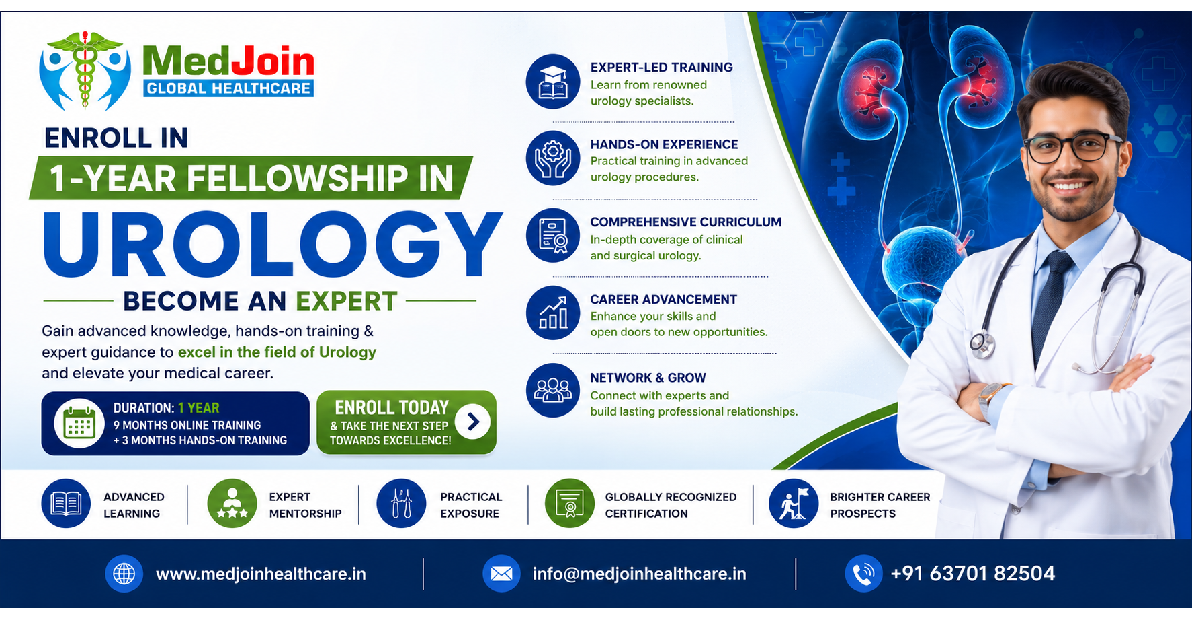
For MBBS doctors looking to move beyond general practice and develop advanced clinical competencies, enrolling in a 1-Year Fellowship in Urology is a strategic career decision. A structured fellowship bridges the gap between undergraduate medical education and specialty practice by providing focused theoretical knowledge, practical clinical exposure, expert mentorship, and hands-on learning.
Whether your goal is to enhance patient outcomes, secure better career opportunities, work in multispecialty hospitals, or establish a successful private practice, a fellowship in urology equips you with the skills and confidence required to excel.
Why Urology Is One of the Fastest-Growing Medical Specialties
Urology is a specialized branch of medicine dedicated to diagnosing, treating, and managing disorders affecting the urinary tract in both men and women, as well as diseases of the male reproductive system. It combines medical management with procedural and surgical expertise, making it one of the most dynamic specialties in modern healthcare.
The global burden of urological diseases continues to increase due to factors such as:
- Aging populations
- Diabetes and hypertension
- Rising obesity rates
- Lifestyle-related kidney disorders
- Increased awareness and screening
- Improved diagnostic technologies
As a result, hospitals, specialty clinics, and healthcare organizations are actively seeking physicians with advanced knowledge in urology.
The Rising Burden of Urological Diseases
India and many other countries are witnessing a steady increase in urological disorders, including:
- Kidney stones
- Urinary tract infections (UTIs)
- Benign Prostatic Hyperplasia (BPH)
- Prostate cancer
- Bladder cancer
- Kidney cancer
- Male infertility
- Erectile dysfunction
- Neurogenic bladder
- Urinary incontinence
- Pediatric urological disorders
- Congenital urinary abnormalities
The increasing incidence of these conditions has significantly expanded the demand for doctors trained in evidence-based urological care.
Why MBBS Doctors Should Specialize in Urology
An MBBS degree provides a strong foundation in medicine, but today's healthcare environment increasingly values specialization. Fellowship training enables doctors to deepen their expertise, improve diagnostic accuracy, and gain confidence in managing complex cases.
A 1-Year Fellowship in Urology allows doctors to:
- Develop advanced clinical decision-making skills
- Learn current international treatment guidelines
- Understand modern diagnostic techniques
- Gain procedural exposure
- Improve patient management
- Enhance career opportunities
- Increase professional credibility
- Build confidence in independent practice
Specialized training also supports better interdisciplinary collaboration with nephrologists, oncologists, endocrinologists, radiologists, emergency physicians, and surgeons.
What Makes Urology an Attractive Career?
Urology offers a unique combination of medicine, diagnostics, technology, and surgery. It provides opportunities to work across diverse healthcare settings, including:
- Multispecialty hospitals
- Super-specialty hospitals
- Government healthcare institutions
- Academic medical centers
- Corporate healthcare chains
- Fertility clinics
- Kidney care centers
- Private practice
- Telemedicine platforms
- International healthcare organizations
Because urology encompasses both outpatient and inpatient care, physicians develop a broad and rewarding clinical practice.
Increasing Demand for Urology Specialists
Several factors contribute to the growing demand for urology professionals:
Aging Population
Older adults commonly experience prostate enlargement, urinary incontinence, kidney disease, and bladder dysfunction, increasing the need for specialized care.
Lifestyle Diseases
Diabetes, hypertension, obesity, and metabolic syndrome significantly increase the risk of kidney disease and urinary complications.
Better Diagnostic Facilities
Advances in ultrasound, CT imaging, MRI, endoscopy, and laboratory diagnostics have enabled earlier detection and more effective management of urological conditions.
Rising Awareness
Patients are increasingly seeking specialist consultation for urinary symptoms, fertility concerns, and preventive health screenings.
Technological Advancements
Modern urology incorporates innovations such as:
- Flexible endoscopy
- Laser lithotripsy
- Laparoscopic surgery
- Robotic-assisted surgery
- Advanced imaging
- Minimally invasive procedures
Doctors trained in these evolving technologies are highly valued by healthcare institutions.
Why Fellowship Training Matters
Medical education is continuously evolving. Fellowship programs provide focused training that extends beyond undergraduate education by emphasizing:
- Clinical reasoning
- Evidence-based practice
- Case-based discussions
- Practical skills
- Multidisciplinary management
- Patient-centered care
- Continuous professional development
Instead of relying solely on textbook knowledge, fellows learn how to apply clinical principles to real-world patient scenarios.
Benefits of a 1-Year Fellowship in Urology
A structured fellowship offers numerous professional advantages:
Advanced Clinical Knowledge
Understand common and complex urological disorders in depth.
Practical Learning
Apply theoretical concepts through clinical exposure and case discussions.
Expert Mentorship
Learn directly from experienced urologists and clinicians.
Improved Diagnostic Skills
Develop confidence in evaluating patients with urinary tract and male reproductive disorders.
Better Treatment Planning
Learn evidence-based medical and procedural management strategies.
Career Advancement
Enhance your profile for hospital positions, specialty clinics, academic roles, and private practice.
Professional Recognition
A fellowship demonstrates your commitment to continuous learning and clinical excellence.
Skills You Will Begin Developing
Throughout the fellowship, doctors strengthen competencies in:
- Comprehensive history taking
- Urological examination
- Diagnostic interpretation
- Imaging review
- Laboratory evaluation
- Medical management
- Emergency assessment
- Referral decision-making
- Patient counseling
- Follow-up planning
These skills contribute directly to better patient care and improved clinical outcomes.
The Future of Urology
Urology is rapidly transforming through advances in precision medicine, artificial intelligence, robotic surgery, digital health, and minimally invasive interventions. Physicians who continually update their knowledge are better positioned to adapt to these changes and provide high-quality care.
A fellowship offers a structured pathway to stay aligned with current standards of practice while preparing for future developments in the specialty.
Who Should Consider This Fellowship?
A 1-Year Fellowship in Urology is well suited for:
- MBBS graduates seeking specialization
- General practitioners
- Early-career medical officers
- Doctors working in emergency medicine
- Physicians in multispecialty hospitals
- Rural healthcare practitioners managing urological cases
- Doctors preparing for long-term specialty careers
The program is designed to strengthen both theoretical understanding and practical clinical competence.
Understanding a Fellowship in Urology
A 1-Year Fellowship in Urology is an advanced, career-focused training program designed to help MBBS doctors develop specialized knowledge and practical skills in diagnosing, managing, and treating diseases of the urinary tract and the male reproductive system. While undergraduate medical education provides a strong foundation in medicine and surgery, fellowship training offers focused learning that prepares doctors to manage urological conditions with greater confidence and clinical competence.
The fellowship combines structured academic learning with practical clinical exposure. Participants gain an in-depth understanding of common and complex urological disorders, modern diagnostic techniques, evidence-based treatment protocols, patient counseling, and multidisciplinary care.
Unlike short workshops or continuing medical education (CME) sessions, a year-long fellowship allows doctors to build knowledge progressively, apply concepts in clinical settings, and develop critical decision-making skills through regular interaction with experienced mentors.
Specialization has become a defining factor in modern medical careers. A 1-Year Fellowship in Urology equips doctors with advanced knowledge, clinical confidence, and practical skills to diagnose and manage a wide range of urological conditions effectively.
By learning from experienced mentors, participating in structured academic sessions, and gaining exposure to real-world clinical practice, physicians can significantly enhance their professional capabilities and expand their career opportunities.
In the following sections of this guide, we will explore the fellowship curriculum, eligibility, learning methodology, clinical skills, career opportunities, salary prospects, and the advantages of pursuing advanced urology training.