
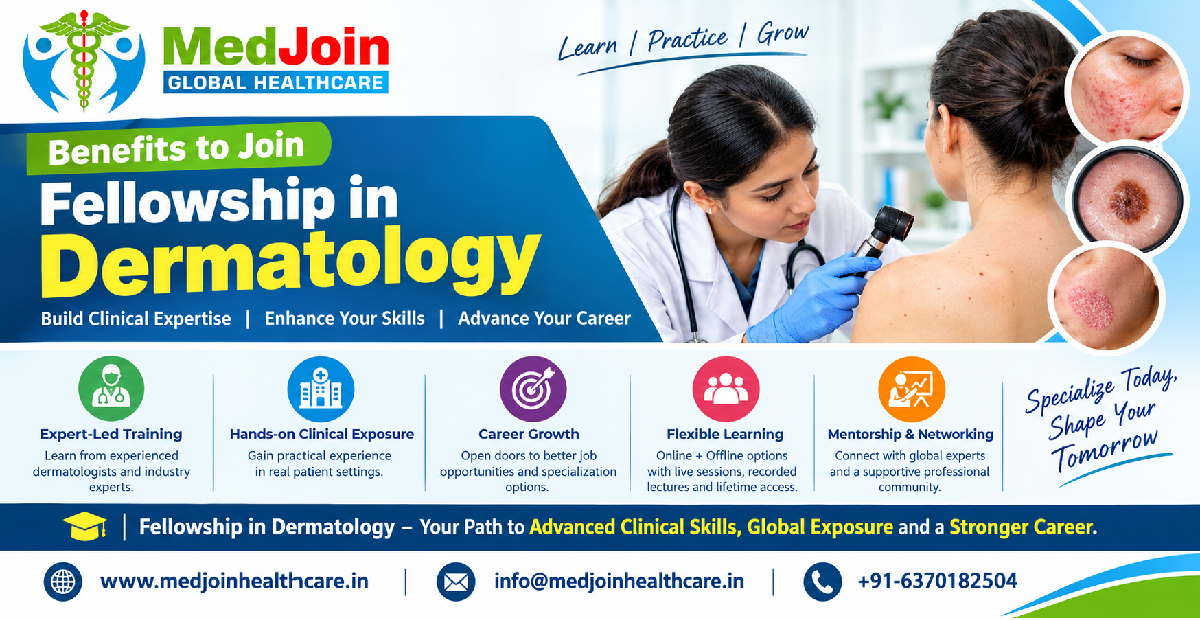
Dermatology has evolved far beyond the traditional treatment of common skin infections, acne and rashes. Today, the specialty encompasses clinical dermatology, hair and nail disorders, inflammatory and autoimmune diseases, pediatric skin conditions, pigmentary disorders, dermatosurgery, trichology, aesthetic dermatology, laser-based procedures and several emerging areas of skin health.
For medical professionals looking to strengthen their clinical knowledge and develop focused expertise, a Fellowship in Dermatology can be an important career-development pathway. It can provide structured exposure to dermatological concepts, diagnostic reasoning, patient assessment and contemporary treatment approaches while helping doctors build a more focused professional profile.
The global need for skin-health services is substantial. A 2026 analysis of Global Burden of Disease 2021 data reported approximately 4.69 billion new cases of skin and subcutaneous diseases globally in 2021, with about 2.03 billion prevalent cases and 41.94 million disability-adjusted life years. Wiley Online Library The World Health Organization has also recognized skin diseases as a global public-health priority, emphasizing the importance of prevention, early detection, diagnosis, treatment, rehabilitation, surveillance and health-workforce capacity. WHO Apps
This article explores the advantages of a Fellowship in Dermatology, how it can support a medical career upgrade, potential career pathways, important skills, future opportunities, program-selection considerations and frequently asked questions.
A Fellowship in Dermatology is a focused medical education and professional-development program designed to provide structured learning in dermatological science and clinical practice.
Depending on the institution and program structure, fellowship training may include:
- Dermatology anatomy and physiology
- Clinical dermatology
- Dermatological history taking
- Skin examination
- Differential diagnosis
- Common skin diseases
- Hair and scalp disorders
- Nail disorders
- Pediatric dermatology
- Infectious dermatology
- Inflammatory skin disease
- Pigmentary disorders
- Autoimmune dermatology
- Dermatological pharmacology
- Dermatoscopy
- Cosmetic dermatology
- Trichology
- Aesthetic procedures
- Patient counselling
- Clinical case discussions
- Evidence-based treatment approaches
The exact curriculum, eligibility, certification and clinical privileges vary between programs and jurisdictions.
A fellowship should therefore be viewed as additional focused education and training, not automatically as an equivalent substitute for a formal specialist residency or postgraduate degree in dermatology.
The American Academy of Dermatology describes dermatologists as physicians specializing in conditions affecting the skin, hair and nails, while also highlighting the extensive training required for specialist dermatology practice.
Why Is Dermatology Becoming an Important Medical Specialty?
Skin is the body's largest organ and frequently provides visible clues about underlying health.
Patients may initially present with:
- Rash
- Itching
- Pigmentation
- Hair loss
- Acne
- Skin infection
- Lesions
- Ulcers
- Nail abnormalities
- Changes in moles
- Chronic wounds
- Allergic reactions
Some dermatological findings can also be associated with systemic conditions.
For example, skin manifestations can occur in:
- Diabetes
- Thyroid disorders
- Autoimmune diseases
- Liver disease
- Kidney disease
- Nutritional deficiencies
- Hematological disorders
- Endocrine disorders
- Infectious diseases
- Genetic conditions
Consequently, dermatology is not simply about treating visible skin problems. It requires clinical observation, diagnostic reasoning and an understanding of systemic medicine.
The global burden further demonstrates why skin health deserves greater clinical attention. WHO's recent policy work describes skin diseases as a major public-health concern and notes their effects on physical health, stigma, discrimination and mental well-being.
Why Consider a Fellowship in Dermatology?
Doctors may consider additional dermatology education for several reasons.
1. To develop focused knowledge
A fellowship can organize dermatology learning into a structured pathway instead of relying only on occasional exposure to dermatological cases.
2. To improve clinical confidence
Repeated exposure to common dermatological presentations can improve systematic patient assessment and differential diagnosis.
3. To broaden career options
Dermatology knowledge can complement general practice, family medicine, emergency care, internal medicine and other healthcare roles.
4. To understand modern dermatology
Contemporary dermatology includes clinical, procedural, cosmetic and technology-assisted areas.
5. To develop a niche
Doctors may eventually focus their professional development on areas such as:
- Clinical dermatology
- Hair disorders
- Cosmetic dermatology
- Aesthetic medicine
- Pigmentary disorders
- Pediatric dermatology
- Dermatosurgery
- Skin infections
Fellowship in Dermatology vs. General Medical Practice
General medical practice requires doctors to evaluate patients across multiple organ systems.
Dermatology, by contrast, allows greater concentration on:
Skin + Hair + Nails + Mucosal manifestations + Related systemic conditions
This focused exposure can be particularly valuable for doctors who regularly encounter patients with dermatological complaints.
For example, a general practitioner may encounter dozens of patients presenting with:
- Acne
- Tinea
- Eczema
- Urticaria
- Psoriasis
- Scabies
- Hair loss
- Pigmentation
- Contact dermatitis
A structured dermatology program can help the physician approach these presentations using a more systematic framework.
Major Advantages of a Dermatology Fellowship
Focused Clinical Knowledge
One of the biggest advantages is concentrated learning.
Instead of studying dermatology as one component of a broad medical curriculum, doctors can dedicate substantial educational time to skin-related conditions.
Improved Diagnostic Approach
Dermatology often relies heavily on visual assessment.
Doctors learn to observe:
- Lesion morphology
- Distribution
- Color
- Shape
- Borders
- Scaling
- Crusting
- Vesiculation
- Ulceration
- Symmetry
- Pattern
- Evolution over time
This develops clinical observation skills.
Understanding Differential Diagnosis
Many skin conditions can appear similar.
For example, a patient presenting with an itchy rash may have:
- Atopic dermatitis
- Contact dermatitis
- Scabies
- Fungal infection
- Drug reaction
- Urticaria
- Psoriasis
A structured approach helps doctors consider the differential diagnosis rather than treating every rash identically.
Exposure to Common Skin Diseases
Dermatology training can provide systematic exposure to frequently encountered conditions.
This is particularly useful for physicians working in:
- Primary care
- Family medicine
- General outpatient departments
- Community healthcare
- Corporate clinics
- Hospital OPDs
- Private practice
Professional Development
Additional focused education can strengthen a doctor's professional profile.
It can demonstrate commitment to continuing medical education and specialty-focused learning.
However, doctors should always represent their qualifications accurately and should not describe a fellowship certificate as equivalent to a recognized specialist qualification unless the relevant regulatory authority explicitly recognizes it as such.
Career Upgrade Through Dermatology Training
A career upgrade does not necessarily mean changing one's entire profession.
It can mean becoming more capable within an existing medical role.
For example, an MBBS doctor working in general practice may develop stronger capabilities in:
- Skin examination
- Dermatological history taking
- Common dermatological diagnosis
- Treatment principles
- Patient education
- Referral decisions
- Follow-up assessment
A physician already working in another specialty may also gain useful complementary knowledge.
For example:
Internal Medicine + Dermatology
Useful when systemic diseases present with skin manifestations.
Pediatrics + Dermatology
Useful because children frequently present with rashes, infections and inflammatory conditions.
Family Medicine + Dermatology
Useful because primary-care physicians commonly encounter skin complaints.
Emergency Medicine + Dermatology
Useful for recognizing serious allergic reactions, drug eruptions, infections and dermatological emergencies.
Clinical Knowledge You Can Develop
A well-structured fellowship curriculum may include several levels of learning.
Foundation
- Skin anatomy
- Skin physiology
- Skin barrier function
- Immunology
- Inflammation
- Pigmentation
- Hair biology
- Nail biology
Clinical Assessment
- History taking
- Physical examination
- Lesion description
- Morphology
- Distribution
- Differential diagnosis
Disease Management
- Pharmacological approaches
- Topical therapies
- Systemic therapies
- Patient counselling
- Follow-up
- Referral
Advanced Areas
- Dermatoscopy
- Trichology
- Cosmetic dermatology
- Procedural dermatology
- Laser technology
- Dermatosurgery
Common Dermatological Conditions Covered
A comprehensive curriculum can include:
- Acne vulgaris
- Rosacea
- Atopic dermatitis
- Contact dermatitis
- Seborrheic dermatitis
- Psoriasis
- Urticaria
- Scabies
- Fungal infections
- Bacterial infections
- Viral infections
- Pigmentary disorders
- Vitiligo
- Melasma
- Alopecia
- Nail disorders
- Autoimmune diseases
- Drug reactions
- Skin tumors
- Pediatric dermatological disorders
The American Academy of Dermatology notes that dermatologists diagnose and treat thousands of diseases affecting the skin, hair and nails.
Dermatoscopy and Modern Diagnostic Approaches
Dermatoscopy allows clinicians to examine skin lesions using magnification and specialized illumination.
It can assist in the evaluation of:
- Pigmented lesions
- Moles
- Suspicious lesions
- Melanocytic lesions
- Certain inflammatory conditions
Doctors interested in advanced dermatology can consider additional training in dermatoscopy and skin imaging.
Aesthetic Dermatology
Aesthetic dermatology has become a major area of interest.
Potential topics include:
- Skin rejuvenation
- Chemical peels
- Acne scar management
- Hyperpigmentation management
- Botulinum toxin principles
- Dermal fillers
- Microneedling
- Laser-based treatments
- Skin tightening
- Phototherapy
However, procedural training should always be undertaken within the practitioner's legal scope of practice, with appropriate supervision, informed consent and patient-safety protocols.
Patient Communication in Dermatology
Dermatology is a highly visible specialty.
Patients may experience embarrassment, anxiety or social stigma because of skin conditions.
Doctors therefore need strong communication skills.
Good counselling should address:
- Diagnosis
- Treatment expectations
- Treatment duration
- Possible adverse effects
- Recurrence
- Skin-care routines
- Lifestyle considerations
- Follow-up requirements
WHO has specifically highlighted the social and emotional consequences of skin diseases, including stigma, discrimination and mental-health effects.
Role of Clinical Case Discussions
Case-based learning can be one of the most valuable components of dermatology education.
A typical case discussion may include:
Patient presentation → History → Examination → Morphology → Differential diagnosis → Investigations → Diagnosis → Treatment → Follow-up
Case discussions teach doctors how to translate theoretical knowledge into clinical reasoning.
Online and Hybrid Fellowship Models
Modern medical education increasingly uses digital learning.
A hybrid dermatology fellowship can combine:
Online Learning
- Recorded lectures
- Live classes
- Digital reading materials
- Case discussions
- Assessments
- Discussion forums
Clinical Exposure
- Hospital or clinic-based observation
- Supervised patient exposure
- Procedural demonstrations
- Clinical case discussions
This model can be useful for working doctors who cannot leave their existing practice for an extended period.
Flexibility for Working Doctors
One major attraction of structured fellowship education is flexibility.
Doctors may continue:
- Clinical practice
- Hospital employment
- Private consultation
- Family responsibilities
- Other professional commitments
while completing structured education, depending on the program's schedule.
Flexible learning can make continuing education more accessible to practicing professionals.
Career Opportunities After Dermatology Training
Career possibilities can vary according to the physician's base qualification, local regulations, additional qualifications and scope of practice.
Potential pathways include:
- General clinical practice with enhanced dermatology knowledge
- Dermatology-focused consultation within permitted scope
- Hospital roles
- Skin-care clinics
- Aesthetic medicine
- Trichology
- Medical education
- Research
- Healthcare industry
- Telemedicine
- Healthcare entrepreneurship
A fellowship does not automatically confer specialist registration or specialist practice rights. Doctors should verify recognition and scope of practice with the relevant medical regulator before advertising themselves as specialists.
Hospital-Based Opportunities
Hospitals require clinicians who can recognize and appropriately manage or refer dermatological conditions.
Doctors with additional dermatology training may contribute to:
- OPD services
- General medicine
- Pediatric services
- Emergency assessment
- Infection management
- Inpatient consultations
- Wound care
- Multidisciplinary teams
Medical Education and Teaching
Doctors who enjoy teaching can develop academic opportunities.
Possible areas include:
- Medical lectures
- CME programs
- Clinical case presentations
- Online teaching
- Training junior doctors
- Educational content development
The combination of clinical knowledge and teaching skills can support an academic career.
Pharmaceutical and Healthcare Industry Opportunities
Doctors with dermatology expertise may also explore non-clinical opportunities.
These can include:
- Medical affairs
- Clinical research
- Medical education
- Pharmaceutical advisory roles
- Clinical content development
- Product training
- Scientific communication
Telemedicine and Digital Dermatology
Digital healthcare is changing how patients access medical advice.
Teledermatology can facilitate:
- Remote consultations
- Follow-up
- Digital image assessment
- Second opinions
- Rural healthcare access
However, image quality, patient consent, privacy, diagnostic limitations and appropriate referral remain important considerations.
Entrepreneurship in Dermatology
Doctors with an entrepreneurial mindset may explore healthcare businesses related to:
- Dermatology clinics
- Hair clinics
- Skin-care centers
- Aesthetic centers
- Teledermatology
- Medical education
- Skin-health technology
Clinical competence should remain the foundation of any healthcare business.
Career Growth for MBBS Doctors
For MBBS doctors, additional focused training can help develop a niche professional identity.
Instead of presenting themselves only as a general medical practitioner, a doctor may develop a focused interest in areas such as:
General Practice + Dermatology
or
Primary Care + Skin Health
or
Medical Practice + Trichology
or
Clinical Medicine + Aesthetic Dermatology
subject to qualifications and local regulatory requirements.
Career Development for Existing Specialists
Dermatology knowledge can also complement other specialties.
Pediatricians
For common pediatric skin conditions.
Physicians
For systemic disease-associated skin manifestations.
Gynecologists
For hormonal and reproductive-age skin and hair conditions.
Endocrinologists
For endocrine-associated skin and hair manifestations.
Emergency Physicians
For severe allergic and dermatological emergencies.
Family Physicians
For common outpatient dermatological conditions.
Building a Dermatology-Focused Professional Profile
Doctors can strengthen their professional profile through:
- Structured education
- Case documentation
- CME participation
- Clinical observation
- Research
- Conferences
- Professional networking
- Mentorship
- Evidence-based practice
A professional portfolio should accurately represent the doctor's qualifications and training.
How Dermatology Can Complement General Practice
General practitioners frequently see skin complaints.
Consider a primary-care clinic where patients present with:
- Itching
- Acne
- Rash
- Hair loss
- Pigmentation
- Fungal infection
- Allergic reactions
- Psoriasis
Dermatology knowledge can help the physician decide:
- What is the likely diagnosis?
- What are the important differential diagnoses?
- Does the patient need investigation?
- Is treatment appropriate in primary care?
- Is referral required?
- What follow-up is needed?
This decision-making framework is valuable even when the physician is not a specialist dermatologist.
Future of Dermatology
The future of dermatology is likely to be shaped by several developments.
These include:
- Artificial intelligence
- Digital imaging
- Teledermatology
- Personalized medicine
- Advanced therapeutics
- Biologics
- Laser technologies
- Regenerative approaches
- Hair restoration
- Cosmetic medicine
- Integrated skin-health services
The field is therefore becoming increasingly interdisciplinary.
Artificial Intelligence in Dermatology
AI has significant potential in dermatology because many conditions produce visible patterns.
Future applications may include:
- Image classification
- Lesion detection
- Risk assessment
- Clinical decision support
- Digital triage
- Research
- Patient monitoring
AI should support—not replace—clinical judgment.
A physician must consider history, examination, context, differential diagnosis and appropriate investigations.
Digital Dermoscopy and Imaging
Digital imaging may allow clinicians to monitor lesions over time.
Potential advantages include:
- Documentation
- Comparison
- Follow-up
- Remote review
- Research
- Clinical education
Technology can improve documentation, but it must be used responsibly and with appropriate privacy safeguards.
Personalized Dermatology
Patients do not always respond identically to treatment.
The future may involve greater personalization based on:
- Genetics
- Disease phenotype
- Immune profile
- Lifestyle
- Environmental factors
- Treatment response
This is especially relevant in chronic inflammatory diseases.
Regenerative and Advanced Aesthetic Medicine
Regenerative medicine is generating increasing interest in aesthetic and dermatological research.
Potential areas include:
- Scar management
- Tissue regeneration
- Hair restoration
- Skin rejuvenation
- Collagen stimulation
Doctors should distinguish between established evidence, emerging evidence and marketing claims.
Growing Interest in Hair and Scalp Care
Hair loss is increasingly becoming an important patient concern.
Potential future growth areas include:
- Hair diagnostics
- Trichoscopy
- Medical treatment
- Scalp health
- Hair transplantation
- Regenerative research
This creates opportunities for doctors who pursue appropriate additional education.
Expansion of Cosmetic Dermatology
The aesthetic dermatology sector continues to develop technologies and procedures.
Potential areas include:
- Acne scar treatment
- Pigmentation management
- Skin rejuvenation
- Laser treatments
- Non-invasive procedures
- Injectable aesthetics
Patient safety and evidence-based treatment should remain more important than commercial trends.
Dermatology and Integrated Healthcare
The future of healthcare is increasingly multidisciplinary.
Dermatology may intersect with:
- Endocrinology
- Oncology
- Rheumatology
- Pediatrics
- Internal medicine
- Surgery
- Psychiatry
- Nutrition
- Immunology
This makes dermatology knowledge useful across multiple healthcare environments.
Advantages of Studying Dermatology Through a Fellowship
A structured fellowship can offer several educational advantages:
Focused curriculum
Learning is organized around a specific specialty.
Case-based education
Doctors can connect theory with clinical presentations.
Mentorship
Experienced faculty can help explain clinical reasoning.
Flexible education
Online components can support working professionals.
Clinical exposure
Where included, supervised patient exposure can improve practical understanding.
Professional networking
Interaction with other doctors can create valuable professional relationships.
Career direction
Focused learning can help doctors decide whether dermatology is an appropriate long-term interest.
Fellowship in Dermatology at MedJoin Global
MedJoin Global Healthcare focuses on continuing medical education and professional development for healthcare professionals.
A structured dermatology fellowship pathway can be designed around the needs of working doctors, combining theoretical learning with case-based education and, where applicable, clinical exposure.
Potential educational components include:
- Dermatology fundamentals
- Clinical examination
- Common dermatological disorders
- Dermatological diagnosis
- Pharmacological principles
- Case discussions
- Hair and scalp disorders
- Pigmentary disorders
- Pediatric dermatology
- Cosmetic dermatology
- Aesthetic medicine
- Trichology
- Contemporary dermatology
- Clinical decision-making
For doctors considering a program, the exact duration, eligibility, clinical training arrangements, curriculum, assessment and certification should be confirmed directly with the current program information.
Is a Fellowship in Dermatology a Good Career Upgrade?
Dermatology is becoming increasingly important within modern healthcare because skin diseases affect billions of people worldwide. Current global evidence places skin and subcutaneous diseases among the world's major health burdens, while WHO has formally recognized skin diseases as a global public-health priority. For doctors interested in expanding their clinical knowledge, a Fellowship in Dermatology can provide a structured pathway for learning about skin, hair and nail disorders, clinical examination, diagnostic reasoning, treatment principles and emerging areas such as trichology, aesthetic dermatology and digital dermatology.
The biggest advantage is not simply receiving another certificate. The real value lies in developing focused knowledge, stronger clinical reasoning, improved patient assessment and a clearer professional direction.
For an MBBS doctor, general practitioner or physician interested in expanding into skin health, dermatology-focused education can complement existing medical practice. For doctors already working in healthcare, it can become an additional area of professional development.
At the same time, doctors should maintain realistic expectations. A fellowship is not automatically equivalent to a recognized specialist postgraduate qualification, and the right to practice or advertise as a specialist depends on applicable regulations and credentials.
The future of dermatology is particularly interesting because clinical medicine is converging with technology. AI-assisted imaging, teledermatology, digital dermoscopy, personalized treatment, advanced therapeutics, hair medicine, aesthetic procedures and regenerative approaches are creating new areas for learning and research.
Ultimately, the strongest dermatology career strategy is:
Learn deeply → Develop clinical reasoning → Gain appropriate supervised experience → Continue learning → Build a focused professional niche → Practice ethically → Keep patient safety first.
For doctors seeking a meaningful career upgrade, stronger dermatology knowledge and exposure to the evolving future of skin healthcare, a well-designed Fellowship in Dermatology can be an important step in lifelong medical education.