
Enroll in 1-Year Fellowship in Clinical Pharmacology | Apply Now
Clinical Pharmacology is one of the fastest-growing medical specialties in the modern healthcare ecosystem. As new drugs, biologics, biosimilars, gene therapies, and personalized medicines continue to transform patient care, there is an increasing demand for healthcare professionals who possess advanced knowledge of drug development, rational prescribing, pharmacovigilance, clinical research, and therapeutic optimization.
A 1-Year Fellowship in Clinical Pharmacology is designed to equip medical professionals with the scientific knowledge and practical skills required to excel in pharmaceutical research, clinical practice, regulatory affairs, and drug safety. Whether you are an MBBS graduate, postgraduate doctor, or a healthcare professional seeking specialization, this fellowship provides comprehensive training in the principles and applications of Clinical Pharmacology.
If you aspire to become an expert in drug therapy, clinical trials, pharmacokinetics, pharmacodynamics, pharmacogenomics, and evidence-based medicine, enrolling in this fellowship can significantly enhance your career prospects both in India and internationally.
What is Clinical Pharmacology?
Clinical Pharmacology is the branch of medical science that studies the effects of drugs in humans. It combines pharmacology with clinical medicine to ensure the safe, effective, and rational use of medications.
Unlike traditional pharmacology, which focuses on laboratory research and animal studies, Clinical Pharmacology emphasizes the application of drug knowledge in patient care.
Clinical Pharmacologists play a vital role in:
- Optimizing drug therapy
- Monitoring drug safety
- Conducting clinical trials
- Developing new medicines
- Managing adverse drug reactions
- Improving prescribing practices
- Supporting regulatory approvals
- Advancing personalized medicine
As healthcare becomes increasingly data-driven and precision-focused, Clinical Pharmacologists are indispensable members of multidisciplinary healthcare teams.
Fundamentals of Clinical Pharmacology, Pharmacokinetics & Pharmacodynamics
Welcome to Part 2 of our comprehensive guide on the 1-Year Fellowship in Clinical Pharmacology. In this section, we explore the scientific foundations of clinical pharmacology, including how drugs are absorbed, distributed, metabolized, and eliminated, as well as how they produce therapeutic and adverse effects in the human body. Mastering these concepts is essential for safe prescribing, individualized therapy, and evidence-based patient care.
Foundations of Clinical Pharmacology
Clinical Pharmacology is the scientific discipline that evaluates how medicines interact with the human body to achieve therapeutic goals while minimizing adverse effects. It integrates pharmacology with clinical medicine to improve patient outcomes through rational prescribing and continuous monitoring.
The discipline focuses on:
- Safe medication use
- Drug efficacy
- Drug safety
- Individualized therapy
- Clinical research
- Therapeutic optimization
- Evidence-based prescribing
- Prevention of adverse drug reactions
Clinical Pharmacologists collaborate with physicians, pharmacists, researchers, regulatory authorities, and pharmaceutical companies to ensure medicines are used effectively throughout their lifecycle.
Why Clinical Pharmacology Matters Today
The healthcare industry has witnessed tremendous advancements in the last decade. Every year, thousands of new pharmaceutical products enter the market.
With these innovations come significant responsibilities:
- Ensuring drug safety
- Evaluating treatment efficacy
- Monitoring adverse reactions
- Reducing medication errors
- Preventing drug interactions
- Supporting regulatory compliance
- Promoting rational prescribing
Clinical Pharmacologists bridge the gap between laboratory discoveries and patient care by translating scientific evidence into safe and effective treatment strategies.
Growing Demand for Clinical Pharmacologists
The pharmaceutical and healthcare industries are expanding rapidly across the globe.
Several factors contribute to the growing demand:
Rising Burden of Chronic Diseases
Diseases such as:
- Diabetes
- Hypertension
- Cardiovascular diseases
- Cancer
- Autoimmune disorders
- Neurological diseases
require long-term medication management and continuous therapeutic monitoring.
Expansion of Clinical Research
India has emerged as a global hub for clinical research due to:
- Large patient populations
- Highly qualified physicians
- Cost-effective research infrastructure
- Improved regulatory frameworks
This expansion has created thousands of opportunities in Clinical Pharmacology.
Growth of the Pharmaceutical Industry
India is among the world's largest producers of generic medicines.
The pharmaceutical sector requires experts in:
- Drug development
- Regulatory affairs
- Medical writing
- Pharmacovigilance
- Clinical operations
- Medical affairs
Personalized Medicine
Modern medicine is shifting from "one-size-fits-all" treatments toward individualized therapy.
Clinical Pharmacologists help determine:
- Which drug is best suited for a patient
- Appropriate dosage
- Genetic influences on drug response
- Drug interactions
- Risk of adverse effects
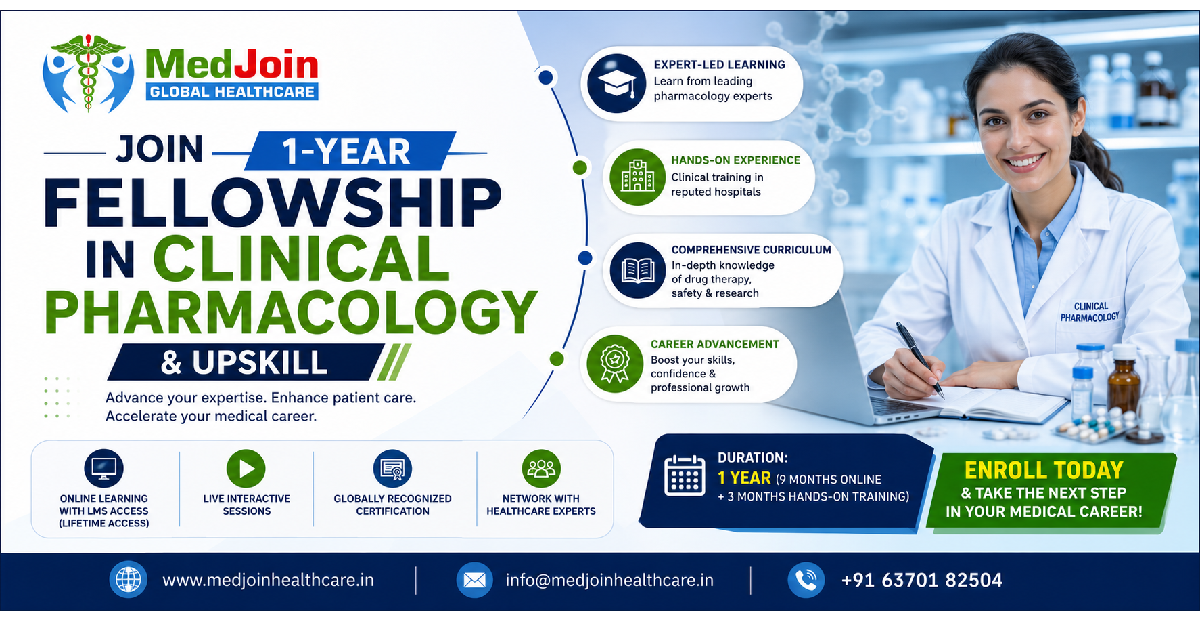
What is a 1-Year Fellowship in Clinical Pharmacology?
A 1-Year Fellowship in Clinical Pharmacology is an advanced professional training program that provides in-depth knowledge of drug sciences and their clinical applications.
The curriculum combines:
- Online learning
- Case-based discussions
- Live interactive sessions
- Clinical exposure
- Research-oriented learning
- Practical assignments
- Evidence-based medicine
The program aims to bridge the gap between academic knowledge and real-world clinical practice.
Who Should Enroll?
This fellowship is ideal for healthcare professionals who wish to specialize in Clinical Pharmacology and advance their careers.
Suitable candidates include:
- MBBS Doctors
- MD/MS Graduates
- General Practitioners
- Family Physicians
- Clinical Researchers
- Medical Officers
- Healthcare Consultants
- Pharmaceutical Professionals
- Medical Academicians
- Doctors preparing for research careers
Why Choose a Fellowship Instead of a Traditional Degree?
Many healthcare professionals cannot afford to leave their jobs for full-time education.
A fellowship offers several advantages:
Flexible Learning
Continue your clinical practice while studying online.
Industry-Relevant Curriculum
Focus on practical knowledge rather than purely theoretical concepts.
Expert Faculty
Learn from experienced clinicians, researchers, and industry experts.
Career-Oriented Training
Gain skills directly applicable to:
- Hospitals
- Pharmaceutical companies
- CROs
- Research organizations
- Academia
- Government agencies
Affordable and Time Efficient
Acquire advanced specialization within one year without interrupting your professional career.
Objectives of the Fellowship
The program is designed to enable participants to:
- Understand principles of Clinical Pharmacology
- Apply evidence-based medicine
- Interpret pharmacokinetic data
- Analyze pharmacodynamic responses
- Conduct clinical research
- Monitor drug safety
- Manage adverse drug reactions
- Understand drug regulations
- Improve prescribing practices
- Enhance patient outcomes
Skills You Will Develop
Upon completion, participants will develop competencies in:
Rational Prescribing
Learn how to prescribe medications safely and effectively.
Clinical Decision Making
Use evidence-based approaches to optimize therapy.
Drug Safety Monitoring
Recognize and manage adverse drug reactions.
Clinical Research
Understand study design, protocol development, and ethical principles.
Therapeutic Drug Monitoring
Interpret laboratory values for dosage adjustments.
Medical Literature Evaluation
Critically appraise clinical research publications.
Regulatory Knowledge
Understand guidelines issued by:
- CDSCO
- DCGI
- ICH
- US FDA
- EMA
- WHO
Key Learning Areas
The fellowship covers a broad spectrum of Clinical Pharmacology, including:
- Basic Pharmacology
- Advanced Pharmacology
- Clinical Therapeutics
- Drug Development
- Pharmacokinetics
- Pharmacodynamics
- Pharmacogenomics
- Clinical Trials
- Pharmacovigilance
- Drug Safety
- Biostatistics
- Research Methodology
- Regulatory Affairs
- Medical Writing
- Precision Medicine
- Artificial Intelligence in Drug Development
Why Healthcare Needs Clinical Pharmacologists
Healthcare systems face numerous challenges:
- Polypharmacy
- Antibiotic resistance
- Medication errors
- Rising healthcare costs
- Increasing elderly populations
- Complex chronic diseases
Clinical Pharmacologists contribute by:
- Optimizing medication regimens
- Reducing adverse drug events
- Supporting antimicrobial stewardship
- Improving therapeutic outcomes
- Guiding evidence-based prescribing
- Enhancing patient safety
Clinical Pharmacology in Modern Healthcare
Clinical Pharmacology supports nearly every medical specialty.
Examples include:
Cardiology
Optimizing anticoagulants, antihypertensives, lipid-lowering agents, and heart failure therapies.
Oncology
Individualizing chemotherapy dosing and monitoring toxicities.
Endocrinology
Managing insulin, oral antidiabetic drugs, thyroid medications, and hormone therapies.
Critical Care
Adjusting drug dosing in critically ill patients with altered pharmacokinetics.
Infectious Diseases
Selecting appropriate antimicrobials while minimizing resistance.
Pediatrics
Calculating weight-based dosing and monitoring safety.
Geriatrics
Managing polypharmacy and age-related pharmacological changes.
Career Opportunities After Completing the Fellowship
Graduates may pursue careers in:
Hospitals
- Clinical Pharmacologist
- Drug Safety Officer
- Therapeutic Consultant
Pharmaceutical Industry
- Medical Advisor
- Clinical Research Physician
- Pharmacovigilance Specialist
- Medical Affairs Manager
- Regulatory Affairs Associate
Clinical Research Organizations (CROs)
- Principal Investigator
- Clinical Trial Manager
- Medical Monitor
- Research Associate
Government Organizations
- Drug Regulatory Agencies
- Public Health Programs
- National Research Institutes
Academia
- Lecturer
- Faculty Member
- Research Scientist
Why This Fellowship Stands Out
A well-designed fellowship offers more than theoretical instruction. It provides practical exposure to real-world clinical scenarios, enabling participants to confidently apply pharmacological principles in patient care and research.
Key features include:
- Comprehensive one-year curriculum
- Flexible online learning
- Expert-led live sessions
- Case-based discussions
- Hands-on clinical training (where applicable)
- Research-focused assignments
- Continuous assessments
- Career-oriented skill development
- Certification upon successful completion
Case Study
Patient: 72-year-old male with chronic kidney disease and hypertension.
Clinical Challenge: The patient develops toxicity after receiving a standard dose of an aminoglycoside antibiotic.
Clinical Pharmacology Approach:
- Assess renal function.
- Review drug clearance.
- Measure serum drug concentrations.
- Adjust the dosing interval.
- Monitor kidney function and therapeutic response.
Outcome: Individualized dosing minimizes toxicity while maintaining effective antimicrobial therapy.
This case illustrates how pharmacokinetic principles directly influence safe prescribing.
Take the Next Step in Your Medical Career
If you are passionate about advancing your expertise in medication management, clinical research, drug safety, and evidence-based therapeutics, a 1-Year Fellowship in Clinical Pharmacology can help you achieve your professional goals. By developing specialized knowledge in one of healthcare's most dynamic fields, you can enhance patient care, expand your career opportunities, and contribute to the future of precision medicine.
Apply today and take the first step toward becoming an expert in Clinical Pharmacology.