
Radiology has become one of the most important areas of modern healthcare. With rapid advances in diagnostic imaging, healthcare professionals increasingly need strong knowledge of imaging techniques, interpretation principles, clinical correlation, and appropriate use of diagnostic modalities.
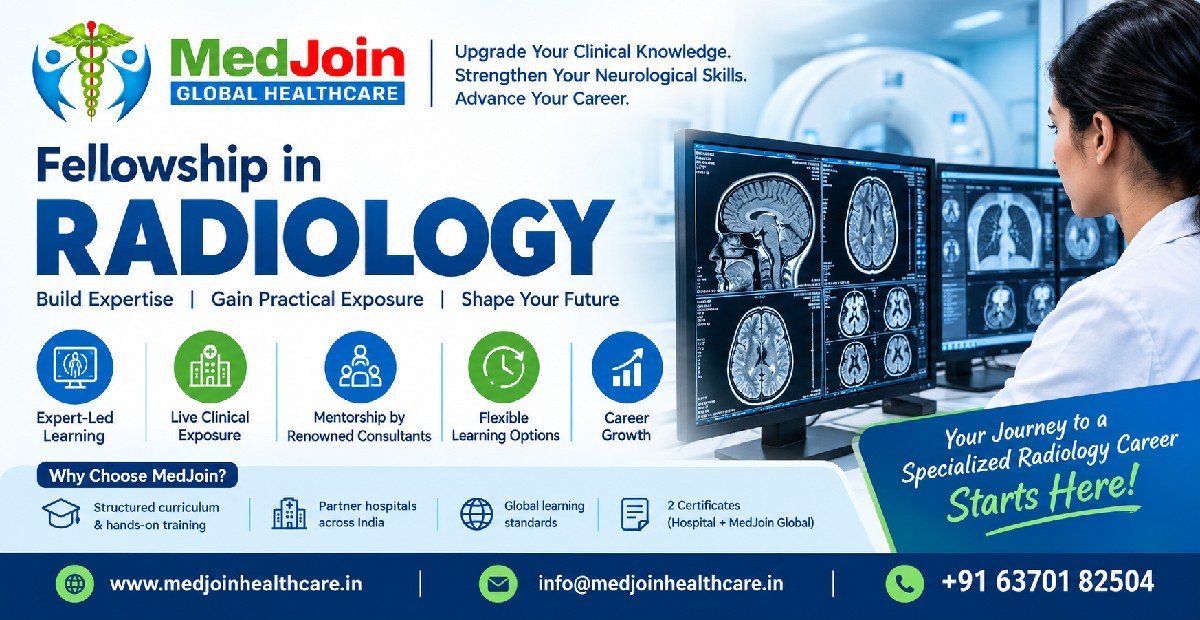
A 1-Year Fellowship in Radiology can provide doctors and eligible healthcare professionals with a structured opportunity to strengthen their knowledge of radiological concepts and develop practical familiarity with diagnostic imaging. Such fellowship programs can be particularly useful for medical professionals who want to expand their clinical knowledge, understand imaging-based diagnosis, or develop an additional area of professional expertise.
With the increasing use of X-ray, ultrasound, CT, MRI, Doppler studies, mammography, and other imaging technologies, radiology continues to play an important role in the diagnosis, treatment planning, monitoring, and follow-up of patients.
This comprehensive guide explains the 1-Year Fellowship in Radiology, including its fee, eligibility, curriculum, learning model, career scope, benefits, clinical exposure, professional opportunities, and frequently asked questions.
Important: A fellowship or certificate program should not be represented as equivalent to a recognized postgraduate medical degree or specialist qualification unless specifically recognized by the relevant statutory authority. Doctors should verify the recognition, scope of practice, and local regulatory requirements applicable to their intended role.
What Is a 1-Year Fellowship in Radiology?
A 1-Year Fellowship in Radiology is a structured educational program designed to provide advanced learning in radiology and diagnostic imaging over approximately 12 months.
Depending on the institution and program model, the fellowship may include:
- Online learning
- Live interactive classes
- Recorded lectures
- Learning Management System (LMS) access
- Case-based discussions
- Assignments and assessments
- Imaging interpretation exercises
- Clinical observership
- Hospital-based exposure
- Mentorship by experienced faculty
- Practical demonstrations where applicable
- Final examinations or assessments
The exact structure, curriculum, clinical exposure, certification, and eligibility requirements vary between institutions.
A well-structured program generally combines theoretical learning with case-based education so that learners can understand how radiological findings relate to clinical presentations.
Why Choose a Fellowship in Radiology?
Radiology has evolved considerably with the development of advanced imaging technologies. Diagnostic imaging is now routinely used across almost every major medical specialty.
A patient presenting with abdominal pain may require ultrasound or CT. A patient with neurological symptoms may require CT or MRI. Musculoskeletal injuries may require X-ray, ultrasound, CT, or MRI depending on the clinical situation.
Similarly, imaging plays an important role in:
- Emergency medicine
- Internal medicine
- Surgery
- Orthopedics
- Neurology
- Cardiology
- Obstetrics and gynecology
- Pediatrics
- Oncology
- Critical care
- Gastroenterology
- Urology
- Nephrology
- Rheumatology
For doctors who regularly encounter patients requiring diagnostic imaging, understanding radiological principles can improve clinical communication and help them better correlate imaging findings with the patient's history and examination.
A fellowship can therefore serve as an additional educational pathway for professionals seeking structured learning in diagnostic imaging.
1-Year Fellowship in Radiology Fee
One of the most important considerations before enrolling in a fellowship is the program fee.
The fee for a 1-Year Fellowship in Radiology can vary depending on factors such as:
- Institution
- Faculty
- Curriculum
- Online or hybrid model
- Duration
- Clinical exposure
- Hospital training
- LMS access
- Live classes
- Assessments
- Certification
- Case-based learning
- Additional academic resources
For a MedJoin Global Healthcare fellowship, prospective applicants should confirm the current Radiology Fellowship fee directly with the admissions team, as program fees and promotional offers may change.
What Can the Fellowship Fee Include?
Depending on the selected program model, the fee may cover:
- Admission and enrollment
- LMS access
- Structured learning modules
- Recorded lectures
- Live sessions
- Study materials
- Assignments
- Assessments
- Case discussions
- Academic support
- Examination
- Fellowship certificate
- Selected clinical/observership components where applicable
Students should always request a written fee structure and confirm exactly what is included before enrollment.
Is EMI Available for the Fellowship in Radiology?
Flexible payment options can make professional education more accessible to working doctors.
Where available, MedJoin Global Healthcare may provide easy EMI options, subject to applicable terms and payment-provider conditions.
Prospective students should confirm:
- Total program fee
- Initial payment
- Number of installments
- EMI eligibility
- Payment schedule
- Applicable processing charges
- Refund and cancellation policy
An installment-based payment structure can allow a doctor to continue professional education without necessarily paying the entire course fee at once.
Who Can Enroll in a Fellowship in Radiology?
Eligibility varies by program.
A fellowship in radiology may be designed primarily for medical professionals who want to develop knowledge in diagnostic imaging.
Depending on the specific program, eligibility may include:
- MBBS doctors
- Medical graduates
- Doctors from relevant clinical specialties
- Healthcare professionals meeting the institution's admission requirements
Applicants should check the official eligibility criteria before submitting an application.
If the program includes hospital-based clinical exposure, additional requirements may apply depending on the hospital and applicable regulations.
Is a Radiology Fellowship Suitable After MBBS?
Doctors who have completed MBBS may consider structured fellowship programs as an additional educational opportunity to expand their knowledge in selected clinical areas.
However, a fellowship should be understood according to its actual academic and regulatory status.
A 1-Year Fellowship in Radiology is not automatically equivalent to MD Radiodiagnosis, DNB Radiology, or another statutory postgraduate specialist qualification.
Doctors should distinguish between:
- Degree programs
- Recognized postgraduate qualifications
- Fellowships
- Certificates
- Continuing medical education
- Observerships
- Skill-development programs
Before enrolling, applicants should carefully examine the awarding institution, curriculum, certification, clinical component, and applicable professional regulations.
1-Year Radiology Fellowship Curriculum
A comprehensive curriculum can introduce learners to the fundamentals and applications of diagnostic imaging.
The exact syllabus varies by institution, but a structured radiology fellowship cover topics various topics, to know more about thr curriculam visit at Fellowship in Radiology page.
Online 1-Year Fellowship in Radiology
Online learning has become an increasingly common component of professional medical education.
An online radiology fellowship may provide:
- LMS access
- Recorded lectures
- Reading materials
- Digital modules
- Case studies
- Assignments
- Assessments
- Live classes
- Expert discussions
One of the key advantages is flexibility.
Working doctors may be able to study according to their professional schedule rather than attending physical classes every day.
LMS-Based Learning
A Learning Management System can provide a centralized academic environment.
Students may access:
- Course modules
- Topics
- Subtopics
- Recorded lectures
- Study materials
- Assignments
- Assessments
- Announcements
- Case discussions
Depending on the program, learners may receive access for the duration of the course or for an extended period.
Live Interactive Sessions
Live sessions can supplement recorded learning.
These sessions may provide opportunities to:
- Ask questions
- Discuss difficult cases
- Interact with faculty
- Review imaging examples
- Clarify concepts
- Participate in discussions
A combination of recorded and live education can provide both flexibility and interaction.
Clinical Exposure in a Radiology Fellowship
Clinical exposure varies significantly among fellowship programs.
Some programs may offer:
- Clinical observership
- Hospital exposure
- Imaging department observation
- Case discussions
- Supervised learning
- Practical demonstrations
If clinical training is included, students should confirm:
- Location
- Duration
- Hospital
- Faculty
- Scope of activities
- Accommodation arrangements
- Travel requirements
- Any additional expenses
Clinical exposure should not be assumed unless it is explicitly included in the program.
Is Clinical Training Mandatory?
The answer depends on the specific fellowship model.
A program may offer:
Online Model
The entire academic program is delivered online.
Hybrid Model
The program combines online education with a defined period of clinical exposure or observership.
Hospital-Based Model
The major component of learning occurs within a hospital or clinical environment.
Students should select the model that matches their educational goals, professional schedule, and regulatory requirements.
Career Scope After a Fellowship in Radiology
Radiology is closely connected with almost every clinical specialty.
A fellowship can potentially support professional development in areas involving:
- Clinical imaging knowledge
- Imaging-based case discussions
- Patient evaluation
- Clinical decision-making
- Communication with radiologists
- Interpretation awareness
- Further academic learning
However, the actual professional scope after completing a fellowship depends on the individual's primary qualification, registration, training, local regulations, employer requirements, and the specific nature of the fellowship.
A fellowship should not automatically be treated as authorization to independently perform or report radiological procedures.
Radiology Career Opportunities
Depending on their primary qualifications and applicable regulations, healthcare professionals with additional radiology education may find opportunities in environments where knowledge of diagnostic imaging is relevant.
Potential settings include:
- Hospitals
- Clinics
- Diagnostic centers
- Academic institutions
- Healthcare organizations
- Medical education
- Research environments
- Telemedicine-related services
- Healthcare technology companies
The availability and eligibility for specific positions depend on employer requirements and applicable professional regulations.
Benefits of a 1-Year Fellowship in Radiology
1. Structured Learning
A fellowship provides a defined curriculum rather than requiring learners to study radiology topics independently.
2. Comprehensive Exposure
A well-designed curriculum can introduce learners to multiple imaging modalities.
3. Case-Based Education
Clinical cases can make theoretical concepts more practical and easier to understand.
4. Flexible Learning
Online components can make education more accessible to working professionals.
5. Expert-Led Sessions
Faculty-led discussions can help learners understand complex imaging concepts.
6. Better Clinical Correlation
Radiology knowledge can help doctors correlate imaging findings with clinical symptoms and examination.
7. Professional Development
Additional education can contribute to a doctor's continuing professional development.
8. Multispecialty Relevance
Radiology knowledge has applications across numerous clinical specialties.
9. Exposure to Modern Imaging
Learners can develop familiarity with contemporary modalities such as CT and MRI.
10. Academic Growth
A fellowship may encourage further learning, research, case discussions, and specialization-related education.
Why Case-Based Radiology Learning Matters
Radiology cannot be fully understood through theoretical definitions alone.
A case-based approach can help learners understand:
Patient history → Clinical question → Imaging modality → Imaging findings → Differential diagnosis → Clinical correlation
For example, the same imaging finding may have different implications depending on:
- Age
- Symptoms
- Medical history
- Laboratory results
- Previous imaging
- Clinical examination
Therefore, clinical correlation is an essential part of radiology education.
Why Choose MedJoin Global Healthcare for a Fellowship in Radiology?
MedJoin Global Healthcare focuses on career-oriented healthcare education and provides structured learning opportunities for medical and healthcare professionals.
A MedJoin fellowship model can combine digital learning with interactive education and, where applicable, clinical exposure.
Key features may include:
- Structured LMS-based learning
- Recorded lectures
- Live interactive sessions
- Academic modules
- Case-based learning
- Assignments
- Assessments
- Expert-led discussions
- Flexible learning
- Clinical observership options where applicable
- Fellowship certification
The exact features available for the Radiology Fellowship should be confirmed with MedJoin Global Healthcare before enrollment.
MedJoin Global Healthcare Learning Approach
The learning approach can be structured around four important pillars:
Clinical Skills
Develop a stronger understanding of clinically relevant concepts.
Flexibility
Learn through online resources and flexible academic schedules where the program model allows.
Mentorship
Interact with experienced faculty through live sessions and academic discussions.
Career Growth
Build additional knowledge that can support long-term professional development.
Online + Clinical Learning Model
A hybrid fellowship may combine:
Online Learning + Live Sessions + Case Discussions + Clinical Exposure
This approach can be useful for professionals who want structured theoretical education along with exposure to real-world healthcare environments.
Where clinical exposure is available, students should confirm the duration, location, hospital, supervision, and scope before enrollment.
1-Year Fellowship in Radiology vs MD Radiodiagnosis
These are different educational pathways.
| Feature | 1-Year Fellowship | MD Radiodiagnosis |
|---|---|---|
| Nature | Fellowship/educational program | Postgraduate medical degree |
| Duration | Typically around 1 year | Longer formal postgraduate training |
| Curriculum | Focused on selected radiology areas | Comprehensive specialist training |
| Admission | Depends on program | Governed by applicable postgraduate admission rules |
| Recognition | Depends on awarding institution/program | Statutory medical qualification where recognized |
| Specialist qualification | Not automatically equivalent | Recognized postgraduate specialty qualification where applicable |
| Clinical training | Varies by fellowship | Structured postgraduate clinical training |
Therefore, students should choose according to their professional objectives and understand the distinction between a fellowship and a recognized specialist qualification.
Radiology Fellowship for General Practitioners
General practitioners frequently encounter patients who require diagnostic imaging.
Additional education in radiology can help them better understand:
- When imaging may be clinically relevant
- Basic imaging terminology
- Common imaging patterns
- Communication with radiologists
- Clinical correlation
- Imaging limitations
The fellowship should complement rather than replace appropriate specialist consultation.
Role of Artificial Intelligence in Radiology
Artificial intelligence is increasingly being studied and implemented across medical imaging.
Potential applications include:
- Image analysis
- Detection assistance
- Workflow prioritization
- Image segmentation
- Quantitative analysis
- Clinical decision support
- Reporting assistance
However, AI tools have limitations and should be used within appropriate clinical and regulatory frameworks.
Understanding both the capabilities and limitations of AI can become increasingly relevant for future healthcare professionals.
Future Scope of Radiology Education
Medical imaging technology continues to evolve.
Future areas of learning may include:
- Advanced MRI
- Artificial intelligence
- Radiomics
- 3D imaging
- Image-guided interventions
- Digital radiology
- Teleradiology
- Structured reporting
- Quantitative imaging
- Precision oncology
Healthcare professionals who continue updating their knowledge can remain familiar with developments in their field.
Radiology and Teleradiology
Digital connectivity has changed the way medical images can be shared.
Teleradiology can facilitate:
- Remote image review
- Specialist consultation
- After-hours reporting
- Communication between hospitals
- Access to radiological expertise
However, professional licensing, data protection, reporting responsibilities, and jurisdiction-specific regulations remain important considerations.
How a Radiology Fellowship Can Support Career Development
A fellowship may contribute to career development by helping learners:
- Expand their knowledge base
- Develop familiarity with imaging modalities
- Improve clinical correlation
- Participate in case discussions
- Strengthen professional confidence
- Build an academic portfolio
- Explore future areas of specialization
Career outcomes depend on individual qualifications, experience, regulatory requirements, and employment conditions.
Why Radiology Is an Important Area of Medical Education
Diagnostic imaging has become an integral part of modern healthcare.
From emergency departments to outpatient clinics, imaging helps healthcare teams investigate symptoms, identify abnormalities, monitor diseases, plan treatments, and assess outcomes.
As imaging technology becomes increasingly sophisticated, medical professionals can benefit from structured education that helps them understand:
- What imaging modality is being used?
- Why is it being used?
- What does the imaging show?
- How does it correlate with the clinical presentation?
- What are the limitations of the imaging method?
These questions form an important part of evidence-based clinical practice.
Enroll in a 1-Year Fellowship in Radiology
A 1-Year Fellowship in Radiology can provide a structured educational pathway for eligible medical professionals who want to strengthen their understanding of diagnostic imaging.
The potential benefits include:
- Structured curriculum
- Flexible learning
- Case-based education
- Exposure to multiple imaging modalities
- Live academic sessions
- Expert discussions
- Clinical exposure where applicable
- Professional development
- Broader clinical knowledge
Before enrolling, applicants should carefully review the current fee, eligibility, curriculum, certification, clinical training, and regulatory status of the specific fellowship.
For doctors seeking an additional educational experience in radiology, MedJoin Global Healthcare can provide information about its available fellowship model, curriculum, learning format, and enrollment process.
Ready to Explore a 1-Year Fellowship in Radiology?
If you are a medical professional interested in developing your knowledge of diagnostic imaging, explore the available Fellowship in Radiology options and speak with the MedJoin Global Healthcare admissions team.
Upgrade Your Clinical Knowledge. Strengthen Your Skills. Advance Your Career.