
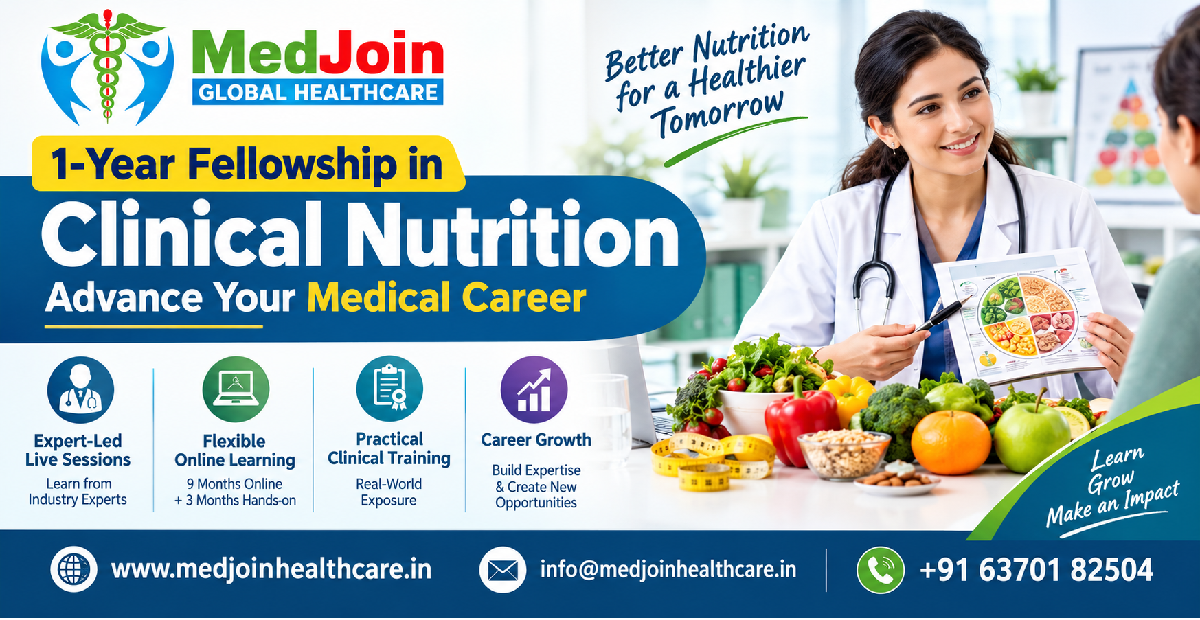
Clinical nutrition has evolved from simply advising patients what to eat into a sophisticated component of modern medical care. Nutrition influences metabolic health, obesity, diabetes, cardiovascular disease, kidney disease, gastrointestinal disorders, liver disease, cancer, critical illness, surgical recovery, geriatrics, pregnancy, and many other clinical conditions.
A 1-Year Fellowship in Clinical Nutrition can provide doctors and healthcare professionals with structured, clinically oriented training in nutritional assessment, medical nutrition therapy, obesity management, micronutrients, enteral and parenteral nutrition, nutrition in chronic disease, ICU nutrition, and multidisciplinary nutritional care.
Current international guidance increasingly emphasizes individualized, patient-centered nutrition care rather than one-size-fits-all diets. The 2026 ADA Standards, for example, emphasize individualized eating patterns based on nutritional quality, total energy, metabolic goals, preferences, and clinical circumstances. ESPEN has also continued updating disease-specific clinical nutrition guidance, including surgery, kidney disease, pancreatitis, IBD, cancer, ICU care, geriatrics, liver disease, and micronutrient management.
Important educational note: The following is a comprehensive curriculum/content framework for a fellowship program. The exact academic title, accreditation, eligibility, clinical privileges, certification, and scope of practice should be represented according to the institution and applicable regulatory requirements.
Introduction to Clinical Nutrition
Clinical nutrition is the application of nutritional science to the prevention, diagnosis, treatment, and supportive management of disease.
Traditionally, nutrition was considered an adjunct to medical treatment. Contemporary medicine recognizes nutrition as an integral component of clinical care.
A patient admitted with severe infection, for example, may develop:
- increased metabolic demand,
- muscle wasting,
- inadequate oral intake,
- electrolyte abnormalities,
- micronutrient deficiencies,
- altered glucose metabolism,
- gastrointestinal dysfunction,
- and increased risk of complications.
Similarly, a patient with obesity and type 2 diabetes may require coordinated nutritional, behavioral, pharmacological, and physical-activity interventions.
The clinical nutrition professional therefore needs to understand not only food composition but also:
- physiology,
- metabolism,
- endocrinology,
- gastroenterology,
- hepatology,
- nephrology,
- cardiology,
- oncology,
- critical care,
- surgery,
- pediatrics,
- geriatrics,
- pharmacology,
- behavioral medicine,
- and public health.
This interdisciplinary nature makes clinical nutrition an increasingly valuable area of postgraduate professional development.
Why Clinical Nutrition Matters in Modern Medicine
Nutrition affects virtually every organ system.
Poor nutritional status can contribute to:
- impaired immunity,
- delayed wound healing,
- sarcopenia,
- infection,
- prolonged hospitalization,
- functional decline,
- metabolic complications,
- poorer treatment tolerance,
- and increased healthcare utilization.
At the other end of the spectrum, excessive energy intake and unhealthy dietary patterns contribute to obesity and cardiometabolic disease.
The modern clinician therefore needs to recognize both:
Undernutrition
and
Overnutrition
while also identifying patients with:
Disease-associated malnutrition
and
Nutritional risk despite apparently normal body weight.
This is why clinical nutrition should not be reduced to "diet charts."
Fellowship Vision
The 1-Year Fellowship in Clinical Nutrition should aim to develop clinicians who can integrate nutrition into routine medical decision-making.
Core vision
To develop competent healthcare professionals capable of:
- Performing comprehensive nutritional assessment.
- Identifying nutritional risk and malnutrition.
- Developing individualized nutrition care plans.
- Applying evidence-based medical nutrition therapy.
- Managing obesity and metabolic disease.
- Understanding enteral and parenteral nutrition.
- Recognizing and managing micronutrient abnormalities.
- Supporting nutritional care in hospitalized and critically ill patients.
- Managing nutrition in common chronic diseases.
- Working effectively within multidisciplinary nutrition teams.
- Educating patients and caregivers.
- Evaluating nutritional interventions using measurable outcomes.
Fellowship Objectives
By completion of the fellowship, the learner should be able to:
Knowledge
- Explain normal human nutritional physiology.
- Describe macronutrient and micronutrient metabolism.
- Understand energy expenditure and energy balance.
- Explain nutritional requirements across the lifespan.
- Understand nutritional changes associated with disease.
- Describe mechanisms of malnutrition.
- Understand principles of medical nutrition therapy.
- Explain enteral and parenteral nutrition.
- Understand nutritional implications of major chronic diseases.
Clinical skills
The fellow should be able to:
- conduct nutrition-focused clinical assessment,
- interpret anthropometric measurements,
- identify nutritional risk,
- evaluate dietary intake,
- interpret relevant biochemical investigations,
- formulate nutritional diagnoses,
- calculate approximate energy and protein requirements,
- develop individualized nutrition plans,
- monitor treatment response,
- identify nutrition-related complications,
- and modify nutrition interventions according to clinical response.
Professional skills
The fellow should develop:
- patient communication,
- counseling,
- shared decision-making,
- multidisciplinary teamwork,
- clinical documentation,
- critical appraisal of literature,
- research skills,
- and ethical decision-making.
One-Year Fellowship Structure
A comprehensive one-year program can be organized into:
Phase I – Foundations
Months 1–3
Phase II – Applied Clinical Nutrition
Months 4–6
Phase III – Advanced Nutrition Medicine
Months 7–9
Phase IV – Advanced Clinical Practice, Research & Fellowship Project
Months 10–12
A blended structure can combine:
- online academic learning,
- live interactive classes,
- case discussions,
- webinars,
- journal clubs,
- clinical case presentations,
- assignments,
- supervised clinical exposure where applicable,
- practical demonstrations,
- research/project work,
- and final assessment.
Artificial Intelligence in Clinical Nutrition
AI can potentially assist with:
- dietary analysis,
- patient education,
- risk prediction,
- documentation,
- personalized recommendations,
- pattern recognition,
- clinical decision support,
- research.
However, fellows should understand limitations including:
- inaccurate data,
- algorithmic bias,
- privacy,
- hallucinated recommendations,
- lack of clinical context.
AI-generated nutritional advice should not replace professional assessment.
Career Opportunities
Clinical nutrition knowledge can complement careers in:
- hospitals,
- diabetes centers,
- obesity/metabolic clinics,
- preventive healthcare,
- wellness medicine,
- critical care,
- gastroenterology,
- nephrology,
- oncology,
- geriatrics,
- primary care,
- corporate wellness,
- healthcare education,
- research,
- telemedicine.
Career scope will depend on the learner's underlying professional qualification and applicable regulations.
Suggested Fellowship Competency Framework
At completion, the fellow should demonstrate competence in five domains.
Domain 1 – Scientific Knowledge
Understand:
- nutrition science,
- metabolism,
- nutrients,
- disease-nutrition interactions.
Domain 2 – Clinical Assessment
Perform:
- nutrition screening,
- nutritional assessment,
- dietary assessment,
- physical assessment.
Domain 3 – Clinical Management
Develop:
- MNT plans,
- oral nutrition strategies,
- enteral nutrition plans,
- parenteral nutrition principles.
Domain 4 – Communication
Demonstrate:
- counseling,
- motivational interviewing,
- patient education,
- multidisciplinary communication.
Domain 5 – Scholarship
Demonstrate:
- literature appraisal,
- research methodology,
- clinical audit,
- evidence-based decision-making.
How the Fellowship Can Upgrade a Medical Career
The value of a clinical nutrition fellowship lies not simply in adding another certificate to a professional profile.
Its greater value is in developing an additional clinical competency.
A physician who understands clinical nutrition can integrate nutritional considerations into:
- diabetes management,
- obesity treatment,
- cardiovascular prevention,
- CKD management,
- GI disease,
- liver disease,
- cancer care,
- critical care,
- geriatric medicine,
- and preventive medicine.
This can help develop a more comprehensive approach to patient care.
A Modern Career Positioning Strategy
After completing appropriate training, clinicians can position themselves around emerging areas such as:
Metabolic Health
Nutrition + obesity + diabetes + lifestyle medicine.
Clinical Nutrition
Nutrition assessment + disease-specific MNT + nutrition support.
Preventive Medicine
Nutrition + physical activity + cardiometabolic risk reduction.
Hospital Nutrition
Malnutrition + enteral nutrition + parenteral nutrition + multidisciplinary care.
Specialized Nutrition
Renal, GI, liver, oncology, critical care and geriatric nutrition.
Marketing Positioning for the Fellowship
For a medical education program, the fellowship can be positioned around the concept:
"Upgrade Your Medical Career with Clinical Nutrition Expertise"
Key value propositions
- 1-Year Advanced Fellowship
- Evidence-Based Clinical Nutrition
- Medical Nutrition Therapy
- Obesity & Metabolic Health
- Diabetes Nutrition
- Critical Care Nutrition
- Enteral & Parenteral Nutrition
- Renal, Liver & GI Nutrition
- Cancer & Geriatric Nutrition
- Clinical Case Discussions
- Research & Evidence-Based Practice
- Advanced Professional Development
Avoid presenting the fellowship as granting clinical privileges, specialist status, or statutory recognition unless the relevant institution/regulator formally provides those rights.
1-Year Fellowship in Clinical Nutrition
Upgrade Your Medical Career with Advanced Clinical Nutrition Expertise
Nutrition is no longer just about preparing a diet chart.
Today, clinical nutrition plays an important role in the prevention and management of obesity, diabetes, cardiovascular disease, kidney disease, gastrointestinal disorders, liver disease, cancer, critical illness, malnutrition, sarcopenia and metabolic disorders.
Join a structured 1-Year Fellowship in Clinical Nutrition designed to help healthcare professionals develop advanced knowledge and practical skills in modern nutrition medicine.
Move Beyond "Diet Advice"
Learn to approach nutrition clinically:
Assess → Diagnose → Personalize → Implement → Monitor → Modify
Upgrade Your Medical Career
Develop an additional area of clinical expertise that can complement your existing medical practice and help you deliver more comprehensive, patient-centered care.
Designed for Healthcare Professionals
Build advanced knowledge through structured academic learning, clinical case discussions, practical application, research activities and professional development.
Clinical Nutrition | Medical Nutrition Therapy | Metabolic Health | Nutrition Support
Start your journey toward advanced clinical nutrition expertise.
Recommended Evidence Base
The curriculum should be periodically updated rather than treated as a static textbook.
Particularly useful sources include:
- ESPEN clinical nutrition guidelines, which are regularly updated and currently cover areas such as ICU nutrition, cancer, surgery, kidney disease, liver disease, geriatrics, IBD, pancreatitis, intestinal failure and micronutrients.
- ADA Standards of Care in Diabetes—2026, particularly sections covering nutrition, obesity/weight management, diabetes and hospital care.
- Current peer-reviewed clinical nutrition literature.
- Relevant national and specialty-society recommendations.
- Institutional protocols for enteral/parenteral nutrition and nutrition support.
The ESPEN guideline platform was updated in 2026 and provides free access to its guideline resources, making it particularly useful for maintaining a fellowship curriculum.
Final Perspective
The future of medicine is increasingly moving from treating disease after it develops toward metabolic health, prevention, personalized care and multidisciplinary management.
Clinical nutrition sits directly at the intersection of these areas.
A well-designed 1-Year Fellowship in Clinical Nutrition can therefore provide structured education in:
Nutrition Science → Nutritional Assessment → Medical Nutrition Therapy → Disease-Specific Nutrition → Nutrition Support → Behavioral Change → Research → Advanced Clinical Practice
The ultimate objective should not be to produce professionals who simply know more about foods.
It should be to develop clinicians who can answer a much more important question:
"How can nutrition be safely and effectively integrated into the medical care of this individual patient?"
That is the central principle of modern clinical nutrition—and the foundation on which a meaningful Clinical Nutrition Fellowship should be built.