
Orthopedics is one of the most clinically demanding areas of medicine, combining detailed anatomical knowledge, diagnostic reasoning, trauma management, surgical principles, rehabilitation and long-term patient care. As populations age, sports participation increases and musculoskeletal disorders remain common, doctors increasingly seek focused training that can strengthen their understanding of orthopedic conditions and modern treatment approaches.
A Fellowship in Orthopedics can provide structured, specialty-focused education for eligible doctors who want to expand their knowledge and clinical exposure in musculoskeletal medicine. Depending on the institution, the program may combine online academic learning, live sessions, case discussions, assessments and clinical or hospital-based exposure.
A Fellowship in Orthopedics is a focused educational and training program designed to help doctors develop additional knowledge and practical exposure in orthopedic and musculoskeletal care.
Orthopedic medicine covers a broad spectrum of conditions involving:
- Bones
- Joints
- Muscles
- Ligaments
- Tendons
- Cartilage
- Spine
- Sports injuries
- Fractures
- Degenerative joint disease
- Musculoskeletal trauma
- Pediatric orthopedic conditions
- Rehabilitation
A well-designed fellowship can organize these areas into a structured curriculum rather than requiring doctors to learn them through fragmented clinical experience.
Depending on the provider, orthopedic fellowship programs may emphasize:
- Orthopedic clinical assessment
- Musculoskeletal examination
- Fracture management
- Trauma care
- Joint disorders
- Sports medicine
- Arthroscopy principles
- Joint replacement concepts
- Spine disorders
- Pediatric orthopedics
- Orthopedic imaging
- Rehabilitation
- Pain management
- Postoperative care
- Evidence-based orthopedic practice
The exact scope varies considerably between programs.
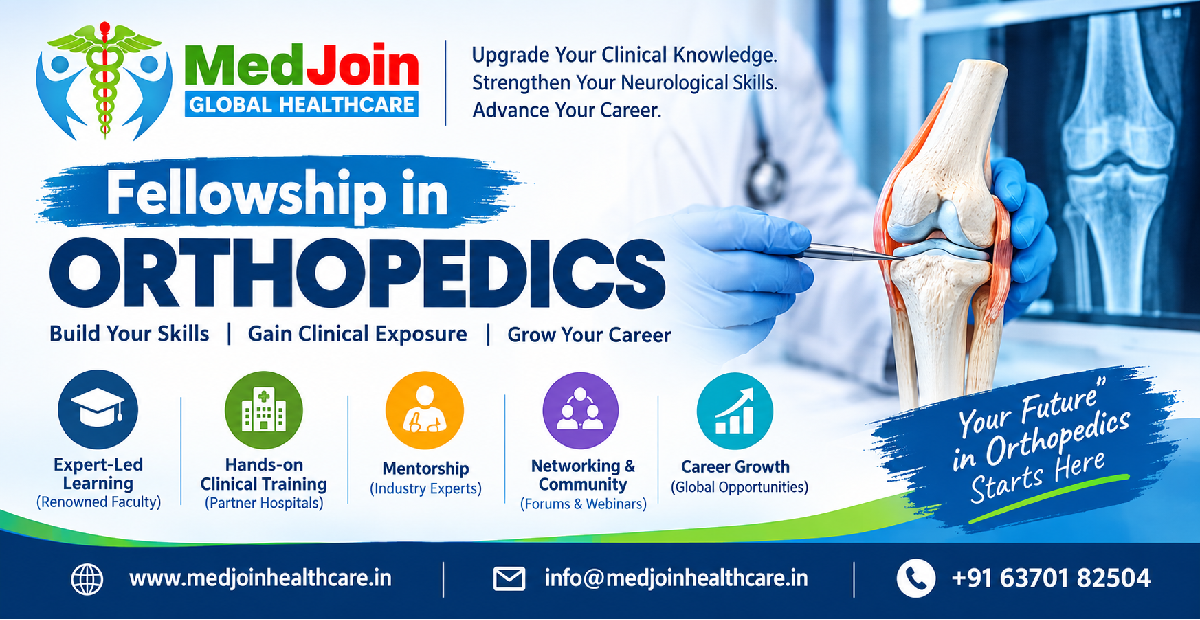
MedJoin Global Healthcare offer Fellowship in Orthopedics as a 12-month fellowship program. Its course page also describes eligibility for MBBS graduates, final-year applicants and doctors with MD/DNB/FNB/residency backgrounds. Because fees and admissions can change between batches, prospective applicants should confirm the current fee and inclusions directly before enrollment.
Why Orthopedic Training Is Important
Musculoskeletal problems can affect mobility, independence, productivity and quality of life.
Orthopedic presentations may range from relatively straightforward conditions such as uncomplicated fractures or osteoarthritis to complex problems involving:
- Polytrauma
- Multiple fractures
- Ligament injuries
- Tendon injuries
- Joint instability
- Spinal disorders
- Bone infections
- Bone tumors
- Pediatric deformities
- Degenerative joint disease
- Sports injuries
- Postoperative complications
Doctors working in primary care, emergency departments, hospitals and outpatient settings may encounter musculoskeletal complaints frequently.
Therefore, systematic orthopedic education can help doctors improve their approach to:
History → Examination → Differential diagnosis → Imaging → Diagnosis → Initial management → Referral → Rehabilitation
The NMC's postgraduate medical education framework emphasizes competency-based learning, theoretical knowledge, practical and clinical skills, communication, research methodology and continuing professional development.
These principles are also useful when evaluating the educational quality of a fellowship program.
Why Choose a Fellowship in Orthopedics?
Doctors may consider orthopedic fellowship training for different reasons.
Some may want to strengthen their clinical foundation after MBBS. Others may already be practicing and want structured exposure to orthopedic cases.
Common objectives include:
3.1 Building orthopedic knowledge
A fellowship can provide systematic learning across major orthopedic topics.
3.2 Improving clinical assessment
Doctors can develop a more structured approach to musculoskeletal history and examination.
3.3 Understanding orthopedic imaging
The curriculum may include interpretation of:
- X-rays
- CT scans
- MRI
- Ultrasound
- Bone scans
3.4 Understanding trauma management
Fracture and trauma modules can help doctors understand principles of:
- Initial stabilization
- Fracture classification
- Immobilization
- Reduction principles
- Surgical indications
- Postoperative management
- Rehabilitation
3.5 Exploring orthopedic subspecialties
Orthopedics includes several subspecialty areas, allowing doctors to identify their preferred area of further development.
Fellowship in Orthopedics Eligibility
Eligibility depends on the institution and the specific fellowship.
MedJoin Global Healthcare currently lists the following categories for its Fellowship in Orthopedics:
- MBBS graduates
- Final-year applicants
- MD/DNB/FNB doctors
- Residents working in healthcare
The course page specifically presents the fellowship as suitable for doctors interested in orthopedic surgery and musculoskeletal care.
Before applying, doctors should verify:
- Required medical qualification
- Registration requirements
- Whether internship completion is required
- Whether practicing doctors are eligible
- Whether overseas doctors are eligible
- Clinical training prerequisites
- Documentation requirements
- Whether clinical exposure is mandatory
Eligibility can differ between providers, so applicants should rely on the current admission criteria of the specific institution.
Is Fellowship in Orthopedics Worth the Investment?
The answer depends on the doctor's career objectives and the design of the program.
A fellowship can provide value when it offers structured learning, relevant faculty interaction, meaningful case exposure and measurable learning outcomes.
The potential value can come from:
Knowledge development
Systematic study of orthopedic conditions.
Clinical confidence
Greater familiarity with musculoskeletal examination and clinical decision-making.
Practical exposure
Where included, supervised clinical or hospital exposure can connect theoretical learning with real-world cases.
Professional development
A structured program demonstrates continued education in a defined clinical area.
Networking
Interaction with faculty, specialists and fellow doctors may create professional learning networks.
However, doctors should not assume that completion of a fellowship automatically confers specialist registration or independent authority to perform procedures. Those matters depend on applicable regulations, registration and institutional policies.
Fellowship vs MS Orthopedics vs DNB Orthopedics
This is an especially important distinction.
A fellowship and a recognized postgraduate medical qualification are not necessarily interchangeable.
In India, recognized postgraduate medical education is governed through the NMC regulatory framework. NMC's regulations distinguish formal postgraduate degree training from other forms of education and specify requirements around recognized institutions, curriculum, training, assessment and qualifications.
General comparison
| Feature | Fellowship in Orthopedics | MS Orthopedics | DNB Orthopedics |
|---|---|---|---|
| Typical purpose | Focused skill development | Formal postgraduate specialization | Formal postgraduate specialization |
| Duration | Varies | Typically 3 years | Typically 3 years |
| Admission pathway | Institution-specific | Regulated PG admission | Regulated PG admission |
| Recognition | Depends on provider/program | NMC-recognized qualification when applicable | NMC-recognized qualification when applicable |
| Clinical exposure | Varies | Extensive structured residency | Extensive structured residency |
| Surgical training | Depends on program | Structured | Structured |
| Best viewed as | Additional education/training | Specialist PG qualification | Specialist PG qualification |
The table should be understood as a general educational comparison, not as a substitute for current NMC rules.
NMC currently publishes postgraduate regulations, recognition regulations and minimum-standard requirements through its official regulatory framework.
Clinical Case-Based Learning
One of the valuable components of specialty-focused education is case-based learning.
For example:
Case 1: Knee Pain
A 48-year-old patient presents with chronic knee pain and morning stiffness.
The learner may work through:
- History
- Examination
- Differential diagnosis
- X-ray interpretation
- Severity assessment
- Conservative treatment
- Indications for referral
Case 2: Road Traffic Trauma
A patient presents after a high-energy accident.
The learner considers:
- Primary trauma assessment
- Limb deformity
- Neurovascular status
- Fracture assessment
- Imaging
- Immobilization
- Surgical referral
Case 3: Sports Injury
A football player presents with acute knee swelling after twisting injury.
The discussion may cover:
- Mechanism
- Examination
- ACL injury
- Meniscal pathology
- MRI indications
- Rehabilitation
- Return-to-sport principles
Case-based learning can connect textbook concepts with real-world clinical reasoning.
Benefits of a Fellowship in Orthopedics
Benefit 1: Focused Specialty Knowledge
A fellowship provides concentrated education rather than broad medical learning.
Doctors can spend structured time studying musculoskeletal disorders and orthopedic management.
Benefit 2: Structured Curriculum
A defined curriculum can make learning more organized.
Instead of learning orthopedic topics randomly, doctors can progress from:
Basic anatomy → Clinical examination → Imaging → Diagnosis → Treatment → Rehabilitation
Benefit 3: Clinical Exposure
Where a program includes hospital training or supervised clinical exposure, doctors can observe how orthopedic teams manage patients in real-world settings.
MedJoin has described clinical fellowship models that can integrate academic education with hospital-based exposure, depending on the program.
Benefit 4: Expert Faculty Interaction
Interaction with experienced orthopedic professionals can help learners understand:
- Clinical decision-making
- Difficult cases
- Surgical indications
- Complications
- Patient communication
- Evidence-based practice
Benefit 5: Case-Based Learning
Real-world cases can help doctors understand how textbook knowledge translates into patient management.
Benefit 6: Flexible Learning
For working doctors, an online component can make continuing education easier to manage.
MedJoin's current Orthopedics course is listed as an online, 12-month program.
Benefit 7: Professional Networking
Fellowship cohorts can create opportunities to interact with:
- Doctors
- Specialists
- Faculty
- Healthcare professionals
- Hospital teams
Networking may support academic collaboration and professional learning.
Benefit 8: Continuous Professional Development
Medicine changes rapidly.
Continuous education can help doctors stay updated with:
- New treatment approaches
- Updated guidelines
- Medical devices
- Imaging technologies
- Surgical innovations
- Rehabilitation strategies
Career Scope After Fellowship in Orthopedics
The career scope depends strongly on the doctor's underlying qualification, registration, experience, local regulations and the specific fellowship.
A fellowship can serve as additional training, rather than automatically changing a doctor's legal professional designation.
Potential professional directions may include:
31.1 Hospital-Based Clinical Roles
Doctors with appropriate qualifications may work in hospital environments where orthopedic knowledge is relevant.
Possible settings include:
- General hospitals
- Trauma centers
- Multispecialty hospitals
- Rehabilitation centers
- Community hospitals
- Emergency departments
Future Scope of Orthopedics
The orthopedic field is being transformed by technology.
Important developments include:
Robotic-assisted surgery
Robotic technologies are being incorporated into selected orthopedic procedures, particularly joint replacement.
Artificial intelligence
AI is increasingly being explored for:
- Imaging analysis
- Surgical planning
- Risk prediction
- Patient monitoring
- Rehabilitation
3D printing
Potential applications include:
- Surgical planning
- Patient-specific models
- Custom implants
- Prosthetic development
Navigation systems
Computer-assisted navigation can support selected orthopedic procedures.
Advanced implants
Continuous development is occurring in:
- Joint implants
- Trauma fixation
- Biomaterials
- Spinal implants
Digital rehabilitation
Technology is increasingly being incorporated into:
- Remote physiotherapy
- Activity monitoring
- Rehabilitation tracking
- Patient education
Future orthopedic professionals will increasingly need both clinical expertise and technological awareness.
Why Digital Learning Matters in Orthopedic Education
Medical education is no longer limited to classroom lectures.
Digital learning can provide:
- Recorded lectures
- Online resources
- Live sessions
- Digital assessments
- Case libraries
- Discussion forums
- Virtual demonstrations
- Literature resources
The advantage is flexibility.
Doctors can potentially study around:
- OPD schedules
- Hospital duties
- Clinical practice
- Emergency shifts
- Family responsibilities
However, digital education should complement—not falsely substitute for—clinical competency when hands-on skills are required.
Why Consider MedJoin Global Healthcare?
For doctors comparing orthopedic fellowship programs, MedJoin's model focuses on flexible medical education.
The platform's current course materials emphasize:
Expert-driven curriculum
The curriculum is designed around specialty-specific medical learning.
Flexible learning
Online access allows doctors to study alongside professional commitments.
Interactive learning
The platform describes case studies, practical assignments and interactive learning resources.
Professional networking
Doctors can interact with other healthcare professionals and learners.
Career development
Specialty-focused education can help doctors strengthen their professional knowledge base.
Is an Orthopedics Fellowship Suitable After MBBS?
This is one of the most important questions.
For an MBBS doctor, a fellowship can provide additional specialty-focused education. However, it should be viewed as supplementary training rather than an automatic replacement for recognized postgraduate specialization.
Doctors seeking formal specialist qualification should separately consider recognized postgraduate pathways such as MS/DNB and review current NMC requirements.
NMC's regulatory framework specifies formal postgraduate training requirements and distinguishes recognized postgraduate qualifications from other educational programs.
Therefore:
MBBS + Fellowship ≠ automatically equivalent to MS Orthopedics
Instead:
MBBS + Fellowship = additional focused education/training, subject to the program's structure and the doctor's existing legal scope of practice.
Can an MBBS Doctor Become an Orthopedic Surgeon Through a Fellowship?
A fellowship alone should not be represented as automatically making an MBBS doctor an orthopedic surgeon.
Formal specialist designation and independent surgical practice depend on recognized qualifications, registration, credentialing, institutional privileges and applicable regulations.
An MBBS doctor can use an orthopedic fellowship to:
- Improve knowledge
- Develop musculoskeletal assessment skills
- Learn orthopedic principles
- Understand trauma management
- Improve referral decisions
- Explore the specialty
- Prepare for further education
Doctors seeking independent specialist orthopedic surgical practice should pursue the appropriate recognized postgraduate pathway.
Fellowship and Career Development
Career development in medicine is rarely based on a single certificate.
A strong professional profile can combine:
Medical qualification + clinical experience + focused training + continuing education + communication + research + ethical practice
An orthopedic fellowship may contribute to the focused-training component.
Doctors should therefore think beyond:
"Will the certificate give me a job?"
A better question is:
"What competencies, knowledge and clinical exposure will I gain from this program, and how do they fit my long-term career plan?"
Fellowship in Orthopedics: Key Benefits at a Glance
| Benefit | Potential Value |
|---|---|
| Specialty-focused learning | Builds orthopedic knowledge |
| Structured curriculum | Organizes learning systematically |
| Case-based education | Develops clinical reasoning |
| Expert interaction | Exposure to specialist perspectives |
| Imaging education | Improves understanding of orthopedic investigations |
| Trauma education | Builds knowledge of injury assessment |
| Rehabilitation concepts | Supports holistic patient management |
| Flexible learning | Useful for working doctors |
| Networking | Connects healthcare professionals |
| Continuing education | Supports lifelong learning |
| Research exposure | Encourages evidence-based practice |
| Career development |
Adds focused training to an existing qualification |
Why Orthopedics Continues to Evolve
Orthopedic medicine is changing rapidly.
Future orthopedic care is likely to increasingly integrate:
- Artificial intelligence
- Robotics
- Digital imaging
- Navigation
- Personalized implants
- 3D printing
- Regenerative approaches
- Wearable technology
- Remote rehabilitation
- Data-driven outcomes
Doctors entering or continuing in this field therefore need a commitment to lifelong learning.
A fellowship can be one component of that journey.
A Fellowship in Orthopedics can provide focused education in musculoskeletal medicine, trauma, joint disorders, imaging, rehabilitation and orthopedic treatment principles.
For doctors considering this pathway, the most important considerations are not simply the certificate or advertised fee. The quality of the curriculum, faculty, clinical exposure, assessment, learning resources, transparency and regulatory positioning should all be evaluated.
At the same time, doctors should understand the distinction between a fellowship and a recognized postgraduate medical qualification. A fellowship can provide additional focused training, but it should not automatically be represented as equivalent to an MS/DNB qualification or as independently conferring specialist registration. Current NMC regulations and recognition requirements should be checked for any professional practice decision.
For a doctor who wants to strengthen orthopedic knowledge, explore musculoskeletal medicine, understand modern orthopedic practice and add structured specialty-focused education to an existing medical career, a carefully selected fellowship can be a useful part of a broader professional-development plan.
Start Your Orthopedic Learning Journey with MedJoin Global Healthcare
Learn. Develop. Advance Your Orthopedic Expertise.
For current admission details, batch dates, fee offers and program inclusions:
Website: www.medjoinhealthcare.in
Email: info@medjoinhealthcare.in
Phone: +91 63701 82504
*Fee, eligibility, curriculum, batch dates and program inclusions may change. Confirm the current details with MedJoin Global Healthcare before enrollment.