
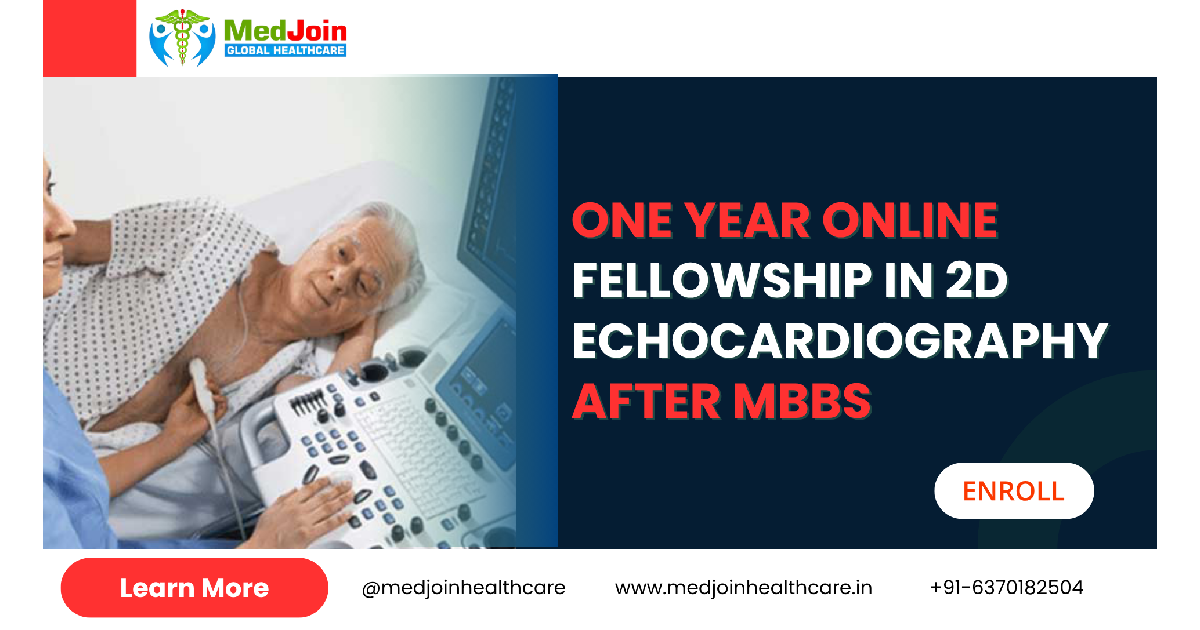
The field of cardiovascular medicine has evolved rapidly over the past few decades, with diagnostic imaging playing a central role in early detection, treatment planning, and patient monitoring. Among the various imaging modalities, 2D echocardiography stands out as a non-invasive, widely accessible, and highly informative technique. For MBBS graduates aiming to specialize or gain an edge in clinical practice, a one-year online fellowship in 2D echocardiography offers an excellent opportunity to acquire focused expertise.
This document provides a comprehensive overview of a one-year online fellowship in 2D echocardiography after MBBS, covering its structure, curriculum, eligibility, benefits, career prospects, and much more.
Understanding 2D Echocardiography
2D echocardiography (two-dimensional echocardiography) is an ultrasound-based imaging technique used to visualize the structure and function of the heart. It allows clinicians to assess cardiac chambers, valves, wall motion, and blood flow patterns in real time.
Key Features
- Non-invasive and safe
- Real-time imaging
- Widely available in clinical settings
- Cost-effective compared to other imaging modalities
- Essential for diagnosis of multiple cardiac conditions
Clinical Applications
- Evaluation of valvular heart disease
- Assessment of cardiomyopathies
- Detection of congenital heart defects
- Monitoring of heart failure
- Identification of pericardial diseases
Need for Specialized Training After MBBS
While MBBS provides a strong foundation in general medicine, it often lacks in-depth, hands-on exposure to advanced diagnostic tools such as echocardiography. With increasing demand for skilled professionals in cardiac imaging, additional training becomes essential.
Gaps in Undergraduate Training
- Limited exposure to echocardiography machines
- Lack of structured interpretation training
- Minimal hands-on practice
- Insufficient clinical correlation
Why a Fellowship?
A fellowship bridges the gap between theoretical knowledge and practical expertise. It provides structured learning, supervised training, and certification, enhancing both competence and confidence.
Overview of the One-Year Online Fellowship
The one-year online fellowship in 2D echocardiography is designed to provide comprehensive training through a combination of theoretical modules, virtual case discussions, video demonstrations, and optional hands-on workshops.
Program Duration
- Total duration: 12 months
- Flexible learning schedule
- Self-paced modules with deadlines
Mode of Delivery
- Online lectures and recorded sessions
- Live interactive webinars
- Case-based discussions
- Digital assessments
Certification
Upon successful completion, candidates receive a fellowship certificate, which can significantly enhance their professional credentials.
Eligibility Criteria
To enroll in this fellowship, candidates typically need:
- MBBS degree from a recognized institution
- Medical registration (state or national)
- Basic understanding of human anatomy and physiology
Some programs may also accept:
- Interns nearing completion of MBBS
- General practitioners
- Junior residents
Curriculum Structure
The curriculum is usually divided into modules, progressing from basic principles to advanced clinical applications.
Module 1: Basics of Ultrasound Physics
- Principles of ultrasound
- Image formation
- Probe selection and handling
- Artifacts and their interpretation
Module 2: Cardiac Anatomy and Physiology
- Detailed cardiac anatomy
- Hemodynamics
- Cardiac cycle
- Correlation with echocardiographic views
Module 3: Standard Echocardiographic Views
- Parasternal long-axis view
- Parasternal short-axis view
- Apical four-chamber view
- Subcostal and suprasternal views
Module 4: Chamber Quantification
- Measurement of cardiac chambers
- Left ventricular function assessment
- Ejection fraction calculation
Module 5: Valvular Heart Disease
- Mitral valve assessment
- Aortic valve pathology
- Tricuspid and pulmonary valves
- Stenosis and regurgitation grading
Module 6: Cardiomyopathies
- Dilated cardiomyopathy
- Hypertrophic cardiomyopathy
- Restrictive cardiomyopathy
Module 7: Pericardial Diseases
- Pericardial effusion
- Cardiac tamponade
- Constrictive pericarditis
Module 8: Congenital Heart Diseases
- Atrial septal defect
- Ventricular septal defect
- Patent ductus arteriosus
Module 9: Advanced Topics
- Doppler echocardiography
- Tissue Doppler imaging
- Stress echocardiography
Module 10: Case Studies and Clinical Integration
- Real-life case discussions
- Diagnostic reasoning
- Reporting and documentation
Teaching Methodology
The fellowship employs a blended learning approach to ensure comprehensive understanding.
Online Lectures
Recorded lectures allow students to learn at their own pace.
Live Sessions
Interactive webinars enable direct communication with faculty.
Case-Based Learning
Real clinical cases enhance diagnostic skills and critical thinking.
Video Demonstrations
Step-by-step demonstrations of echocardiographic techniques.
Assessment and Evaluation
Assessment is continuous and multi-dimensional.
Types of Assessments
- Multiple-choice questions (MCQs)
- Image interpretation tests
- Case-based discussions
- Final examination
Certification Criteria
- Minimum attendance in live sessions
- Passing score in assessments
- Completion of assignments
Hands-On Training Opportunities
Although the program is online, many institutions offer optional hands-on workshops.
Importance of Hands-On Training
- Improves probe handling skills
- Enhances image acquisition techniques
- Builds confidence in real-world settings
Workshop Features
- Supervised scanning sessions
- Use of real echocardiography machines
- Feedback from experienced cardiologists
Advantages of an Online Fellowship
Flexibility
- Learn at your own pace
- Suitable for working professionals
Accessibility
- No geographical constraints
- Access to global faculty
Cost-Effectiveness
- Lower fees compared to traditional programs
- Savings on travel and accommodation
Skill Enhancement
- Focused training in a high-demand area
- Improved diagnostic capabilities
Career Opportunities After Completion
A fellowship in 2D echocardiography opens multiple career pathways.
Clinical Practice
- Work in hospitals and clinics
- Assist cardiologists in diagnosis
Diagnostic Centers
- Perform echocardiography independently
- Generate diagnostic reports
Academic Roles
- Teaching positions in medical institutions
- Training junior doctors
Research Opportunities
- Participate in clinical studies
- Publish research papers
Telemedicine
- Remote reporting and consultations
- Collaboration with global healthcare providers
Scope in India and Globally
In India
- Rising burden of cardiovascular diseases
- Increasing demand for skilled echocardiographers
- Expansion of diagnostic centers
Globally
- High demand in developed countries
- Opportunities in tele-echocardiography
- Scope for further specialization
Challenges and Limitations
Limited Hands-On Exposure
Online format may restrict practical training.
Self-Discipline Required
Students must be motivated to complete modules.
Variable Recognition
Not all fellowships are equally recognized.
Choosing the Right Fellowship Program
Factors to Consider
- Accreditation and recognition
- Faculty expertise
- Curriculum depth
- Availability of hands-on training
- Alumni reviews
Future Trends in Echocardiography
- Integration with artificial intelligence
- 3D and 4D echocardiography
- Portable and handheld devices
- Tele-echocardiography advancements
A one-year online fellowship in 2D echocardiography after MBBS is a valuable investment for medical professionals seeking to enhance their diagnostic skills and career prospects. With the growing burden of cardiovascular diseases and the increasing reliance on imaging, expertise in echocardiography is becoming indispensable.
This fellowship not only bridges the gap between theoretical knowledge and clinical practice but also opens doors to diverse career opportunities. With the right program, dedication, and hands-on practice, candidates can significantly elevate their professional journey in the field of cardiovascular medicine.