
Haematology is one of the most rapidly advancing specialties in modern medicine, playing a pivotal role in diagnosing, treating, and managing disorders related to blood, bone marrow, lymphatic tissues, and the immune system. As healthcare systems worldwide continue to face increasing incidences of anemia, blood cancers, bleeding disorders, thrombosis, and genetic blood diseases, the demand for healthcare professionals with specialized knowledge in haematology has grown significantly.
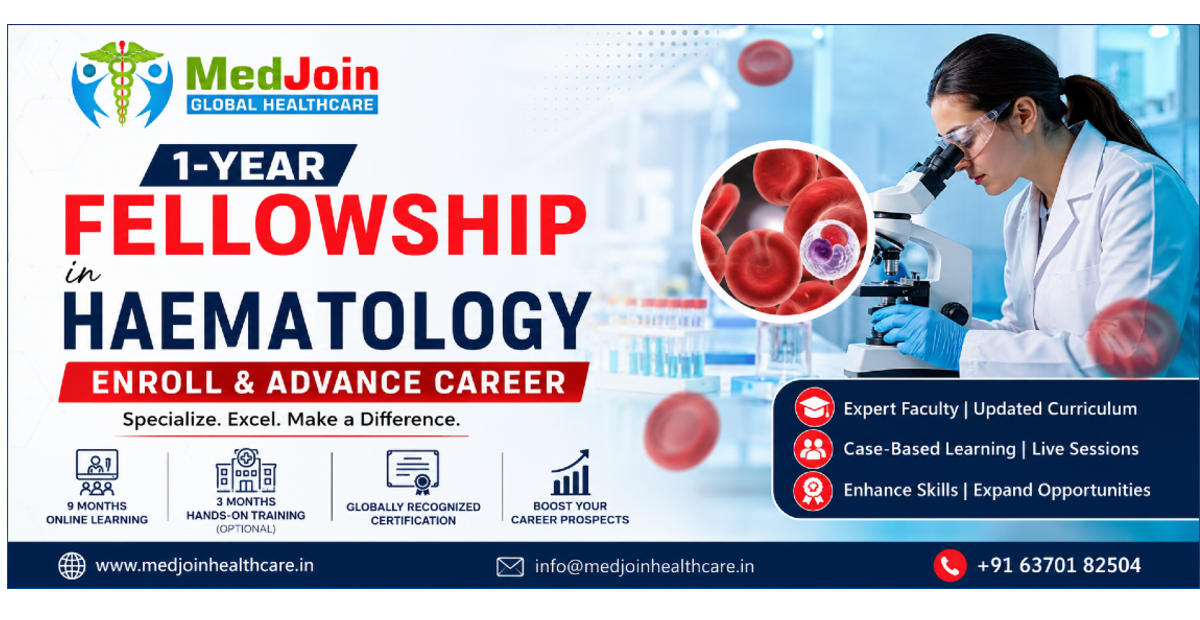
For MBBS graduates, postgraduate doctors, and physicians looking to advance their clinical expertise, enrolling in a 1-Year Fellowship in Haematology provides an excellent opportunity to build specialized knowledge, enhance clinical decision-making skills, and improve career prospects in hospitals, diagnostic centers, blood banks, academic institutions, and research organizations.
The fellowship is designed to bridge the gap between undergraduate medical education and specialty-level clinical practice by providing comprehensive training in both theoretical concepts and practical applications of haematology. Participants gain a thorough understanding of blood disorders, laboratory investigations, bone marrow pathology, transfusion medicine, hematologic malignancies, coagulation disorders, and the latest advances in precision medicine.
Whether you aspire to work in tertiary care hospitals, establish a specialized clinical practice, pursue academics, or contribute to medical research, a structured fellowship program equips you with the skills required to excel in today's evolving healthcare environment.
Why Haematology is One of the Most Important Medical Specialties
Blood is often described as the "river of life" because it transports oxygen, nutrients, hormones, immune cells, and waste products throughout the body. Even minor abnormalities in blood composition can significantly affect multiple organ systems.
Haematologists play an essential role in diagnosing conditions that may initially present with nonspecific symptoms such as fatigue, fever, weight loss, bruising, recurrent infections, or unexplained bleeding.
Their expertise extends across numerous clinical domains including:
- Red blood cell disorders
- White blood cell disorders
- Platelet abnormalities
- Coagulation disorders
- Bone marrow diseases
- Hematological malignancies
- Blood transfusion medicine
- Stem cell transplantation
- Laboratory haematology
- Molecular diagnostics
Modern healthcare increasingly depends upon accurate laboratory interpretation, making haematology an indispensable specialty for clinicians across internal medicine, oncology, pediatrics, surgery, obstetrics, emergency medicine, and critical care.
What is Haematology?
Haematology is the branch of medicine dedicated to studying blood and blood-forming organs. It involves understanding the physiology, pathology, diagnosis, treatment, and prevention of diseases affecting:
- Blood cells
- Bone marrow
- Lymphatic system
- Coagulation pathways
- Plasma proteins
- Immune mechanisms
The specialty integrates clinical medicine with advanced laboratory sciences, enabling physicians to accurately diagnose complex disorders using hematological investigations and evidence-based treatment protocols.
A haematologist combines clinical expertise with laboratory interpretation to provide comprehensive care for patients with benign and malignant blood disorders.
The Growing Need for Haematology Specialists
Healthcare systems globally are witnessing a sharp increase in the prevalence of hematological diseases due to several factors:
Aging Population
Older adults are more susceptible to:
- Myelodysplastic syndrome
- Leukemia
- Multiple myeloma
- Lymphoma
- Chronic anemia
- Venous thromboembolism
The expanding geriatric population has created greater demand for physicians trained in blood disorders.
Rising Cancer Burden
Blood cancers account for a significant proportion of all cancer diagnoses.
Common hematologic malignancies include:
- Acute leukemia
- Chronic leukemia
- Hodgkin lymphoma
- Non-Hodgkin lymphoma
- Multiple myeloma
- Myeloproliferative neoplasms
Early diagnosis dramatically improves patient outcomes, making specialist training increasingly valuable.
Increasing Lifestyle Disorders
Modern lifestyles contribute to numerous hematological complications through:
- Obesity
- Diabetes
- Smoking
- Chronic inflammation
- Cardiovascular disease
These factors elevate the risk of thrombosis, coagulation abnormalities, and vascular disorders.
Improved Diagnostic Technologies
The rapid evolution of diagnostic tools—including flow cytometry, molecular testing, cytogenetics, and next-generation sequencing—has transformed the practice of haematology. Physicians must continually update their knowledge to interpret these advanced investigations effectively.
Why Pursue a 1-Year Fellowship in Haematology?
Medical education provides foundational knowledge of blood disorders, but advanced clinical practice requires focused training.
A fellowship allows doctors to develop expertise in:
- Advanced diagnostics
- Clinical decision-making
- Laboratory interpretation
- Evidence-based treatment
- Complex patient management
- Multidisciplinary collaboration
It also provides structured exposure to real-world cases encountered in modern clinical practice.
Benefits of Enrolling in a Fellowship in Haematology
1. Specialized Clinical Knowledge
Participants gain comprehensive understanding of:
- Red blood cell physiology
- White blood cell disorders
- Platelet function
- Bone marrow pathology
- Hemostasis
- Coagulation mechanisms
- Blood cancers
This specialized knowledge enhances confidence in clinical decision-making.
2. Improved Diagnostic Skills
Doctors learn to interpret:
- Complete blood count (CBC)
- Peripheral blood smear
- Reticulocyte count
- Coagulation profile
- Iron studies
- Vitamin assays
- Bone marrow aspiration
- Bone marrow biopsy
- Flow cytometry
- Cytogenetics
- Molecular diagnostics
Accurate interpretation leads to earlier diagnosis and improved patient outcomes.
3. Better Career Opportunities
A fellowship enhances employability in:
- Multispecialty hospitals
- Cancer centers
- Blood banks
- Diagnostic laboratories
- Academic institutions
- Medical colleges
- Research organizations
- Clinical trial units
Employers increasingly value physicians with additional specialty training.
4. Increased Professional Recognition
Advanced qualifications demonstrate commitment to lifelong learning and continuous professional development, strengthening your professional profile.
5. Practical Learning
Many fellowship programs incorporate:
- Clinical case discussions
- Interactive lectures
- Expert mentorship
- Laboratory demonstrations
- Optional hands-on clinical exposure
This combination of theoretical and practical training supports better application of knowledge in clinical settings.
Core Areas Covered During the Fellowship
The curriculum typically includes:
Basic Haematology
- Blood formation
- Hematopoiesis
- Blood cell morphology
- Blood physiology
Red Blood Cell Disorders
- Iron deficiency anemia
- Megaloblastic anemia
- Hemolytic anemia
- Aplastic anemia
- Hemoglobinopathies
White Blood Cell Disorders
- Leukocytosis
- Leukopenia
- Neutropenia
- Eosinophilia
- Leukemia
Platelet Disorders
- Thrombocytopenia
- Thrombocytosis
- Platelet dysfunction
Coagulation Disorders
- Hemophilia
- Von Willebrand disease
- Disseminated intravascular coagulation
- Deep vein thrombosis
Blood Cancers
- Acute leukemia
- Chronic leukemia
- Multiple myeloma
- Lymphoma
- Myelodysplastic syndrome
Transfusion Medicine
- Blood grouping
- Compatibility testing
- Blood components
- Massive transfusion protocols
- Adverse transfusion reactions
Laboratory Haematology
- Peripheral smear interpretation
- Bone marrow examination
- Flow cytometry
- Molecular diagnostics
Essential Skills You Will Develop
Upon completion of the fellowship, participants are expected to strengthen skills in:
- Clinical evaluation of hematological disorders
- Interpretation of laboratory investigations
- Differential diagnosis
- Evidence-based management
- Patient counseling
- Multidisciplinary collaboration
- Clinical documentation
- Research appraisal
- Diagnostic reasoning
- Professional communication
Career Scope of Haematology (2026–2035)
The future of haematology is exceptionally promising due to rapid advances in diagnostics, personalized medicine, and cancer care. Specialists with focused training are likely to find opportunities in:
- Super-specialty hospitals
- Oncology centers
- Bone marrow transplant units
- Blood banks
- Clinical laboratories
- Academic institutions
- Pharmaceutical companies
- Clinical research organizations
- Public health programs
- Telemedicine platforms
As healthcare systems continue to emphasize early diagnosis and precision treatment, expertise in haematology will remain highly relevant.
A 1-Year Fellowship in Haematology offers a structured pathway for doctors to deepen their understanding of blood disorders, refine diagnostic skills, and enhance their professional growth. With the increasing burden of hematological diseases and ongoing innovations in diagnostics and therapeutics, specialized training can help clinicians deliver better patient care while expanding their career opportunities.
A 1-Year Fellowship in Haematology provides in-depth exposure to the science and practice of blood disorders, integrating clinical medicine with advanced diagnostics and transfusion medicine. Through a comprehensive curriculum, case-based discussions, and evidence-based learning, participants build the expertise needed to manage a wide range of hematological conditions.
Clinical Applications, Emerging Technologies, Career Growth & Future Scope (2026–2035)
Healthcare is rapidly evolving, and haematology is among the specialties experiencing the greatest transformation. Advances in molecular diagnostics, immunotherapy, precision medicine, artificial intelligence (AI), and stem cell transplantation have significantly improved the diagnosis and treatment of blood disorders.
A 1-Year Fellowship in Haematology prepares healthcare professionals to meet these evolving clinical demands by combining evidence-based medical knowledge with practical diagnostic and therapeutic skills.
Artificial Intelligence in Haematology
Artificial intelligence is reshaping diagnostic medicine.
Current applications include:
Automated Blood Smear Analysis
AI-assisted image recognition improves:
- Cell classification
- Detection of abnormal morphology
- Diagnostic consistency
Predictive Analytics
Machine learning models help predict:
- Disease progression
- Treatment response
- Relapse risk
- Survival outcomes
Laboratory Automation
AI enhances:
- Workflow efficiency
- Quality control
- Error reduction
- Report generation
Clinical Decision Support
Decision-support systems assist physicians by integrating laboratory results, clinical findings, and evidence-based recommendations.
While AI enhances efficiency, clinical judgment remains indispensable.
Molecular Diagnostics
Modern haematology increasingly relies on advanced molecular techniques.
Participants are introduced to:
- Polymerase Chain Reaction (PCR)
- Fluorescence In Situ Hybridization (FISH)
- Cytogenetic analysis
- Next-Generation Sequencing (NGS)
- Gene mutation profiling
These technologies support accurate diagnosis, prognosis, and treatment selection.
Immunotherapy in Blood Cancers
Immunotherapy has revolutionized hematologic oncology.
Key concepts include:
- Monoclonal antibodies
- CAR-T cell therapy
- Immune checkpoint inhibitors
- Bispecific antibodies
- Targeted immunotherapy
Although highly specialized, understanding these therapies helps clinicians participate in multidisciplinary cancer care.
Stem Cell Transplantation
Stem cell transplantation offers curative treatment for several hematological diseases.
Participants learn:
- Indications
- Donor selection
- Conditioning regimens
- Graft-versus-host disease
- Post-transplant monitoring
- Infection prevention
This knowledge is valuable even for physicians who refer patients to transplant centers.
Research Opportunities
Haematology is a research-intensive specialty with continuous innovations.
Doctors can contribute to:
- Clinical trials
- Translational research
- Molecular genetics
- Artificial intelligence applications
- Drug development
- Biomarker discovery
- Population health studies
Research involvement strengthens academic credentials and professional growth.
Academic Career Path
A fellowship also supports careers in medical education.
Graduates may participate in:
- Teaching undergraduate students
- Postgraduate training
- Continuing medical education (CME)
- Faculty development
- Medical writing
- Clinical guideline development
Strong academic skills are increasingly valued in teaching hospitals and universities.
Salary and Career Growth (Indicative)
Compensation varies depending on qualifications, location, experience, and employer. A fellowship in haematology can enhance professional competitiveness and may contribute to career progression into senior clinical, academic, or research roles. Salary growth is influenced by factors such as additional certifications, years of experience, institutional responsibilities, and regional healthcare demand.
Global Demand for Haematology Professionals
Healthcare systems worldwide continue to experience increasing demand due to:
- Aging populations
- Rising cancer incidence
- Expansion of diagnostic laboratories
- Personalized medicine
- Bone marrow transplantation programs
- Advanced cancer care
Countries across Asia, the Middle East, Europe, Australia, and North America continue investing in hematology services and laboratory infrastructure.
Haematology is at the forefront of modern medicine, integrating laboratory science, clinical care, oncology, immunology, genetics, and precision medicine. With advances in AI, molecular diagnostics, targeted therapies, and stem cell transplantation, clinicians equipped with specialized knowledge are increasingly valuable across healthcare systems.
A 1-Year Fellowship in Haematology offers an opportunity to strengthen clinical expertise, stay current with evolving medical practices, and expand career prospects in hospitals, diagnostic services, research, and academia.