
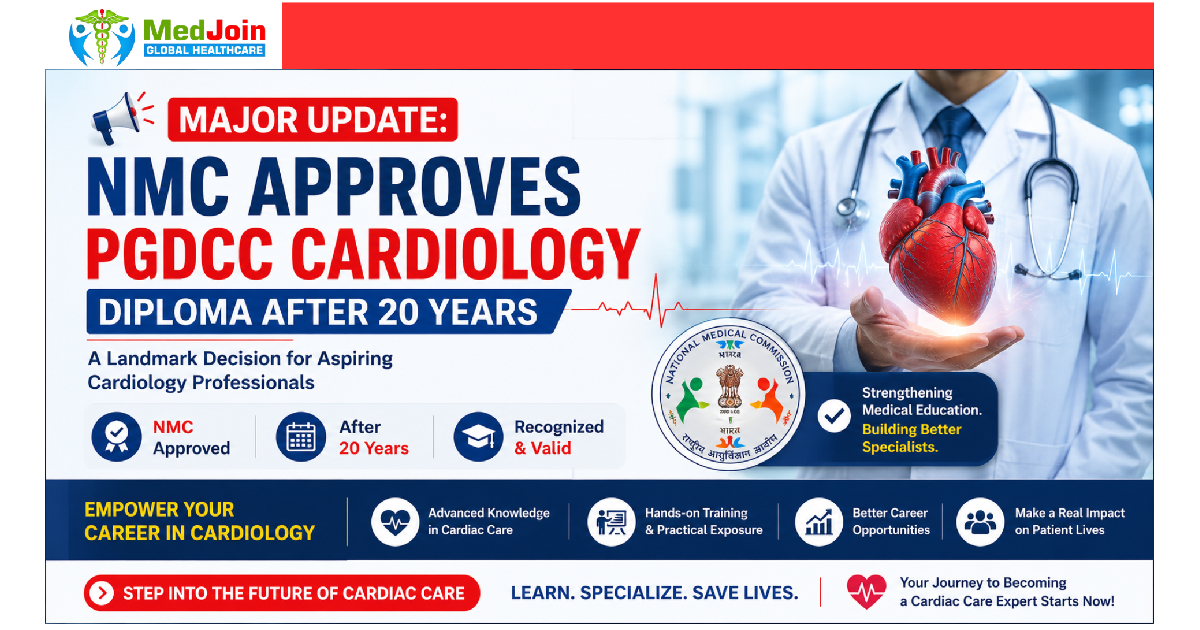
In a landmark decision for India’s healthcare and medical education landscape, the National Medical Commission (NMC) has granted formal recognition to the Post Graduate Diploma in Clinical Cardiology (PGDCC), ending a prolonged regulatory and legal struggle that spanned nearly two decades. This move not only validates the qualifications of thousands of doctors but is also expected to significantly improve access to cardiac care across the country.
Background: A Diploma in Limbo
The PGDCC programme was introduced in 2006 by Indira Gandhi National Open University (IGNOU) to address India’s acute shortage of cardiology specialists. The course trained MBBS doctors in non-invasive cardiology, enabling them to diagnose, manage, and refer cardiac cases effectively.
However, despite its practical relevance, the diploma ran into regulatory hurdles:
- The erstwhile Medical Council of India (MCI) refused recognition.
- The programme lacked prior approval under existing medical education regulations.
- The qualification nomenclature was not included in official postgraduate frameworks.
As a result, although over 1,700 doctors completed the course between 2006 and 2013, their degrees remained unrecognized for years, limiting career progression and formal acceptance in government systems.
The Turning Point: NMC Recognition
After years of legal petitions, policy discussions, and advocacy—particularly by the Indian Association of Clinical Cardiologists (IACC)—the NMC has now granted retrospective recognition to the PGDCC qualification.
Key highlights of the decision include:
- Recognition applies to all students enrolled between 2006 and 2013.
- The diploma has been redesignated as Clinical Cardio Physician (Non-Invasive) (PGDCCP-NI).
- The decision effectively ends a 20-year regulatory deadlock.
- Around 1,700 doctors will now have formally recognized qualifications.
This recognition follows approvals from the Union Health Ministry and internal NMC deliberations in 2025.
Why This Matters: Bridging India’s Cardiology Gap
India faces a significant shortage of heart specialists:
- Only about 5,000–6,000 cardiologists serve a population of over 1.4 billion.
- Cardiovascular diseases account for nearly 28% of all deaths in the country.
The PGDCC-trained doctors are not full-fledged cardiologists but play a crucial intermediary role:
- Early detection of heart disease
- Stabilisation of cardiac emergencies
- Preventive care and patient counselling
- Referral of complex cases to tertiary centres
Experts believe that integrating these practitioners into the healthcare system will:
- Reduce pressure on urban cardiac centres
- Improve access in tier-2 and tier-3 cities
- Enable earlier diagnosis and treatment
Impact on Doctors and Careers
For PGDCC graduates, the NMC’s decision is transformative:
- Their qualifications are now legally valid and recognized
- They become eligible for government jobs and public health roles
- Professional credibility and career mobility improve significantly
For many, this decision resolves years of uncertainty, as they had been practicing without formal recognition despite possessing specialized training.
Role of IGNOU and the Programme’s Reach
Indira Gandhi National Open University, one of the world’s largest open universities, conducted the PGDCC programme through a network of institutions across India.
- The course was offered at dozens of centres nationwide
- It focused on practical, non-invasive cardiology skills
- It targeted general physicians seeking specialization
Despite its discontinuation in 2013 due to regulatory issues, the programme continued to be seen as a viable solution to India’s specialist shortage.
Policy and Healthcare Significance
The recognition is being viewed as a policy shift with broader implications:
1. Strengthening Mid-Level Specialization
India’s healthcare system increasingly relies on mid-level specialists to fill gaps in rural and semi-urban areas.
2. Flexible Medical Education Pathways
The move signals openness toward alternative training models, including distance and hybrid medical education.
3. Legal Precedent
It demonstrates that long-pending qualification disputes can be resolved through regulatory reform and advocacy.
Challenges and Considerations
While the move is widely welcomed, some concerns remain:
- PGDCC holders are limited to non-invasive cardiology practice
- Clear guidelines are needed to define their scope of work
- Integration into the healthcare system must be structured and monitored
Ensuring quality and patient safety will be crucial as these practitioners are formally absorbed into the system.
The NMC’s recognition of the PGDCC cardiology diploma marks a decisive step in aligning medical education with India’s healthcare needs. By validating the qualifications of over 1,700 doctors and enabling their integration into the formal system, the decision not only corrects a long-standing regulatory anomaly but also strengthens the country’s capacity to tackle its growing cardiovascular disease burden.
After a wait of nearly two decades, the move stands as a significant milestone—both for affected doctors and for India’s evolving healthcare framework.