
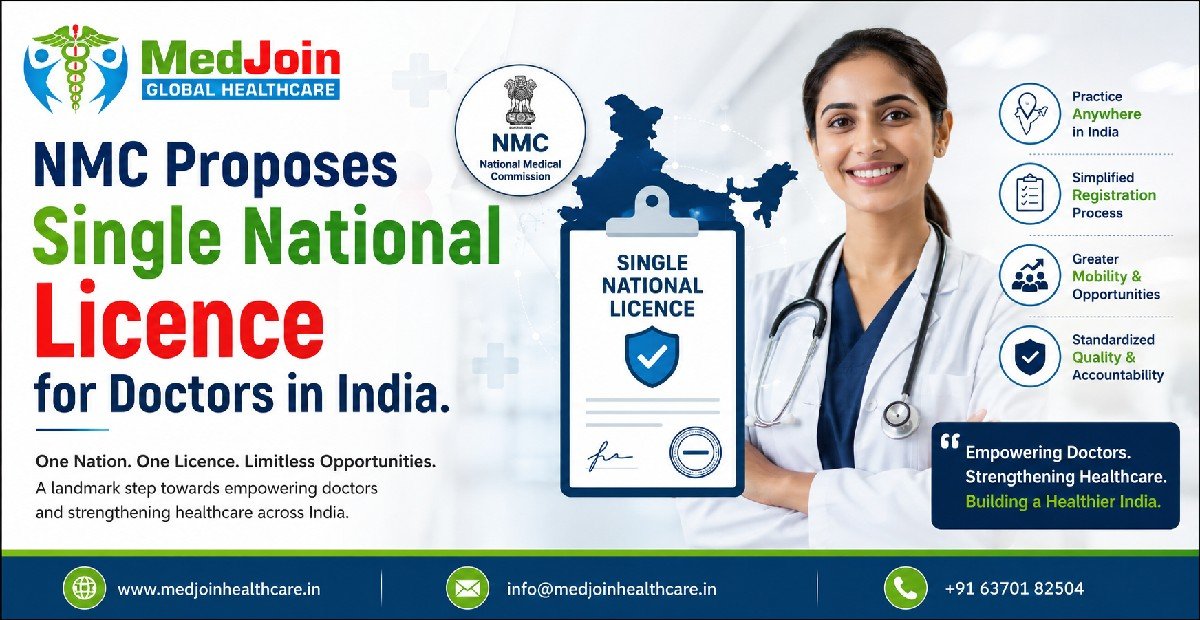
A major change could be on the horizon for medical practitioners in India. The National Medical Commission (NMC) has proposed a system under which doctors could receive a unique identification number linked to the National Medical Register (NMR), giving them eligibility to practise medicine across India.
Under the proposal, registration would continue to originate through a State Medical Register, but the doctor's unique identification number would also provide registration in the National Medical Register and eligibility to practise anywhere in the country.
If implemented, the move could significantly simplify the current registration framework and make it easier for doctors to relocate, work across states, join hospitals in different parts of India and participate in clinical assignments without navigating multiple state-level registration processes.
What Is the NMC?
The National Medical Commission (NMC) is India's statutory medical regulator under the Ministry of Health and Family Welfare. It is responsible for regulating medical education, professional standards and important aspects of registration and medical practice.
The NMC has already established systems for registration of medical practitioners and maintains national-level records of registered doctors. Its website provides facilities related to doctor registration, additional qualifications, certificates and the Indian Medical Register.
The proposed single-licence approach appears to be part of a broader effort to create a more integrated and digitally connected medical registration system.
What Is the Proposed Single Licence System?
The proposal centres on assigning a Unique Identification Number (UID) to registered medical practitioners.
According to the reported draft provisions, the UID would be generated after registration in a State Medical Register. The UID would then provide registration in the National Medical Register and eligibility to practise medicine anywhere in India.
In practical terms, the system could work broadly as follows:
Medical qualification → State registration → Unique Identification Number → National Medical Register → Eligibility to practise across India
This would represent a major shift from a system in which doctors may need to deal with state-specific registration requirements when moving their professional practice.
Why Is a Single National Licence Important?
India has a highly mobile healthcare workforce. Doctors frequently move between states for employment, postgraduate training, fellowships, teaching assignments, hospital appointments, clinical observerships and private practice.
A nationally valid licence could therefore reduce administrative barriers.
1. Easier Inter-State Practice
One of the biggest potential advantages would be the ability of a registered doctor to practise across state boundaries without having to obtain separate registration for every state.
For example, a doctor registered in Uttar Pradesh who accepts a hospital position in Maharashtra, Karnataka, Delhi or Kerala could potentially use the same national registration to establish eligibility to practise.
2. Reduced Administrative Burden
Doctors currently have to navigate registration-related procedures involving medical councils and documentation. A nationally integrated system could reduce duplication and make the process more efficient.
The NMC already provides online services for registration, certificates and related professional documentation, creating an existing digital foundation for such integration.
3. Greater Professional Mobility
A single national licence could make it easier for doctors to:
- Change states for employment
- Work in multiple hospital networks
- Accept short-term clinical assignments
- Participate in medical camps
- Undertake teaching or academic engagements
- Provide services in underserved regions
- Move between metropolitan and rural healthcare facilities
This could be particularly beneficial for specialists and doctors working in hospital chains operating across several states.
4. Better Verification of Doctors
A national identification system could also make verification easier for hospitals, employers, insurers and patients.
The National Medical Register is intended to provide information about registered medical practitioners, while the NMC already maintains systems for registration and professional credentials.
A unified digital identity could potentially allow authorised stakeholders to verify:
- Doctor registration status
- Qualifications
- Additional qualifications
- Licence status
- Disciplinary information
- Registration validity
How Would the UID Work?
According to the reported draft proposal, the UID would incorporate the code of the relevant state or Union Territory along with the registration number assigned by the State Medical Register. The resulting NMR number would be valid for medical practice across India.
Importantly, this does not necessarily mean that State Medical Councils would disappear.
Instead, the proposed model appears to retain state registration while connecting it to a national registration framework.
This distinction is important because the State Medical Councils could continue to play a role in registration, professional conduct and disciplinary processes.
What Happens If a Doctor Faces Disciplinary Action?
A national registration system also needs an effective mechanism for professional accountability.
The reported proposal addresses this by linking disciplinary information between the National Medical Register and State Medical Registers.
If disciplinary action is recommended by a State Medical Council other than the council where the doctor is primarily registered, the action would reportedly be reflected in the National Medical Register and automatically updated in the primary state register.
This could create a more connected regulatory environment and reduce the possibility of disciplinary information remaining isolated within one state.
Will the Licence Be Permanent?
The reported draft proposal provides for a five-year validity period for the licence to practise medicine.
A doctor would need to apply for renewal within the prescribed period. If renewal is not completed within three months after expiry, the doctor's entry in the State Medical Register would become inactive and the doctor would not be entitled to practise. The inactive status would also be reflected in the National Medical Register.
This suggests that the proposed model would not simply provide a one-time lifetime licence. Instead, continued practice would remain linked to active registration and renewal.
What About Medical Ethics and Professional Conduct?
A single national licence would need to operate alongside India's professional conduct framework.
The NMC maintains regulations governing registered medical practitioners and professional conduct. Its rules and regulations section includes the National Medical Commission Registered Medical Practitioner (Professional Conduct) Regulations, 2023.
A national registration system could therefore provide a stronger mechanism for connecting professional conduct records with a doctor's national registration identity.
This could be important in cases involving serious professional misconduct, suspension or other regulatory action.
What Could This Mean for Doctors?
For doctors, the proposed reform could be particularly significant.
Doctors Working in Multiple States
Doctors employed by national hospital chains could potentially find it easier to work across different branches without dealing with repeated state registration procedures.
Specialists and Consultants
Consultants who travel between cities for clinical practice, teaching or specialised procedures could benefit from greater regulatory portability.
Doctors Moving for Employment
Young doctors frequently relocate after postgraduate training. A national licence could simplify the transition from one state to another.
Doctors Working in Rural and Underserved Areas
A nationally portable registration system could potentially facilitate temporary or permanent deployment of doctors to areas experiencing shortages.
Potential Benefits for Patients
The proposal is not only about administrative convenience for doctors. It could also have implications for patients.
A more integrated national register could make it easier for patients and healthcare institutions to verify whether a doctor is actively registered.
It could also support greater transparency around professional credentials and regulatory status.
A unified system may ultimately contribute to greater trust in digital healthcare records and professional verification.
Challenges That Need to Be Addressed
Although a single national licence could offer substantial benefits, implementation would need to address several important issues.
State and National Regulatory Coordination
India's medical regulation involves both national and state-level institutions. Clear responsibilities would be required to prevent confusion regarding registration, disciplinary proceedings and appeals.
Data Accuracy
A national register is only useful when information is accurate and regularly updated.
Changes in registration status, additional qualifications, disciplinary orders and licence renewals would need to be reflected promptly.
Digital Infrastructure
The system would require secure and reliable digital infrastructure capable of handling a very large number of medical professionals.
Data Privacy and Security
Because a national medical register contains professional identity and credential information, strong cybersecurity, authentication and data-protection mechanisms would be essential.
Renewal Compliance
Doctors would need a clear, simple and accessible renewal process to prevent accidental lapse of practice rights.
Is This Already a Final Rule?
This distinction is important.
The proposal should not be interpreted as an already implemented universal single licence unless and until the relevant regulations are finally notified and brought into force.
The NMC's official website lists the Registration of Medical Practitioners and Licence to Practice Medicine (Amendment) Regulations, 2026, and an April 2026 notification concerning proposed amendments.
Therefore, doctors should rely on the final notification and operational instructions issued by the NMC rather than assuming that the proposed system has already replaced existing registration requirements.
Single Licence vs Existing Registration Model
| Aspect | Existing/Current Framework | Proposed National Model |
|---|---|---|
| Registration | State medical registration plays a major role | State registration linked to national registration |
| National identity | National register exists | UID/NMR-linked identification proposed |
| Practice across states | Administrative requirements may arise when moving states | Eligibility to practise anywhere in India proposed |
| Disciplinary information | Can involve state-level mechanisms | Greater national-state information linkage proposed |
| Licence validity | Governed by applicable regulations | Reported proposal: five years |
| Digital verification | Existing NMC registration systems | Potentially more integrated national verification |
A Major Step Toward One National Medical Workforce
India's healthcare system is increasingly interconnected. Hospital groups operate across multiple states, telemedicine is expanding, doctors frequently relocate, and healthcare delivery increasingly depends on digital credentials.
Against this background, a nationally portable medical licence could become an important regulatory reform.
The proposed UID-linked National Medical Register model attempts to combine the strengths of state-level registration with the convenience of national practice eligibility.
If implemented effectively, it could reduce paperwork for doctors while improving transparency, mobility and regulatory coordination.
What Doctors Should Watch For
Doctors should closely monitor official NMC notifications for:
- Final notification of the amended regulations
- Date from which the new system becomes operational
- Process for obtaining the UID
- Integration of existing State Medical Council registrations
- Licence renewal requirements
- Treatment of inactive registrations
- Procedures for disciplinary action
- Requirements for doctors registered with foreign medical qualifications
- Digital verification and National Medical Register updates
The NMC continues to publish registration-related regulations and notices through its official website.
Conclusion
The National Medical Commission's proposed single-licence framework could mark a significant change in how doctors are registered and regulated in India.
The central idea is straightforward: a doctor should have a nationally recognised professional identity that allows eligible practice across India, while maintaining appropriate regulatory oversight.
The proposed UID and National Medical Register could make doctor mobility easier, reduce administrative duplication and strengthen nationwide verification of medical professionals.
However, the success of the system will depend on how smoothly the NMC, State Medical Councils and digital registration platforms are integrated.
For doctors, hospitals and healthcare organisations, this is therefore a development worth following closely as the regulatory framework evolves.
Important: This article discusses the reported proposal and NMC regulatory developments available as of August 2026. Doctors should verify the latest final NMC notification before changing their registration or practice arrangements.