
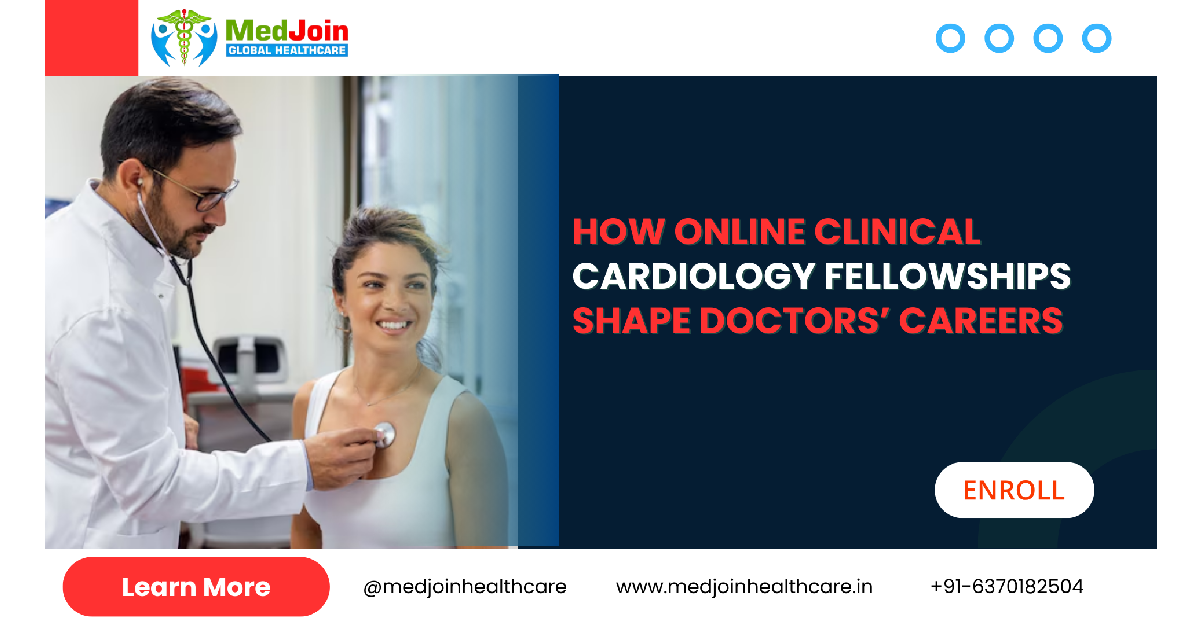
Clinical cardiology is one of the most dynamic and demanding specialties in modern medicine. With cardiovascular diseases remaining a leading cause of mortality worldwide, the need for well-trained cardiologists has never been greater. Traditionally, advanced training in cardiology took place through in-person fellowships anchored to teaching hospitals or medical institutions. However, the rapid evolution of digital technology and the expansion of telemedicine have catalyzed a new paradigm: online fellowships in clinical cardiology.
These online or hybrid (online + hands-on) programs are reshaping how doctors attain specialized knowledge, connect with experts globally, and advance their clinical careers. This article explores how online fellowship programs are redefining cardiology education, enhancing professional growth, and influencing the future of cardiovascular care.
1. The Emergence of Online Fellowships in Clinical Cardiology
1.1 What Is an Online Fellowship?
An online fellowship is a structured advanced educational program designed for postgraduate physicians, delivered primarily through virtual platforms. Unlike traditional fellowships that emphasize physical attendance at a hospital or university, online fellowships leverage:
- Live virtual lectures
- On-demand video modules
- Interactive case discussions
- Digital simulations
- Virtual grand rounds
- Online assessments
- Mentorship via teleconferencing
These programs may also include short on-site clinical rotations, depending on the curriculum.
1.2 Why the Shift to Digital?
Several global trends influenced the rise of online clinical training:
- Technological advances: High-speed internet, teleconferencing tools, mobile learning.
- Globalization of medicine: Need for accessible international training.
- COVID-19 pandemic: Forced rethinking of in-person learning.
- Work-life balance: Doctors balancing practice with advanced training.
As a result, clinical cardiology fellowships are no longer exclusive to those near premier academic centers.
2. The Appeal of Online Cardiology Fellowships
2.1 Accessibility Across Geographies
One major advantage is that physicians from remote or underserved regions can access world-class cardiology education without relocating. This democratization fosters equity in medical training.
2.2 Flexibility for Busy Clinicians
Doctors in clinical practice often struggle to commit to multi-year full-time programs. Online fellowships allow them to learn at their own pace — balancing work, family, and education.
2.3 Cost-Effectiveness
Traditional fellowships involve tuition, relocation, and living expenses. Online programs can significantly reduce these costs, making advanced training affordable for many.
2.4 Exposure to Global Expertise
Online platforms enable interaction with international faculty — experts from premier institutions across continents — expanding knowledge beyond local practices.
2.5 Customizable Learning Pathways
Many online fellowships offer elective modules in sub-specialties like:
- Interventional cardiology
- Heart failure and transplantation
- Electrophysiology
- Preventive cardiology
- Pediatric cardiology
This allows doctors to tailor their training based on interests and career goals.
3. Enhancing Clinical Competence and Skills
3.1 Deepening Theoretical Knowledge
Online fellowships deliver advanced lectures on complex topics, often taught by leading experts. Doctors gain deeper understanding in areas such as:
- Coronary artery disease
- Cardiac imaging
- Arrhythmias
- Congenital heart disease
- Emerging therapies
3.2 Case-Based Learning and Problem Solving
Interactive case discussions and real-life clinical scenarios help doctors refine diagnostic reasoning and management skills. Fellows learn to:
- Analyze ECGs and echocardiograms
- Interpret hemodynamic data
- Customize patient-centric treatment plans
- Integrate evidence-based guidelines
3.3 Simulations and Virtual Labs
Some online fellowships incorporate simulation modules — enabling practice of procedural skills, decision making, and crisis management in virtual settings.
3.4 Feedback and Assessment
Regular quizzes, assignments, and mentor feedback keep learners accountable and provide measurable performance metrics. This reinforces mastery and identifies areas for improvement.
4. Bridging Theory and Practice
4.1 Clinical Observerships and Hybrid Models
Some online programs incorporate short on-site observerships in partner hospitals. This allows doctors to supplement virtual learning with hands-on clinical exposure.
4.2 Telemedicine Integration
Online fellowships often emphasize telecardiology skills — training fellows to use telehealth tools for remote patient evaluation and follow-up, a vital competency in modern practice.
4.3 Application of Guidelines
Fellows learn to apply global cardiovascular guidelines (e.g., ACC/AHA, ESC) in practical care plans, fostering evidence-based care.
5. Professional Growth and Career Advancement
5.1 Enhanced Credibility and Recognition
Completing a reputable online fellowship adds academic weight to a physician’s credentials. It can:
- Enhance CVs for competitive job markets
- Strengthen eligibility for academic positions
- Support promotions and leadership roles
5.2 Transition to Specialized Roles
Doctors can transition from general practice to specialized cardiology roles, including:
- Cardiac imaging specialist
- Interventional cardiologist (after further on-site training)
- Heart failure specialist
- Electrophysiologist (with advanced focus)
5.3 Opening Doors for Fellowships Abroad
Completion of a structured online program can strengthen applications for in-person fellowships — especially in competitive institutions.
5.4 Academic Opportunities
Online fellows often receive invitations to:
- Present at conferences
- Publish case reports or reviews
- Participate in journal clubs
This supports academic development.
6. Research Skills and Scholarly Output
6.1 Research Methodology Training
Many online fellowships include modules on:
- Clinical research design
- Biostatistics
- Literature review
- Scientific writing
This equips doctors to conduct meaningful research.
6.2 Mentored Research Projects
Fellows may engage in guided research projects, often resulting in:
- Manuscripts for publication
- Conference presentations
- Institutional quality improvements
6.3 Access to Global Research Networks
Online platforms connect doctors with research mentors and collaborators worldwide — increasing the likelihood of multi-center studies.
7. Networking and Community Building
7.1 Learning With a Global Cohort
Online fellowships bring together doctors from different countries. This diversity enriches learning by exposing participants to varied healthcare systems, case profiles, and clinical perspectives.
7.2 Mentorship and Professional Relationships
Digital mentorship fosters long-term professional relationships. Fellows often continue to collaborate with mentors and peers after program completion.
7.3 Alumni Networks
Many online fellowship programs maintain active alumni communities, providing:
- Job leads
- Research collaboration opportunities
- Continuing education resources
These networks augment career mobility.
8. Technological Innovation in Curriculum Delivery
8.1 Learning Platforms and Interactive Tools
Online fellowships use state-of-the-art platforms featuring:
- Live broadcasting
- Digital whiteboards
- Break-out rooms
- Polling and quizzes
- Discussion boards
8.2 Artificial Intelligence and Adaptive Learning
Some programs introduce AI mechanisms that:
- Track progress
- Recommend personalized content
- Provide adaptive assessments
These tools tailor the educational journey for optimal retention.
8.3 Virtual Reality (VR) and Augmented Reality (AR)
Innovative programs may use VR/AR to simulate:
- Cardiac procedures
- Anatomy exploration
- Emergency scenarios
This enhances experiential learning without patient risk.
9. Challenges and Limitations
9.1 Hands-On Clinical Training
The greatest challenge is replicating hands-on patient care. Certain procedural competencies (e.g., catheterization) still require in-person training.
9.2 Infrastructure Constraints
In some regions, limited internet bandwidth or lack of digital devices can hinder participation.
9.3 Recognition and Accreditation
Not all online fellowships are equally recognized. Physicians must choose programs with credible accreditation and faculty.
9.4 Motivation and Self-Discipline
Online learning requires self-directed study habits. Without structured schedules, some participants may struggle to stay on track.
9.5 Time Zone Differences
International cohorts may face scheduling conflicts due to time zone variations for live sessions.
10. Choosing the Right Online Fellowship in Clinical Cardiology
10.1 Accreditation and Certification
Look for programs endorsed by recognized cardiology societies or academic institutions.
10.2 Curriculum and Scope
Assess whether the syllabus aligns with your career focus — general cardiology vs sub-specialization.
10.3 Faculty Expertise
Investigate faculty credentials, clinical achievements, and teaching reputation.
10.4 Practical Components
Prefer programs with hybrid components, simulations, and opportunities for clinical observerships.
10.5 Peer and Alumni Feedback
Research reviews from previous participants to gauge experience and outcomes.
10.6 Cost and Time Commitment
Evaluate affordability, payment plans, scholarship options, and flexibility in deadlines.
11. Impact on Patient Care and Healthcare Systems
11.1 Quality of Clinical Decisions
Physicians with higher training make more informed decisions — reducing diagnostic errors and improving outcomes.
11.2 Adoption of Evidence-Based Practices
Online fellowships emphasize guideline-driven care — standardizing management of complex cardiac conditions.
11.3 Enhanced Preventive Cardiology
Doctors trained in modern risk stratification and preventive strategies can better counsel patients on lifestyle and risk reduction.
11.4 Telecardiology and Remote Care
Training in telehealth tools improves access to cardiology consultation, especially in rural or underserved areas.
12. Case Vignettes: Real-World Impact on Careers
Case 1: Rural Doctor to Cardiovascular Specialist
A physician in a small town completed an online cardiology fellowship, enabling:
- Enhanced ECG interpretation
- Initiation of heart failure protocols
- Referral optimization to tertiary centers
This uplifted local care quality.
Case 2: Research Breakthrough
An online fellow developed a multi-center registry project under mentorship, leading to publications in an indexed cardiology journal.
Case 3: Career Transition
A physician switched from general internal medicine to a dedicated cardiology practice, supported by fellowship credentials.
13. The Future of Online Cardiology Fellowships
13.1 Expansion of Hybrid Models
Future programs will likely blend virtual learning with structured hands-on clinical rotations in partner hospitals.
13.2 Credentialing and Global Standards
International cardiology societies may develop standardized online fellowship frameworks, improving recognition and mobility.
13.3 Personalized AI-Driven Learning
AI will play a larger role in customizing education pathways and performance analytics.
13.4 Integration With Health Systems
Online fellows may participate in digital referrals, telemedicine programs, and multinational quality improvement initiatives.
13.5 Lifelong Learning Models
Continuing professional development (CPD) will increasingly be delivered through modular online platforms with micro-credentials.
14. Reflections for Aspiring Cardiologists
Online fellowships are not merely temporary alternatives — they represent a shift in how specialized medical education is delivered and consumed. For doctors seeking:
- Flexibility
- Global exposure
- Advanced clinical insights
- Research engagement
- Career mobility
online fellowships in clinical cardiology offer a compelling pathway.
However, success in these programs requires:
- Discipline
- Commitment
- Selection of credible programs
- Active engagement in virtual communities
When leveraged strategically, online fellowships can accelerate careers, enhance patient care, and build leaders in cardiovascular medicine.
The landscape of cardiology education is evolving. Online fellowships are not only expanding access to advanced cardiovascular training but also shaping the careers of doctors in profound ways — transforming clinical competence, research acumen, professional networks, and patient outcomes.
As digital learning continues to mature, physicians who embrace the opportunities offered by online fellowship in clinical cardiology position themselves on the cutting edge of medical knowledge, equipped to lead in a globalized, technology-driven healthcare environment.