
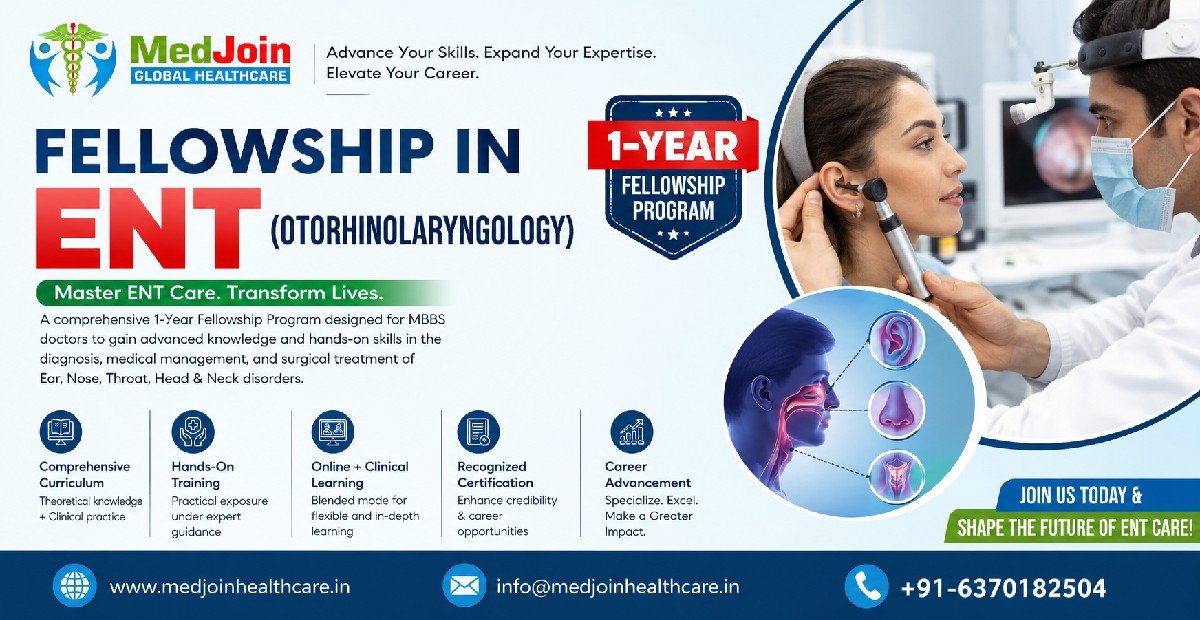
Otorhinolaryngology—commonly known as ENT—is one of the most dynamic and clinically diverse branches of medicine. It covers the diagnosis, treatment, and management of conditions affecting the ear, nose, throat, head, neck, upper airway, voice, hearing, balance, and related structures. For doctors who want to strengthen their clinical expertise, develop greater confidence in ENT practice, and expand their professional opportunities, structured postgraduate clinical training can provide valuable additional exposure.
A 1-Year Fellowship in ENT (Otorhinolaryngology) can be an important career-development pathway for eligible medical professionals who want focused learning beyond their basic medical qualification. By combining structured academic learning with practical clinical exposure, a fellowship can help doctors understand ENT presentations, diagnostic approaches, treatment planning, procedural principles, and patient management in a more systematic way.
Modern ENT practice has evolved significantly. Advances in endoscopy, audiology, vestibular assessment, imaging, microsurgery, airway management, sleep medicine, voice care, and minimally invasive procedures have created new opportunities for clinicians who develop focused skills in the specialty.
For an MBBS doctor, general physician, medical officer, or other eligible healthcare professional considering specialization or focused clinical training, an ENT fellowship can offer exposure to an extensive range of common and complex conditions.
The goal is not simply to add another certificate to a professional profile. A meaningful fellowship should help participants develop clinical reasoning, examination skills, diagnostic thinking, procedural awareness, communication skills, and confidence in appropriate patient referral and management.
This comprehensive guide explores what a 1-Year Fellowship in ENT involves, who may consider it, what participants can learn, the importance of hands-on clinical exposure, career opportunities, curriculum areas, learning methodology, potential professional benefits, and how to select an appropriate fellowship program.
Why Consider a 1-Year Fellowship in ENT?
Medical education does not end with obtaining a degree. Healthcare continues to evolve, and doctors increasingly need opportunities to update their clinical knowledge and develop focused competencies.
A structured ENT fellowship can provide an organized learning pathway for doctors who want to understand the specialty in greater depth.
Key reasons to consider an ENT fellowship include:
1. Focused specialty exposure
Instead of encountering ENT conditions occasionally in general practice, a fellowship provides structured exposure to the specialty.
2. Strengthening clinical examination skills
ENT diagnosis depends heavily on systematic examination. Learning how to assess the ear, nose, throat, neck, cranial nerves, airway, voice, and related structures is fundamental.
3. Understanding modern diagnostic techniques
ENT increasingly uses:
- Nasal endoscopy
- Otoscopy
- Microscopy
- Audiometry
- Tympanometry
- Imaging
- Laryngoscopic assessment
- Vestibular testing
- Sleep-related evaluation
Understanding the indications and interpretation of these investigations can improve clinical decision-making.
4. Practical clinical exposure
Where a program includes supervised clinical training, participants may observe and assist with appropriate procedures and patient management under qualified specialists.
5. Improved referral decisions
General physicians frequently encounter ENT complaints. Focused training can help clinicians recognize when a condition can be managed appropriately and when specialist referral is necessary.
6. Professional development
A structured fellowship may strengthen a doctor's professional portfolio and demonstrate commitment to continuing medical education and specialty-focused learning.
7. Exposure to advanced ENT practice
Participants can learn about emerging approaches in:
- Endoscopic sinus surgery
- Otology
- Rhinology
- Laryngology
- Sleep medicine
- Pediatric ENT
- Head and neck practice
- Airway management
- Audiology
- Vestibular medicine
Fellowship vs. Formal Postgraduate ENT Degree
One of the most important distinctions for prospective candidates is the difference between a fellowship and a formal postgraduate specialty qualification.
A formal postgraduate ENT degree or diploma is generally a regulated qualification governed by the applicable medical education and professional regulatory framework.
A fellowship is typically a focused additional training program designed to enhance knowledge and clinical exposure in a specific field.
Therefore, prospective candidates should understand exactly what a fellowship provides.
A fellowship may be useful for:
- Focused specialty learning
- Continuing professional development
- Clinical exposure
- Skill enhancement
- Career development
- Building familiarity with ENT practice
However, candidates should not assume that completing a fellowship automatically confers the same professional rights, specialist registration, or independent specialist status as a recognized postgraduate medical degree.
This distinction should be clearly communicated by every responsible training provider.
What Does a 1-Year ENT Fellowship Typically Cover?
A comprehensive ENT fellowship can be structured around the major domains of Otorhinolaryngology.
A typical curriculum may include:
- ENT anatomy
- Physiology of hearing, balance, smell, taste, and voice
- ENT history taking
- ENT clinical examination
- Otology
- Rhinology
- Laryngology
- Pediatric ENT
- Head and neck conditions
- Audiology
- Vestibular disorders
- Sleep medicine
- Airway emergencies
- ENT infections
- Allergic disorders
- Trauma
- Endoscopy
- ENT imaging
- Common ENT procedures
- Surgical principles
- Postoperative care
- Emergency management
- Patient counseling
- Referral protocols
- Evidence-based clinical practice
The exact curriculum varies between institutions.
What Can You Learn During a 12-Month ENT Fellowship?
A year-long fellowship allows the curriculum to be divided into progressive learning stages.
Months 1–3: Foundation
Focus areas may include:
- ENT anatomy
- Clinical history
- ENT examination
- Otoscopy
- Basic audiology
- Common ear disorders
- Common nasal disorders
- Common throat disorders
Months 4–6: Intermediate ENT
Possible areas:
- Chronic ear disease
- Hearing loss
- Vertigo
- Chronic rhinosinusitis
- Nasal endoscopy
- Pediatric ENT
- Laryngeal disorders
- Voice problems
Months 7–9: Advanced Clinical Exposure
Potential areas:
- Endoscopic procedures
- Complex sinus disease
- Airway disorders
- Sleep medicine
- Head and neck disorders
- ENT emergencies
- Imaging interpretation
Months 10–12: Consolidation
Possible activities:
- Case presentations
- Clinical discussions
- Procedure observation
- Advanced case management
- Research/project work
- Final assessment
- Professional development
The exact structure varies between institutions.
Case-Based Learning in ENT
Case-based learning can help doctors convert theoretical knowledge into clinical reasoning.
Example cases may include:
Case 1: Hearing loss
A patient presents with progressive hearing impairment.
The doctor needs to determine:
- Conductive or sensorineural?
- Unilateral or bilateral?
- Acute or chronic?
- Associated tinnitus?
- Associated vertigo?
- Need for audiometry?
- Need for imaging?
- Need for urgent referral?
Case 2: Nasal obstruction
Potential causes include:
- Deviated septum
- Allergic rhinitis
- Nasal polyps
- Chronic sinusitis
- Mass lesion
Clinical examination and appropriate investigations help establish the diagnosis.
Case 3: Hoarseness
Persistent hoarseness may have multiple causes.
The clinician should assess:
- Duration
- Voice use
- Smoking history
- Reflux symptoms
- Associated swallowing problems
- Neck symptoms
- Airway symptoms
Red flags require appropriate ENT evaluation.
Clinical Documentation Skills
Good clinical documentation is an essential professional skill.
ENT documentation may include:
- Chief complaint
- History
- Examination findings
- Audiology findings
- Endoscopic findings
- Imaging
- Diagnosis
- Differential diagnosis
- Treatment plan
- Follow-up
- Referral
Accurate records improve communication, continuity of care, patient safety, and medico-legal protection.
Patient Counseling in ENT
Many ENT conditions require patient education.
Doctors may need to explain:
- Diagnosis
- Treatment options
- Expected recovery
- Medication use
- Lifestyle measures
- Warning signs
- Follow-up requirements
- Surgical options
- Potential complications
Communication should be clear, evidence-based, and appropriate to the patient's understanding.
Infection Control in ENT
ENT procedures can involve exposure to secretions and respiratory droplets.
Training should emphasize:
- Hand hygiene
- Personal protective equipment
- Instrument sterilization
- Disinfection
- Safe endoscopy practices
- Sharps safety
- Biomedical waste management
Infection prevention is a core part of safe clinical practice.
ENT in Primary Care
ENT complaints are common in general practice.
A primary-care physician may encounter:
- Earache
- Earwax
- Hearing loss
- Sinus symptoms
- Allergic rhinitis
- Sore throat
- Tonsillitis
- Dizziness
- Tinnitus
- Hoarseness
- Epistaxis
Focused ENT training can help doctors recognize common conditions and identify red flags requiring specialist assessment.
Recognizing ENT Red Flags
One of the most valuable skills is recognizing symptoms that require urgent evaluation.
Potential red flags include:
- Sudden hearing loss
- Severe airway difficulty
- Persistent unexplained hoarseness
- Neck mass
- Recurrent unexplained epistaxis
- Significant swallowing difficulty
- Unexplained weight loss with ENT symptoms
- Neurological symptoms associated with vertigo
- Severe facial swelling
- Deep neck infection symptoms
The exact urgency depends on the clinical context.
Career Benefits of an ENT Fellowship
A fellowship can contribute to professional development in several ways.
Clinical confidence
Structured exposure may increase familiarity with ENT presentations and examination.
Broader clinical knowledge
Participants gain focused knowledge in a specialty that intersects with general medicine.
Better referral decisions
Doctors may become more confident identifying patients requiring specialist care.
Professional differentiation
Focused additional training can strengthen a professional portfolio.
Exposure to specialists
Working with experienced ENT clinicians may provide valuable professional learning opportunities.
Continuing education
A fellowship can support lifelong learning and professional development.
Career Opportunities After ENT-Focused Training
Career opportunities depend on the participant's primary qualification, local regulations, clinical competence, and employer requirements.
Potential pathways may include:
- General medical practice with enhanced ENT knowledge
- Hospital medical officer roles
- Primary-care practice
- ENT-focused clinical support roles
- Clinical education
- Healthcare administration
- Research
- Further postgraduate specialty training
- Fellowship-level clinical roles where legally appropriate
A fellowship should not be presented as a substitute for a formal specialist qualification where specialist registration is legally required.
ENT Fellowship and Medical Career Growth
Doctors today increasingly seek focused clinical education.
A broad MBBS foundation provides exposure to many specialties. A fellowship allows participants to explore a specific area in greater depth.
For a doctor interested in ENT, this may become the first step toward:
- Deeper specialty learning
- Formal postgraduate education
- Research
- Clinical practice development
- Academic opportunities
The fellowship can therefore be viewed as part of a longer professional-development journey.
Why Choose a 1-Year Program Instead of a Short Course?
A short certificate may introduce a topic, but a year-long program can provide more time for progressive learning.
A longer fellowship can potentially provide:
- Structured curriculum
- Repeated exposure
- Longitudinal patient observation
- Case discussions
- Progressive learning
- Clinical integration
- Assessment
- Research exposure
- Greater opportunity for supervised practice
The quality of the program matters more than duration alone.
A 12-month program should have clearly defined learning outcomes and meaningful academic and clinical components.
ENT Fellowship for Working Doctors
Working doctors may find it difficult to leave their current jobs for full-time education.
A structured hybrid fellowship may offer greater flexibility through:
- Recorded academic sessions
- Scheduled live classes
- Digital learning materials
- Case discussions
- Periodic clinical training
However, candidates should verify whether clinical attendance requirements are compatible with their schedule.
ENT Fellowship and Long-Term Career Planning
Before enrolling, candidates should identify their long-term goal.
Goal 1: Enhance general practice
An ENT fellowship may help strengthen the management of common ENT presentations.
Goal 2: Prepare for further specialization
The fellowship can provide exposure to the specialty before pursuing a formal postgraduate pathway.
Goal 3: Develop hospital-based skills
Focused training can complement a medical officer role.
Goal 4: Enter academic or research work
ENT offers numerous research opportunities.
Goal 5: Build a focused clinical portfolio
The fellowship can demonstrate additional specialty-oriented education.
Why ENT Is a Promising Clinical Field
ENT combines:
- Medicine
- Surgery
- Technology
- Diagnostics
- Emergency care
- Pediatrics
- Rehabilitation
- Preventive medicine
- Quality-of-life improvement
Few specialties provide such a diverse combination.
From hearing and balance to airway and voice, ENT offers a wide clinical spectrum.
Skills You Can Aim to Develop
By the end of a structured fellowship, participants may aim to improve:
Knowledge
- ENT anatomy
- Disease mechanisms
- Clinical presentations
- Investigations
- Treatment principles
Clinical skills
- History taking
- ENT examination
- Otoscopy
- Basic interpretation of audiology
- Nasal examination
- Clinical assessment of throat and neck
Diagnostic reasoning
- Differential diagnosis
- Red-flag identification
- Appropriate investigation selection
- Referral decisions
Professional skills
- Communication
- Documentation
- Case presentation
- Teamwork
- Patient counseling
Academic skills
- Literature review
- Research
- Presentation
- Evidence-based medicine
Frequently Asked Questions
What is a 1-Year Fellowship in ENT?
It is a structured educational and clinical training program focused on Otorhinolaryngology, covering areas such as ear, nose, throat, airway, hearing, balance, voice, and related head-and-neck conditions.
Is an ENT fellowship equivalent to an MD/MS/recognized postgraduate ENT qualification?
No. A fellowship and a regulated postgraduate specialist qualification are different. Candidates should verify the recognition and scope of the specific program.
Who can enroll?
Eligibility varies by program. Many programs are designed for qualified doctors, including MBBS graduates, subject to institutional requirements.
Does the fellowship include hands-on training?
Some programs include supervised clinical exposure or hands-on components. Candidates should confirm the exact clinical structure before enrollment.
Can an MBBS doctor benefit from an ENT fellowship?
Yes, focused ENT education may help an eligible MBBS doctor improve knowledge of common ENT presentations, examination, diagnostic reasoning, and referral.
Does the fellowship make me an ENT specialist?
A fellowship should not automatically be interpreted as conferring specialist registration or the same status as a recognized postgraduate ENT qualification.
What topics are covered?
Typical areas include otology, rhinology, laryngology, pediatric ENT, audiology, vestibular disorders, sleep medicine, airway management, head and neck disorders, endoscopy, imaging, and ENT emergencies.
Is online learning available?
Some fellowships use hybrid or online academic learning. The exact format varies.
Is clinical training important?
Yes. Clinical exposure is particularly valuable for developing examination, patient communication, procedural awareness, and real-world clinical reasoning.
What career opportunities are available?
Career possibilities depend on the participant's underlying qualification and local regulations. Potential benefits include enhanced clinical knowledge, hospital roles, primary-care development, research, further education, and focused professional development.
How a Fellowship Can Upgrade Your Medical Career
The phrase "upgrade your career" should mean more than earning another certificate.
Career growth comes from developing meaningful competencies.
An ENT fellowship can potentially help you:
Learn → Observe → Practice under supervision → Receive feedback → Apply knowledge → Build confidence → Continue learning.
This progression can help transform theoretical knowledge into practical understanding.
Why Clinical Exposure Matters
Consider two doctors.
Doctor A studies ENT conditions through books and online lectures.
Doctor B studies the same material and also observes ENT clinics, interacts with patients under supervision, reviews audiograms, watches endoscopy, discusses cases with specialists, and observes procedures.
Both can develop theoretical knowledge.
However, clinical exposure gives Doctor B opportunities to understand how knowledge is applied in real patient situations.
That is the value of structured clinical training.
The Future of ENT
The future of ENT is likely to be influenced by:
- Advanced endoscopy
- Minimally invasive procedures
- Precision medicine
- Digital healthcare
- Artificial intelligence
- Advanced imaging
- Hearing technology
- Robotic surgery
- Sleep medicine
- Regenerative medicine
- Improved rehabilitation
- Personalized treatment
Doctors who continue updating their skills will be better positioned to adapt to these changes.
Upgrade Your ENT Knowledge. Strengthen Your Clinical Future.
The healthcare environment is becoming increasingly competitive.
Doctors are expected to maintain clinical competence, stay updated with medical advances, communicate effectively with patients, and understand modern diagnostic technologies.
A 1-Year Fellowship in ENT (Otorhinolaryngology) can be considered by doctors who want to build focused knowledge and clinical exposure in one of medicine's most diverse specialties.
From ear disease and hearing loss to sinus disorders, vertigo, voice problems, airway emergencies, pediatric ENT, sleep medicine, and head-and-neck conditions, the specialty offers a broad and rewarding learning journey.
The most valuable outcome of a fellowship is not merely the certificate.
It is the knowledge you acquire, the cases you understand, the clinical skills you develop, the professional relationships you build, and the confidence you gain to continue learning.
A career in medicine is a continuous journey of learning.
As healthcare advances, doctors need opportunities to update their knowledge and develop focused competencies. ENT is a particularly diverse specialty that combines clinical medicine, diagnostics, procedures, surgery, emergency care, technology, rehabilitation, and patient-centered care.
A 1-Year Fellowship in ENT (Otorhinolaryngology) can provide a structured pathway for eligible doctors who want to explore the specialty in greater depth.
Through academic learning, case discussions, clinical observation, supervised exposure, assessments, and continuous professional development, participants can work toward stronger understanding of ENT conditions and modern clinical practice.
From otology and audiology to rhinology, endoscopy, laryngology, pediatric ENT, vestibular medicine, sleep disorders, airway management, and head-and-neck conditions, the fellowship can provide exposure to a wide spectrum of clinical problems.
However, choosing the right program is essential. Candidates should evaluate the curriculum, faculty, clinical training, supervision, certification, recognition, assessment, and professional scope before enrolling.
Most importantly, doctors should remember that a fellowship complements their existing medical qualification. It should be viewed as a pathway for focused education and professional development, not automatically as a replacement for a regulated postgraduate specialist qualification.
If your goal is to strengthen your ENT knowledge, gain structured clinical exposure, understand modern diagnostic approaches, and take the next step in your professional development, a well-designed one-year ENT fellowship may be a valuable addition to your medical career journey.
Upgrade Your Career with Focused ENT Education
1-Year Fellowship in ENT (Otorhinolaryngology)
Learn. Observe. Develop. Advance.
Build focused knowledge in:
- Otology
- Rhinology
- Laryngology
- Audiology
- Vertigo and vestibular disorders
- Pediatric ENT
- Sleep medicine
- ENT emergencies
- Head and neck disorders
- Endoscopy
- ENT imaging
- Clinical case management
Take the next step toward focused clinical learning and professional growth in Otorhinolaryngology.