
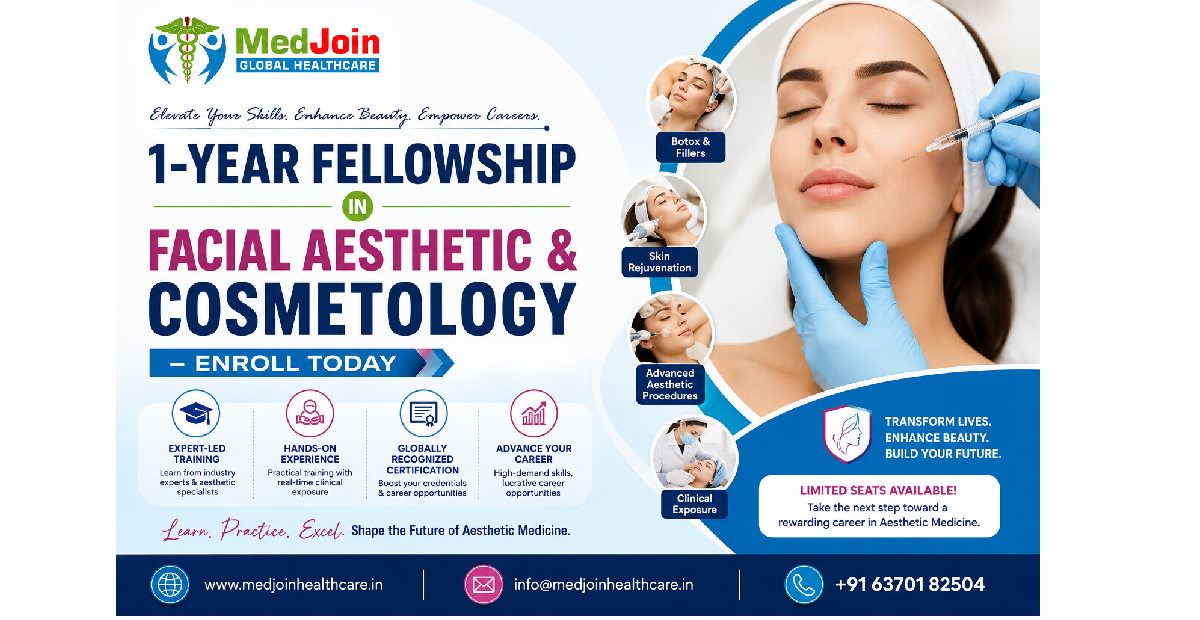
The field of Facial Aesthetic and Cosmetology has experienced remarkable growth over the past decade. With increasing awareness about skin health, anti-aging treatments, minimally invasive cosmetic procedures, and facial rejuvenation, patients are actively seeking qualified medical professionals who can deliver safe, evidence-based aesthetic treatments.
For doctors looking to diversify their clinical expertise, enhance patient satisfaction, and build a rewarding career, enrolling in a 1-Year Fellowship in Facial Aesthetic and Cosmetology is one of the smartest professional investments.
Unlike short-term workshops that focus on a few cosmetic procedures, a structured fellowship provides comprehensive knowledge of facial anatomy, aesthetic assessment, dermatological principles, injectable treatments, laser technologies, chemical peels, skin rejuvenation, patient consultation, complication management, and ethical practice.
Whether you are an MBBS doctor, BDS practitioner, MD, MS, BHMS, BAMS, or another licensed healthcare professional, this fellowship equips you with advanced knowledge and practical skills to confidently deliver modern aesthetic treatments while maintaining patient safety and clinical excellence.
If your goal is to expand your practice, increase professional credibility, and enter one of healthcare's fastest-growing specialties, a 1-Year Fellowship in Facial Aesthetic and Cosmetology can help you achieve that vision.
Why Facial Aesthetic Medicine Is Growing Rapidly
The global aesthetic medicine industry has transformed dramatically over the past several years. Patients are increasingly choosing minimally invasive procedures over traditional cosmetic surgeries due to shorter recovery times, lower risks, reduced costs, and natural-looking outcomes.
Today's patients seek treatments for:
- Facial rejuvenation
- Wrinkle reduction
- Acne scar management
- Pigmentation correction
- Hair restoration
- Skin tightening
- Lip enhancement
- Jawline contouring
- Double chin reduction
- Anti-aging therapies
- Non-surgical facelift procedures
- Skin brightening
- Hydration therapies
As awareness continues to grow, so does the demand for trained medical professionals who understand facial anatomy, evidence-based treatment planning, and complication prevention.
This has created exceptional career opportunities for doctors with specialized training in facial aesthetics.
Why Every Doctor Should Consider Aesthetic Medicine
Modern healthcare is evolving rapidly. Patients are no longer visiting clinics only when they become ill. Preventive healthcare, wellness, anti-aging medicine, and aesthetic enhancement have become important aspects of comprehensive patient care.
Doctors who add aesthetic procedures to their practice often experience several professional benefits.
Diversified Clinical Practice
Aesthetic medicine allows physicians to expand beyond traditional consultation services by offering high-demand cosmetic procedures.
Enhanced Patient Satisfaction
Patients appreciate treatments that improve confidence, appearance, and overall quality of life. Successful aesthetic outcomes often result in high patient satisfaction and long-term relationships.
Continuous Learning
Facial aesthetics is a dynamic specialty with constant advancements in injectables, energy-based devices, regenerative medicine, and skincare technologies.
A structured fellowship helps doctors remain updated with current clinical practices.
Professional Recognition
Doctors with formal fellowship training are often viewed as more credible and knowledgeable than practitioners relying solely on short workshops.
What Is a 1-Year Fellowship in Facial Aesthetic and Cosmetology?
A 1-Year Fellowship in Facial Aesthetic and Cosmetology is an advanced academic and clinical training program designed to help healthcare professionals develop specialized expertise in aesthetic medicine.
The fellowship combines theoretical learning with practical exposure, enabling participants to understand:
- Facial anatomy
- Aging mechanisms
- Cosmetic dermatology
- Injectable treatments
- Laser principles
- Chemical peels
- Skin rejuvenation
- Hair restoration
- Patient assessment
- Clinical photography
- Treatment planning
- Management of complications
- Ethical and legal considerations
Instead of focusing on isolated procedures, the fellowship develops comprehensive clinical decision-making skills that improve treatment outcomes and patient safety.
Why Choose a 1-Year Fellowship Instead of Short Workshops?
Many doctors initially attend one-day or weekend aesthetic workshops. While these programs introduce basic concepts, they rarely provide the depth required for independent clinical practice.
A one-year fellowship offers several advantages.
Comprehensive Curriculum
Participants learn the scientific foundation behind every procedure rather than simply memorizing techniques.
Better Clinical Confidence
Repeated learning, case discussions, and mentor interactions improve confidence in patient management.
Evidence-Based Practice
Doctors understand current research, treatment protocols, safety guidelines, and international best practices.
Long-Term Mentorship
Unlike workshops that end after one or two days, fellowship programs provide continuous academic support throughout the learning journey.
Structured Skill Development
Learning progresses from basic concepts to advanced procedures in a logical sequence.
What You Will Learn During the Fellowship
An advanced fellowship covers every important aspect of aesthetic medicine.
Facial Anatomy
Understanding facial muscles, nerves, vascular structures, fat compartments, retaining ligaments, and aging changes forms the foundation of safe aesthetic practice.
Without proper anatomical knowledge, cosmetic procedures carry unnecessary risks.
Skin Science
Participants develop a detailed understanding of:
- Skin physiology
- Skin barrier function
- Pigmentation biology
- Collagen remodeling
- Photoaging
- Intrinsic aging
- Extrinsic aging
These concepts help doctors personalize treatments according to individual patient needs.
Patient Assessment
Every successful aesthetic procedure begins with comprehensive consultation.
Doctors learn how to:
- Evaluate facial symmetry
- Assess skin quality
- Understand patient expectations
- Identify contraindications
- Discuss realistic outcomes
- Obtain informed consent
Injectable Procedures
Injectables remain one of the most popular segments of aesthetic medicine.
The fellowship introduces scientific principles behind various injectable therapies while emphasizing patient selection, anatomical safety, and complication prevention.
Chemical Peels
Participants learn:
- Types of peeling agents
- Indications
- Contraindications
- Patient preparation
- Post-procedure care
- Management of adverse effects
Laser Technologies
Modern aesthetic practice increasingly incorporates laser-based treatments.
Doctors gain knowledge regarding:
- Laser physics
- Tissue interactions
- Patient selection
- Safety precautions
- Clinical indications
Acne Scar Management
Acne scars remain one of the most common cosmetic concerns.
Participants understand different scar classifications and multimodal treatment strategies.
Anti-Aging Medicine
Modern anti-aging treatments involve a combination of lifestyle modification, skincare, injectables, regenerative therapies, and device-based procedures.
The fellowship explores holistic approaches to facial rejuvenation.
Importance of Facial Anatomy in Aesthetic Practice
One of the biggest differences between experienced aesthetic physicians and beginners lies in their understanding of anatomy.
Facial anatomy influences:
- Injection safety
- Product placement
- Natural results
- Risk reduction
- Patient satisfaction
A structured fellowship emphasizes anatomy repeatedly throughout the curriculum, helping doctors develop procedural confidence.
Patient Safety Comes First
One of the primary goals of any quality fellowship is patient safety.
Doctors learn:
- Sterile techniques
- Infection prevention
- Emergency preparedness
- Recognition of complications
- Management protocols
- Documentation standards
- Ethical practice
Safety should always remain the cornerstone of aesthetic medicine.
Benefits of Structured Online Learning
Many doctors hesitate to pursue higher education because of demanding clinical schedules.
Modern fellowship programs address this challenge through flexible online learning platforms.
Participants can:
- Learn at their own pace
- Watch recorded lectures anytime
- Revisit complex topics
- Access updated study materials
- Attend live webinars
- Participate in case discussions
- Balance education with clinical practice
This flexibility enables working professionals to continue upgrading their skills without interrupting their careers.
Expert Mentorship Makes the Difference
Learning directly from experienced faculty provides invaluable clinical insights.
Mentors help participants understand:
- Clinical decision-making
- Procedure selection
- Patient communication
- Treatment customization
- Practical challenges
- Ethical dilemmas
- Complication management
This guidance bridges the gap between theoretical learning and real-world practice.
Building a Future-Ready Medical Career
Healthcare is becoming increasingly competitive. Patients are looking for qualified professionals who can provide comprehensive solutions under one roof.
Doctors who acquire advanced aesthetic skills are better positioned to:
- Expand their services
- Increase patient retention
- Build professional credibility
- Diversify their income streams
- Stay ahead of emerging trends
- Develop specialized expertise
A structured fellowship supports long-term career growth while promoting safe and ethical clinical practice.
Why the Demand for Facial Aesthetic Specialists Is Increasing Worldwide
The practice of aesthetic medicine has evolved from being a niche specialty into one of the fastest-growing segments of healthcare. People today are more conscious of their appearance than ever before, driven by social media, professional expectations, increased awareness of skincare, and advancements in minimally invasive cosmetic treatments.
Unlike the past, when cosmetic procedures were largely associated with celebrities, today's patients come from all walks of life. Young professionals seek preventive anti-aging treatments, middle-aged individuals look for facial rejuvenation, and older patients aim to maintain a youthful appearance without undergoing surgery.
This growing demand has created an excellent opportunity for doctors who possess formal training in Facial Aesthetic and Cosmetology.
Healthcare professionals with specialized fellowship training are increasingly being preferred by patients because they understand facial anatomy, patient safety, evidence-based treatment planning, and complication management.
The Shift Toward Non-Surgical Aesthetic Procedures
Modern patients increasingly prefer procedures that offer visible results with minimal downtime. This shift has significantly expanded the scope of aesthetic medicine.
Popular non-surgical treatments include:
- Facial rejuvenation
- Anti-aging therapies
- Wrinkle reduction
- Volume restoration
- Skin tightening
- Acne scar treatment
- Pigmentation management
- Hair restoration
- Facial contouring
- Skin resurfacing
- Chemical peels
- Medical-grade skincare
- Laser treatments
- Regenerative therapies
These procedures allow patients to return to their daily routine quickly while achieving natural-looking outcomes.
For doctors, mastering these techniques opens doors to a rapidly expanding field with long-term growth potential.
Why Formal Fellowship Training Matters
Many healthcare professionals attend weekend workshops or short certification courses to learn aesthetic procedures. While these programs introduce basic concepts, they often lack comprehensive education in anatomy, patient assessment, safety protocols, and complication management.
A structured one-year fellowship provides a much stronger educational foundation.
Participants develop expertise in:
- Scientific principles behind each treatment
- Facial anatomy and vascular structures
- Comprehensive patient evaluation
- Individualized treatment planning
- Ethical clinical practice
- Managing adverse events
- Long-term patient follow-up
This structured approach helps build confidence and promotes safer clinical practice.
Career Opportunities After Completing a 1-Year Fellowship in Facial Aesthetic and Cosmetology
One of the biggest advantages of pursuing a 1-Year Fellowship in Facial Aesthetic and Cosmetology is the wide range of career opportunities it opens for healthcare professionals. As patient demand for minimally invasive aesthetic procedures continues to rise, qualified doctors with specialized training are increasingly sought after across hospitals, dermatology centers, cosmetic clinics, wellness chains, and private practices.
Unlike many traditional specialties that rely heavily on hospital infrastructure, facial aesthetic medicine offers flexibility. Doctors can integrate aesthetic procedures into their existing practice, join established cosmetic clinics, collaborate with dermatologists and plastic surgeons, or eventually establish their own aesthetic center.
A structured fellowship prepares doctors with the knowledge, confidence, and clinical understanding required to pursue these diverse career paths.
Career Path 1: Enhance Your Existing Medical Practice
Many doctors begin their careers in general practice, family medicine, internal medicine, dentistry, or other specialties. Adding facial aesthetic services can significantly broaden the scope of care they offer.
Instead of referring patients elsewhere for cosmetic concerns, doctors can provide comprehensive solutions under one roof.
Examples include:
- Facial rejuvenation consultations
- Skin health assessments
- Anti-aging treatment plans
- Acne and acne scar management
- Hair restoration consultations
- Pigmentation treatment
- Preventive skincare programs
By integrating aesthetic medicine into an existing clinic, doctors can improve patient retention while expanding their professional expertise.
Career Path 2: Join an Established Aesthetic Clinic
The demand for trained aesthetic physicians has increased substantially over the last decade.
Many organizations actively recruit doctors with formal fellowship training because these professionals possess structured knowledge in:
- Facial anatomy
- Patient consultation
- Evidence-based treatment planning
- Ethical practice
- Clinical documentation
- Complication management
Working in an established clinic also provides valuable exposure to experienced mentors, advanced technologies, and diverse patient cases.
Career Path 3: Work with Multispecialty Hospitals
Many multispecialty hospitals now include cosmetic dermatology and aesthetic medicine departments.
Doctors with fellowship training may contribute to services such as:
- Medical cosmetology
- Anti-aging clinics
- Skin rejuvenation programs
- Hair restoration clinics
- Laser treatment centers
- Wellness and preventive healthcare departments
This allows healthcare professionals to practice aesthetic medicine while remaining connected to multidisciplinary patient care.
Career Path 4: Start Your Own Aesthetic Clinic
One of the most rewarding long-term goals for many doctors is establishing an independent aesthetic practice.
A fellowship provides the academic foundation necessary for:
- Patient evaluation
- Treatment planning
- Clinical documentation
- Ethical practice
- Risk management
- Practice development
Although building a successful clinic requires business planning, marketing, infrastructure, and regulatory compliance, specialized training significantly improves professional confidence.
Career Path 5: Academic and Clinical Training
Experienced practitioners often contribute to education by:
- Conducting workshops
- Participating in conferences
- Mentoring junior doctors
- Delivering lectures
- Publishing clinical research
- Supporting evidence-based practice
A strong educational background creates opportunities beyond routine clinical work.
The Rising Demand for Aesthetic Medicine in India
India has emerged as one of the fastest-growing markets for aesthetic medicine.
Several factors contribute to this growth:
Increased Awareness
Patients today are more informed about available treatment options than ever before.
Higher Disposable Income
More individuals are investing in skincare, preventive anti-aging treatments, and cosmetic procedures.
Social Media Influence
Professional appearance and digital visibility have increased interest in facial aesthetics among younger populations.
Preference for Non-Surgical Procedures
Patients increasingly prefer minimally invasive treatments that involve less downtime than traditional surgery.
These trends indicate sustained long-term demand for qualified aesthetic practitioners.
Why Patients Prefer Fellowship-Trained Doctors
Patients are becoming increasingly selective when choosing healthcare providers for cosmetic procedures.
Formal fellowship training inspires confidence because it reflects structured education rather than isolated procedural workshops.
Patients often value doctors who demonstrate:
- Strong anatomical knowledge
- Comprehensive consultation skills
- Ethical decision-making
- Scientific understanding
- Personalized treatment planning
- Commitment to patient safety
Trust remains one of the strongest factors influencing patient loyalty.
Why Invest in Your Professional Development?
Medicine is constantly evolving. Doctors who continue learning remain better prepared to meet changing patient expectations and emerging healthcare trends.
Investing in advanced education helps:
- Expand clinical knowledge
- Improve patient confidence
- Enhance professional credibility
- Diversify clinical services
- Build long-term career resilience
Education remains one of the most valuable investments a healthcare professional can make.
Success Begins with Continuous Learning
Every experienced aesthetic physician started with a decision to learn.
Whether your goal is to enhance your existing practice, pursue a new career direction, or develop specialized expertise, structured fellowship training provides a strong foundation for future growth.
The journey requires dedication, curiosity, ethical practice, and a commitment to lifelong learning.
Those qualities ultimately define successful healthcare professionals.