
Introduction: A New Era in Medicine
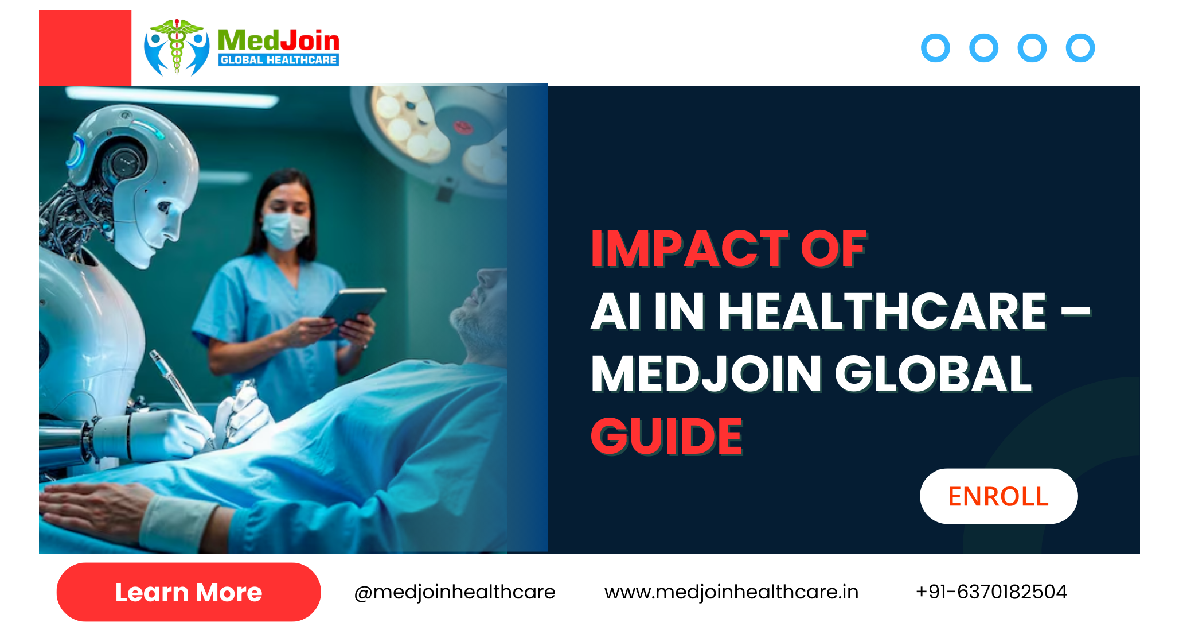
Healthcare is undergoing one of the most profound transformations in its history. From the stethoscope to robotic surgery, innovation has always shaped medicine. Today, however, the change is more intelligent, data-driven, and predictive than ever before. Artificial Intelligence (AI) is redefining how diseases are diagnosed, how treatments are delivered, how hospitals operate, and how patients experience care.
According to MedJoin Global, Artificial Intelligence is not merely a technological trend—it is a strategic shift that is reshaping global healthcare systems. For physicians, specialists, healthcare administrators, and medical students, understanding AI is no longer optional; it is essential.
This comprehensive article explores the transformative role of AI in modern healthcare, as described by MedJoin Global, highlighting its applications, benefits, ethical considerations, and future impact.
1. Understanding Artificial Intelligence in Healthcare
Artificial Intelligence refers to computer systems capable of performing tasks that typically require human intelligence. These tasks include pattern recognition, decision-making, language understanding, and predictive analysis.
In healthcare, AI systems are designed to:
- Analyze medical images
- Predict disease risk
- Assist in clinical decision-making
- Automate documentation
- Optimize hospital workflows
- Enhance patient monitoring
- Personalize treatment plans
AI integrates technologies such as:
- Machine Learning (ML)
- Deep Learning
- Natural Language Processing (NLP)
- Computer Vision
- Predictive Analytics
- Robotics
According to MedJoin Global, the true power of AI lies in its ability to process vast volumes of medical data faster and more accurately than traditional methods.
2. AI in Disease Diagnosis
One of the most revolutionary impacts of AI is in diagnostics.
2.1 Medical Imaging
AI-powered imaging systems assist radiologists in detecting:
- Tumors
- Fractures
- Hemorrhages
- Lung nodules
- Stroke patterns
- Cardiac abnormalities
Deep learning algorithms can analyze CT scans, MRIs, and X-rays with remarkable precision. These systems serve as decision-support tools, improving diagnostic accuracy and reducing human error.
MedJoin Global emphasizes that AI does not replace radiologists—it enhances their efficiency and confidence.
2.2 Pathology and Laboratory Medicine
AI assists in:
- Analyzing histopathology slides
- Identifying cancer markers
- Predicting tumor aggressiveness
- Screening blood samples
- Detecting infectious organisms
Automated systems reduce turnaround time and increase standardization in lab reporting.
2.3 Early Disease Detection
Predictive algorithms analyze patient data such as:
- Genetic information
- Lifestyle data
- Electronic medical records
- Lab values
- Vital signs
AI can identify early warning signs of:
- Sepsis
- Cardiac arrest
- Diabetes progression
- Kidney failure
- Cancer recurrence
Early detection saves lives and reduces treatment costs.
3. AI in Personalized Medicine
Personalized medicine aims to tailor treatments to individual patients based on genetic, environmental, and lifestyle factors.
3.1 Genomic Analysis
AI processes genomic sequencing data to:
- Identify disease-causing mutations
- Predict drug responses
- Design targeted therapies
Precision oncology, for example, uses AI to match cancer patients with the most effective therapies.
3.2 Treatment Optimization
AI can recommend:
- Drug dosages
- Therapy adjustments
- Risk-benefit analysis
- Personalized rehabilitation plans
MedJoin Global highlights that AI-driven personalization enhances patient outcomes while minimizing adverse effects.
4. AI in Clinical Decision Support Systems (CDSS)
Clinical Decision Support Systems provide physicians with:
- Real-time alerts
- Drug interaction warnings
- Evidence-based treatment recommendations
- Diagnostic suggestions
AI-enhanced CDSS reduces medical errors and supports evidence-based practice.
For example:
- Alerts for abnormal lab results
- Sepsis prediction tools
- Antibiotic stewardship guidance
These systems act as intelligent assistants, not replacements.
5. AI in Surgery and Robotics
Surgical innovation has reached unprecedented levels.
5.1 Robotic-Assisted Surgery
AI-enhanced robotic systems improve:
- Precision
- Minimally invasive procedures
- Reduced complications
- Faster recovery times
Robotic assistance supports surgeons in delicate operations such as cardiac, urological, and neurosurgical procedures.
5.2 Predictive Surgical Planning
AI analyzes patient anatomy and predicts:
- Surgical risks
- Blood loss probability
- Complication likelihood
This improves preoperative planning and patient safety.
6. AI in Telemedicine and Remote Care
Telemedicine has expanded rapidly in recent years. AI enhances virtual healthcare by:
- Automating triage
- Analyzing patient symptoms
- Providing chatbot consultations
- Monitoring chronic conditions remotely
Remote patient monitoring devices collect data on:
- Blood pressure
- Blood glucose
- Heart rhythm
- Oxygen saturation
AI analyzes this data in real-time, alerting physicians to potential complications.
MedJoin Global views AI-enabled telemedicine as a solution for rural and underserved populations.
7. AI in Healthcare Administration
Healthcare efficiency depends on operational excellence.
7.1 Workflow Optimization
AI improves:
- Patient scheduling
- Resource allocation
- Staff management
- Bed utilization
- Operating room efficiency
Hospitals benefit from reduced waiting times and improved productivity.
7.2 Medical Documentation Automation
Natural Language Processing enables:
- Automated transcription
- Smart documentation
- Clinical note generation
- Coding assistance
This reduces physician burnout caused by excessive paperwork.
7.3 Revenue Cycle Management
AI assists in:
- Insurance claim processing
- Fraud detection
- Billing accuracy
- Financial forecasting
Administrative efficiency translates into better patient care.
8. AI in Drug Discovery and Research
Traditional drug development takes years and billions of dollars.
AI accelerates:
- Molecule identification
- Clinical trial design
- Patient recruitment
- Adverse event monitoring
- Data analysis
Machine learning models simulate how compounds interact with biological systems, shortening research timelines.
MedJoin Global recognizes AI-driven drug discovery as one of the most transformative advancements in modern medicine.
9. AI in Chronic Disease Management
Chronic diseases require continuous monitoring.
AI assists in managing:
- Diabetes
- Hypertension
- Chronic kidney disease
- Heart failure
- COPD
Smart systems predict exacerbations and recommend preventive measures.
For example:
- Insulin dose adjustment algorithms
- Cardiac risk monitoring
- Dialysis adequacy tracking systems
Chronic disease management becomes proactive rather than reactive.
10. AI in Emergency and Critical Care
In emergency medicine, time is critical.
AI systems:
- Predict cardiac arrest
- Detect sepsis early
- Analyze ECG abnormalities
- Prioritize triage cases
Critical care units benefit from predictive monitoring that identifies deterioration before it becomes irreversible.
MedJoin Global emphasizes that AI supports life-saving decision-making in high-risk settings.
11. AI in Mental Health
Mental health applications of AI include:
- Chat-based therapy support
- Mood tracking apps
- Suicide risk prediction
- Behavioral pattern analysis
AI assists psychologists and psychiatrists in early detection and intervention strategies.
12. AI and Medical Education
Artificial Intelligence is also reshaping medical training.
12.1 Adaptive Learning
AI-driven platforms personalize:
- Study plans
- Clinical case simulations
- Performance assessments
- Skill tracking
12.2 Simulation Training
Virtual reality combined with AI allows:
- Surgical simulations
- Emergency scenario training
- Diagnostic practice modules
MedJoin Global integrates AI awareness into fellowship and specialization programs, preparing doctors for the future of healthcare.
13. Ethical Considerations in AI Healthcare
While AI offers immense benefits, ethical challenges exist.
13.1 Data Privacy
Patient data must be:
- Secure
- Encrypted
- Compliant with regulations
13.2 Algorithm Bias
AI systems trained on limited datasets may produce biased outcomes. Diversity in training data is critical.
13.3 Accountability
Who is responsible when AI makes an error?
AI must function as decision-support—not decision-maker.
MedJoin Global emphasizes ethical AI education for healthcare professionals.
14. Challenges in AI Implementation
Despite its promise, AI adoption faces barriers:
- High infrastructure costs
- Integration with existing systems
- Regulatory complexities
- Resistance to change
- Training gaps
Healthcare institutions must invest in education and structured implementation strategies.
15. The Future of AI in Healthcare
The future may include:
- Fully integrated smart hospitals
- Predictive population health management
- AI-powered robotic nursing assistants
- Genomic-driven personalized treatment
- Real-time disease outbreak prediction
- Fully automated diagnostics
AI will continue to evolve—but human expertise will remain central.
16. MedJoin Global’s Perspective on AI in Healthcare
According to MedJoin Global, the future of medicine belongs to clinicians who:
- Understand AI tools
- Interpret AI recommendations
- Maintain ethical standards
- Combine technology with compassion
- Lead digital transformation initiatives
MedJoin Global encourages physicians to embrace AI as an ally, not a competitor.
The organization promotes awareness of:
- AI-driven diagnostics
- Data literacy
- Digital health integration
- Research innovation
- Ethical governance
By integrating AI knowledge into specialization programs and fellowships, MedJoin Global prepares healthcare professionals for next-generation practice.
17. AI as an Enabler, Not a Replacement
One of the most important messages emphasized by MedJoin Global is that AI does not replace doctors. It enhances:
- Clinical precision
- Diagnostic speed
- Data analysis
- Operational efficiency
Empathy, ethical judgment, and human connection remain irreplaceable.
- AI handles complexity.
- Doctors provide care.
Together, they redefine healthcare excellence.
Embracing Intelligent Healthcare
Artificial Intelligence is revolutionizing every aspect of modern healthcare—from diagnostics and surgery to administration and education. Its potential to improve patient outcomes, reduce costs, and enhance efficiency is immense.
However, successful integration requires:
- Education
- Ethical awareness
- Clinical oversight
- Continuous adaptation
As described by MedJoin Global, healthcare professionals who embrace AI will lead the next era of medicine. Those who understand its capabilities and limitations will deliver safer, smarter, and more personalized care.
The future of healthcare is not just digital—it is intelligent.
And the time to understand it is now.