
Nephrology has evolved far beyond the diagnosis and medical management of kidney disease. Modern kidney care increasingly depends on timely procedures, vascular access expertise, image-guided interventions, dialysis access preservation, kidney biopsy, and multidisciplinary management of critically ill patients with acute and chronic kidney disorders.
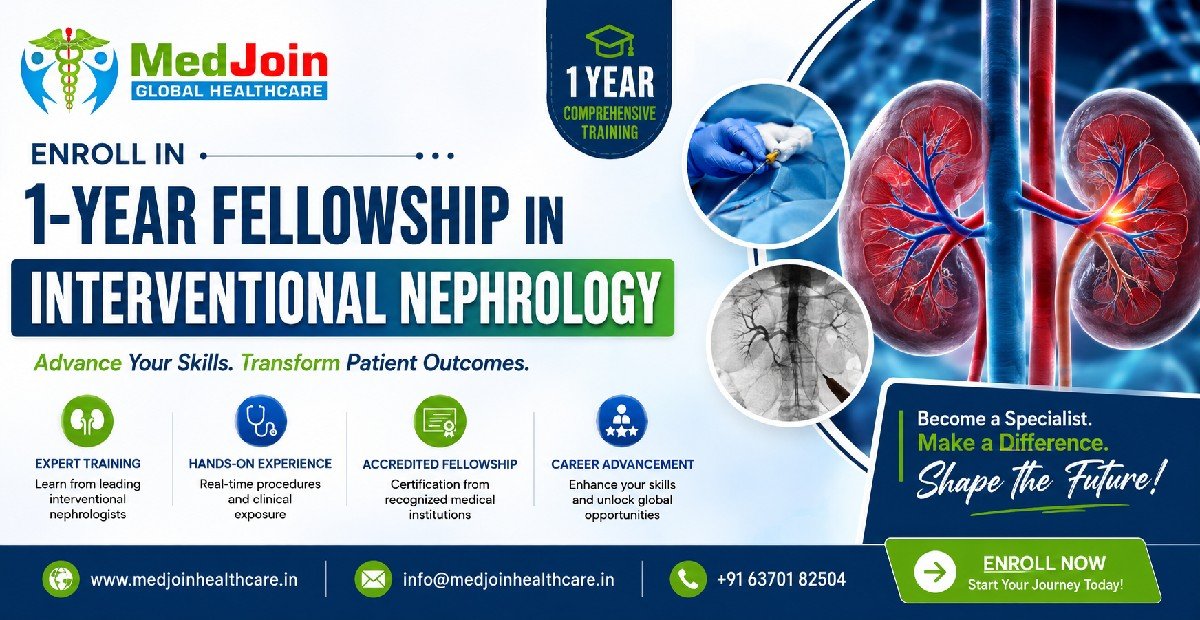
For doctors who want to develop advanced clinical capabilities in this rapidly developing area, a 1-Year Fellowship in Interventional Nephrology can provide a structured pathway to deepen their knowledge and understand the practical aspects of procedures performed in nephrology practice.
Interventional nephrology sits at the intersection of nephrology, vascular medicine, critical care, radiology, and procedural medicine. The field focuses on procedures that support diagnosis and treatment of kidney disease and, importantly, maintain reliable vascular access for patients receiving hemodialysis.
The modern nephrologist may encounter patients requiring temporary or tunneled dialysis catheter placement, arteriovenous fistula assessment, vascular access surveillance, kidney biopsy, peritoneal dialysis catheter-related procedures, ultrasound-guided vascular procedures, and management of access-related complications. Developing competence in these areas can improve clinical decision-making and strengthen collaboration with vascular surgeons, interventional radiologists, intensivists, anesthesiologists, and other specialists.
A fellowship should not be viewed simply as another certificate. The real value of advanced clinical training lies in structured learning, supervised exposure, case-based education, procedural understanding, complication recognition, patient safety, and the ability to integrate procedural knowledge with overall patient care.
A carefully designed 1-Year Fellowship in Interventional Nephrology can help doctors build these competencies progressively. It can combine theoretical education with clinical case discussions, procedural demonstrations, simulation or supervised clinical exposure where available, imaging interpretation, dialysis access management, and evidence-based decision-making.
This comprehensive guide explains the field of interventional nephrology, the importance of specialized training, the major clinical areas covered by a fellowship, expected learning outcomes, potential career applications, eligibility considerations, and how doctors can evaluate a fellowship before enrollment.
What Is Interventional Nephrology?
Interventional nephrology is a subspecialty-oriented area of nephrology that emphasizes minimally invasive diagnostic and therapeutic procedures relevant to kidney disease, dialysis, vascular access, and renal replacement therapy.
Traditional nephrology focuses heavily on diagnosis and medical management of conditions such as:
- Acute kidney injury
- Chronic kidney disease
- Glomerular diseases
- Electrolyte disorders
- Acid-base disorders
- Hypertension
- Kidney failure
- Dialysis
- Transplant-related kidney disease
Interventional nephrology adds an important procedural dimension to this clinical framework.
Depending on institutional practice and local credentialing, interventional nephrology may involve exposure to:
- Ultrasound-guided vascular access
- Temporary dialysis catheter placement
- Tunneled dialysis catheter procedures
- Hemodialysis vascular access evaluation
- Arteriovenous fistula and graft assessment
- Kidney biopsy
- Peritoneal dialysis catheter-related procedures
- Vascular access surveillance
- Recognition and management of dialysis access complications
- Imaging interpretation related to vascular access
- Procedural preparation and post-procedure monitoring
- Selected endovascular interventions in collaboration with appropriate specialists
The exact scope varies considerably between institutions and training programs.
A key principle is that procedural training must always correspond to the learner's qualifications, institutional privileges, supervision, local regulations, and documented competency.
A fellowship therefore should not merely teach how a procedure is performed. It should teach when a procedure is indicated, when it should be avoided, how the patient should be assessed, how risks should be minimized, how complications should be recognized, and when another specialist should be involved.
Why Is Interventional Nephrology Becoming Increasingly Important?
The global burden of kidney disease continues to create a substantial need for nephrology services. As more patients progress to advanced kidney disease and require renal replacement therapy, maintaining dependable dialysis access becomes increasingly important.
Hemodialysis depends on vascular access. A functioning access pathway is essential for effective treatment, but vascular access can fail because of:
- Stenosis
- Thrombosis
- Infection
- Poor maturation
- Aneurysmal changes
- Hemorrhage
- Catheter dysfunction
- Malposition
- Central venous disease
- Repeated cannulation injury
These problems can interrupt dialysis and increase hospitalization, morbidity, and healthcare costs.
The nephrologist is often in a unique position to identify access problems because the patient may be seen repeatedly in the dialysis unit. Understanding access examination, ultrasound findings, catheter-related complications, and referral pathways can therefore be highly valuable.
Similarly, kidney biopsy remains an important diagnostic procedure for selected patients with unexplained kidney dysfunction, proteinuria, hematuria, or suspected glomerular and systemic diseases.
Interventional nephrology education can help clinicians understand the complete procedural pathway:
Patient selection → pre-procedure assessment → informed consent → imaging and laboratory evaluation → procedural planning → sterile technique → procedure → monitoring → complication recognition → documentation → follow-up.
This broader approach is much more valuable than learning procedural steps in isolation.
Why Choose a 1-Year Fellowship in Interventional Nephrology?
A one-year program can provide sufficient time for progressive learning rather than attempting to compress complex clinical concepts into a short certificate course.
A structured 12-month fellowship may allow the learner to move through multiple stages:
Stage 1: Foundation
The doctor revises essential nephrology, dialysis, vascular anatomy, imaging, patient assessment, and procedural safety.
Stage 2: Intermediate Learning
The learner develops deeper understanding of vascular access, biopsy principles, ultrasound, dialysis catheter management, and procedural complications.
Stage 3: Advanced Clinical Exposure
The learner participates in case discussions, observes procedures, practices appropriate skills under supervision where available, and learns to integrate imaging with clinical decision-making.
Stage 4: Consolidation
The learner reviews complex cases, complications, clinical decision pathways, and evidence-based approaches.
Stage 5: Professional Application
The learner develops a clearer understanding of how interventional nephrology can be incorporated into clinical practice within the limits of professional credentials and institutional authorization.
This longitudinal structure can be especially useful for doctors who want more than theoretical knowledge.
Month-Wise Structure of a 1-Year Fellowship
A structured program can be organized over 12 months.
Month 1: Foundations
Topics:
- Introduction to interventional nephrology
- Renal anatomy
- Vascular anatomy
- Patient selection
- Procedural safety
- Infection prevention
- Consent
- Ultrasound basics
Month 2: Ultrasound and Vascular Access
Topics:
- Ultrasound principles
- Vessel identification
- Doppler
- Ultrasound-guided vascular access
- Access assessment
- Complications
Month 3: Dialysis Catheters
Topics:
- Temporary dialysis access
- Tunneled catheter concepts
- Catheter care
- Dysfunction
- Infection
- Malposition
- Removal principles
Month 4: AV Fistula
Topics:
- AV fistula anatomy
- Maturation
- Physical examination
- Ultrasound
- Stenosis
- Thrombosis
- Cannulation principles
Month 5: AV Grafts
Topics:
- Graft anatomy
- Graft dysfunction
- Infection
- Thrombosis
- Stenosis
- Pseudoaneurysm
- Referral pathways
Month 6: Kidney Biopsy
Topics:
- Indications
- Contraindications
- Pre-procedure assessment
- Ultrasound guidance
- Specimen handling
- Post-biopsy monitoring
- Complications
Month 7: Advanced Vascular Access
Topics:
- Central venous disease
- Access failure
- Complex cases
- Imaging interpretation
- Access preservation
Month 8: Peritoneal Dialysis Procedures
Topics:
- Catheter concepts
- Catheter dysfunction
- Infection
- Troubleshooting
- Patient selection
Month 9: Critical Care Nephrology
Topics:
- AKI
- CRRT
- Dialysis access
- Hemodynamic instability
- Fluid management
- Electrolyte emergencies
Month 10: Complications and Troubleshooting
Topics:
- Bleeding
- Infection
- Thrombosis
- Catheter complications
- Access failure
- Emergency response
Month 11: Case-Based Advanced Learning
Topics:
- Complex vascular access cases
- Difficult biopsy cases
- Multidisciplinary cases
- Imaging interpretation
- Procedural decision-making
Month 12: Consolidation and Assessment
Topics:
- Revision
- Case presentations
- Clinical assignments
- Procedure logs
- Assessment
- Final project
- Career planning
Hands-On Clinical Training: Why It Matters
One of the most important considerations when evaluating a fellowship is the difference between theoretical exposure and supervised clinical experience.
Reading about a procedure is fundamentally different from seeing how the patient is assessed, observing the workflow, understanding equipment selection, and participating under appropriate supervision.
Hands-on clinical training may provide exposure to:
- Patient preparation
- Consent
- Ultrasound assessment
- Sterile preparation
- Procedural workflow
- Post-procedure care
- Complication recognition
- Clinical documentation
However, the phrase "hands-on" should never be interpreted as permission to independently perform procedures without appropriate supervision, credentialing, and institutional authorization.
A responsible fellowship should clearly explain:
- Where clinical training occurs
- Who supervises trainees
- Which procedures are available
- Whether participation is observational or practical
- How competency is assessed
- What documentation is maintained
- What professional privileges apply
Online Learning and Clinical Exposure
A modern fellowship can combine different educational methods.
Online Learning
Online education can provide:
- Recorded lectures
- Reading materials
- Clinical presentations
- Case discussions
- MCQs
- Assignments
- Assessments
- Live academic sessions
This format provides flexibility for working doctors.
Clinical Training
Clinical exposure can provide:
- Patient interaction
- Procedure observation
- Imaging review
- Dialysis unit exposure
- Case discussions
- Supervised procedural learning where applicable
A hybrid model can therefore combine flexibility with clinical exposure.
Career Opportunities After Interventional Nephrology Training
Interventional nephrology training can complement existing medical qualifications.
Potential professional applications include:
- Nephrology practice
- Dialysis centers
- Hospitals
- Critical care settings
- Renal care units
- Academic institutions
- Clinical education
- Dialysis access programs
- Multidisciplinary kidney care services
Career opportunities depend on the physician's primary qualification, experience, registration, institutional privileges, and local regulations.
A fellowship is best viewed as additional specialized training, not a substitute for a recognized postgraduate specialty qualification where such qualification is required.
How Interventional Nephrology Can Strengthen a Doctor's Clinical Profile
A physician with knowledge of procedural nephrology can better understand the complete patient pathway.
Consider a patient with advanced kidney disease who requires hemodialysis.
The care pathway may involve:
Diagnosis → CKD management → dialysis planning → vascular access planning → access creation → maturation → dialysis initiation → access surveillance → complication management → long-term preservation.
Interventional nephrology knowledge can contribute to several stages of this pathway.
This integrated understanding may make clinical discussions with vascular surgeons, radiologists, intensivists, and dialysis teams more effective.
Fellowship Versus Short-Term Certificate Course
A short certificate course may introduce a specific subject quickly.
A one-year fellowship can provide a broader and longitudinal learning experience.
| Feature | Short Course | 1-Year Fellowship |
|---|---|---|
| Duration | Short | 12 months |
| Curriculum | Usually focused | Broader |
| Case exposure | Limited/variable | Potentially longitudinal |
| Procedural learning | Limited/variable | Structured where available |
| Assessments | Variable | More comprehensive |
| Clinical integration | Limited | Greater potential |
| Academic depth | Moderate | Higher |
| Portfolio development | Limited | Potentially stronger |
The best choice depends on the doctor's goals, existing qualification, available time, and desired level of specialization.
Technology and the Future of Interventional Nephrology
Technology is rapidly changing healthcare.
Future developments may include:
- Improved ultrasound systems
- Portable ultrasound
- Artificial intelligence-assisted imaging
- Advanced vascular access monitoring
- Digital dialysis monitoring
- Improved catheter technology
- Better access surveillance
- Remote education
- Simulation-based procedural training
Doctors who understand both clinical medicine and technology may be better prepared for these changes.
Artificial Intelligence in Nephrology
Artificial intelligence can potentially assist with:
- Risk prediction
- Imaging interpretation
- Clinical decision support
- Dialysis monitoring
- Patient stratification
- Data analysis
- Research
However, AI should support rather than replace qualified clinical judgment.
Doctors must understand:
- Data quality
- Bias
- Validation
- Clinical limitations
- Patient privacy
- Appropriate use
Why Interventional Nephrology Is an Emerging Area of Opportunity
Kidney care is becoming increasingly technology-driven.
The combination of:
- Point-of-care ultrasound
- Advanced dialysis
- Vascular access technology
- Image-guided procedures
- CRRT
- Digital monitoring
- Multidisciplinary care
creates opportunities for doctors with specialized procedural knowledge.
Interventional nephrology can therefore become a valuable component of modern renal medicine.
Why MedJoin's 1-Year Fellowship Can Be Considered by Doctors
A well-structured fellowship should focus on the practical needs of working doctors.
A program such as the 1-Year Fellowship in Interventional Nephrology can be designed around:
- Structured academic learning
- Clinical case discussions
- Procedural education
- Dialysis access concepts
- Ultrasound-based learning
- Kidney biopsy principles
- Catheter management
- Complication recognition
- Critical care nephrology
- Assessments
- Professional development
The objective is to help doctors build a stronger conceptual and clinical foundation in procedural kidney care.
For prospective learners, the most important consideration should be whether the program's curriculum, faculty, clinical exposure, assessment, and credentialing arrangements match their professional goals.
A Stronger Medical Career Begins With Continuous Learning
Healthcare is changing rapidly.
Doctors who remain committed to lifelong learning can adapt more effectively to new technology, procedures, clinical evidence, and patient-care models.
A focused fellowship provides a structured environment in which physicians can explore a specialized clinical area while continuing to build their broader professional capabilities.
Interventional nephrology is particularly relevant because it combines:
Nephrology + Imaging + Procedures + Dialysis + Vascular Medicine + Critical Care + Patient Safety
This multidisciplinary nature makes it an intellectually and clinically engaging area of medicine.
A 1-Year Fellowship in Interventional Nephrology can provide doctors with a structured opportunity to expand their knowledge of procedural kidney care, dialysis access, ultrasound, vascular access management, kidney biopsy principles, dialysis catheter care, critical care nephrology, and complication recognition.
The field is increasingly important because patients with advanced kidney disease often require complex renal replacement therapy and durable vascular access. Understanding how these systems are assessed, maintained, and managed can strengthen the clinical capabilities of doctors working in renal and dialysis settings.
A one-year structured fellowship can help bridge the gap between theoretical medical education and advanced clinical learning. Through academic modules, case discussions, ultrasound education, vascular access training, procedural observation or appropriately supervised clinical exposure, assessments, and continuous professional development, doctors can build a stronger foundation in this specialized field.
However, a fellowship should always be understood as additional professional education rather than a replacement for recognized postgraduate qualifications or independent procedural credentialing.
For doctors seeking to advance their medical career, expand their clinical knowledge, understand modern dialysis access management, and develop specialized expertise in procedural nephrology, a carefully selected one-year fellowship can be an important step in their professional development.
Advance your medical career. Strengthen your clinical knowledge. Explore the evolving field of Interventional Nephrology.
Enroll in a 1-Year Fellowship in Interventional Nephrology
Learn. Practice under appropriate supervision. Build clinical confidence. Advance your professional journey.
Ready to advance your medical career with specialized training in Interventional Nephrology?
Explore the 1-Year Fellowship in Interventional Nephrology and develop advanced knowledge in dialysis access, vascular procedures, ultrasound, kidney biopsy principles, critical care nephrology, and procedural patient safety.
Start your professional learning journey with MedJoin Global Healthcare.